
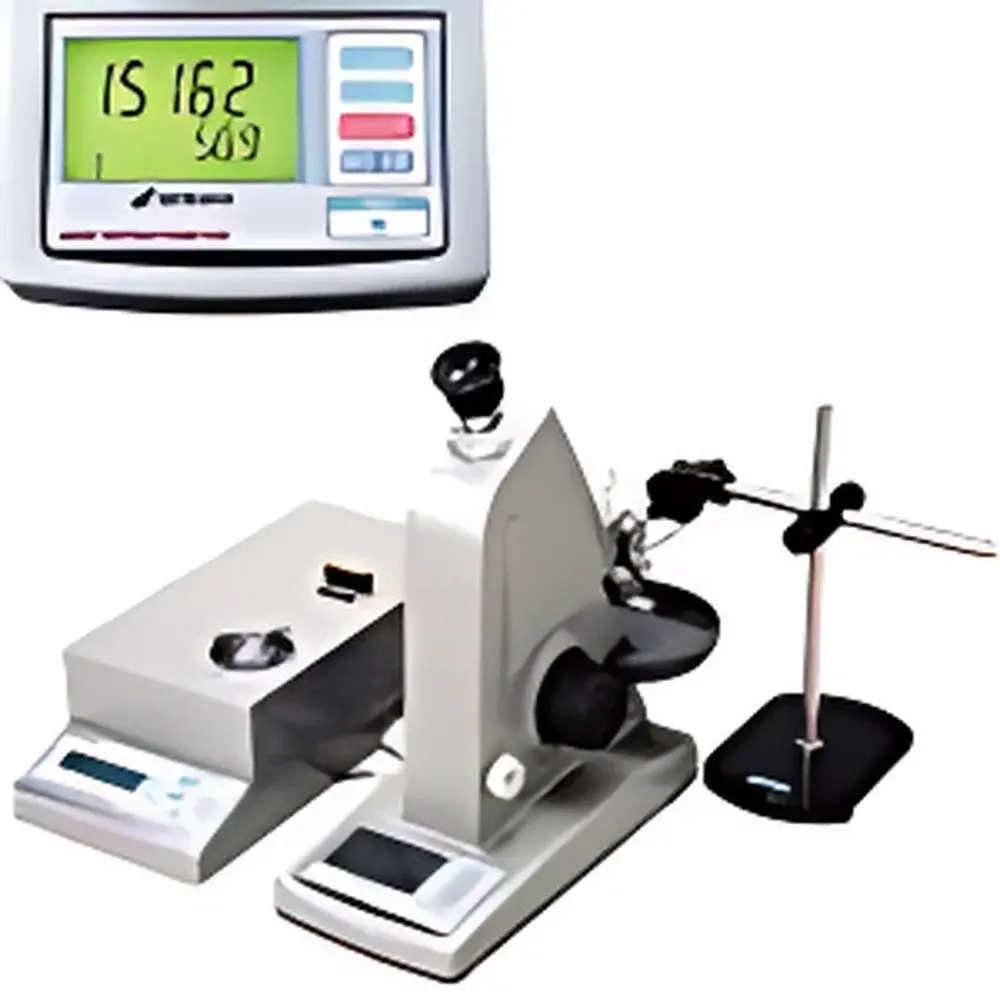
ATAGO DR-M4 Multi-Wavelength Abbe Refractometer
| Brand | ATAGO |
|---|---|
| Origin | Japan |
| Model | DR-M4 |
| Type | Benchtop Refractometer |
| Temperature Control | Yes |
| Digital Display | Yes |
| Refractive Index Range | 1.5219–1.9218 (450 nm) |
| Measurement Accuracy | ±0.0002 (with 500–650 nm filter) |
| Resolution | 0.0001 (nD), 0.1 (Abbe number) |
| Wavelength Range | 450–1100 nm (NIR observation eyepiece required for 681–1100 nm) |
| Temperature Range | 5–50 °C |
| Data Output | Optional DP-AD digital printer |
| Power Supply | AC 160–240 V, 50/60 Hz |
| Dimensions & Weight | 13 × 29 × 31 cm, 6.0 kg (main unit) |
Overview
The ATAGO DR-M4 Multi-Wavelength Abbe Refractometer is a precision benchtop optical instrument engineered for high-accuracy measurement of refractive index (n) and Abbe number (vd or ve) across a broad spectral range—from visible (450 nm) to near-infrared (1100 nm). Based on the classical Abbe principle—utilizing critical angle detection at the prism-sample interface—the DR-M4 enables wavelength-dependent dispersion analysis essential for characterizing optical materials such as encapsulation resins, electronic adhesives, optical polymers, and specialty glasses. Its dual-wavelength capability (standard 589 nm sodium D-line plus user-selectable 450 nm, 680 nm, and 1100 nm) supports rigorous material specification in R&D and QC environments where chromatic dispersion behavior directly impacts performance in optoelectronic packaging, lens design, and photonic component manufacturing.
Key Features
- Multi-wavelength refractive index measurement from 450 nm to 1100 nm, with dedicated calibration paths for each spectral band
- Integrated Peltier-based temperature control (5–50 °C) ensuring thermal stability within ±0.1 °C during measurement
- High-resolution LCD display showing real-time nD, nF, nC, vd, and ve values with 0.0001 refractive index resolution
- Optical boundary-line detection system with crosshair alignment for operator-independent endpoint determination
- Compliance with ISO 17025 traceability requirements when used with certified reference standards (e.g., NIST SRM 1484)
- Benchtop architecture with rigid aluminum housing, minimizing vibration-induced drift and supporting long-term repeatability
Sample Compatibility & Compliance
The DR-M4 accommodates liquid, paste, and low-viscosity semi-solid samples—including UV-curable encapsulants, silicone gels, epoxy resins, and acrylate-based optical adhesives—without requiring dilution or solvent addition. Sample volume requirement is ≤0.2 mL per measurement. All optical components meet JIS B 7021 and ASTM D1218 standards for refractometer performance verification. For regulated industries (e.g., medical device manufacturing or aerospace-grade optical assembly), the instrument supports GLP/GMP documentation workflows when paired with optional DP-AD digital printer for audit-trail-capable hardcopy output. NIR measurements (681–1100 nm) require the separately ordered infrared observation eyepiece (ATAGO Part No. 1414-01), which incorporates anti-reflection coated optics optimized for low-signal detection.
Software & Data Management
While the DR-M4 operates as a standalone instrument with embedded firmware, its digital output interface (RS-232) enables seamless integration into laboratory information management systems (LIMS) or custom QA databases. When connected to the optional DP-AD digital printer, all measurements—including timestamp, wavelength setting, temperature reading, and operator ID—are logged with full traceability. The system complies with FDA 21 CFR Part 11 requirements for electronic records when deployed with validated printer drivers and access-controlled user accounts. Raw data export supports CSV format for post-acquisition dispersion curve fitting (e.g., Sellmeier or Cauchy equation modeling) using third-party analytical software.
Applications
- Quality control of optical encapsulation compounds used in LED packaging, photovoltaic modules, and sensor housings
- Dispersion profiling of high-index resins for augmented reality (AR) waveguide fabrication
- Batch-to-batch consistency verification of electronic underfill materials per IPC-J-STD-020
- Development of gradient-index (GRIN) optical adhesives for micro-optics bonding
- Validation of refractive index matching between substrates and bonding layers in semiconductor packaging
- Research on thermo-optic coefficients (dn/dT) via controlled-temperature refractive index sweeps
FAQ
What wavelength filters are included standard with the DR-M4?
The instrument ships with a 589 nm sodium D-line filter as standard. Additional interference filters (450 nm, 680 nm, 1100 nm) are available as optional accessories.
Is temperature calibration required before each measurement?
No—integrated Pt100 sensor and closed-loop Peltier control maintain setpoint stability; however, daily verification using a certified water standard (nD = 1.3330 at 20 °C) is recommended per ISO 17025.
Can the DR-M4 measure opaque or highly scattering samples?
It is optimized for transparent to translucent liquids and gels; turbid or particulate-laden samples require centrifugation or filtration prior to analysis to avoid signal noise.
Does the DR-M4 support automated wavelength scanning?
No—it requires manual filter exchange and recalibration for each wavelength; however, measurement protocols can be pre-defined in LIMS for sequential multi-wavelength runs.
What is the minimum sample thickness required for accurate NIR measurements?
For 1100 nm operation, a minimum optical path length of 1.5 mm is recommended to ensure sufficient signal-to-noise ratio when using the NIR observation eyepiece.




