
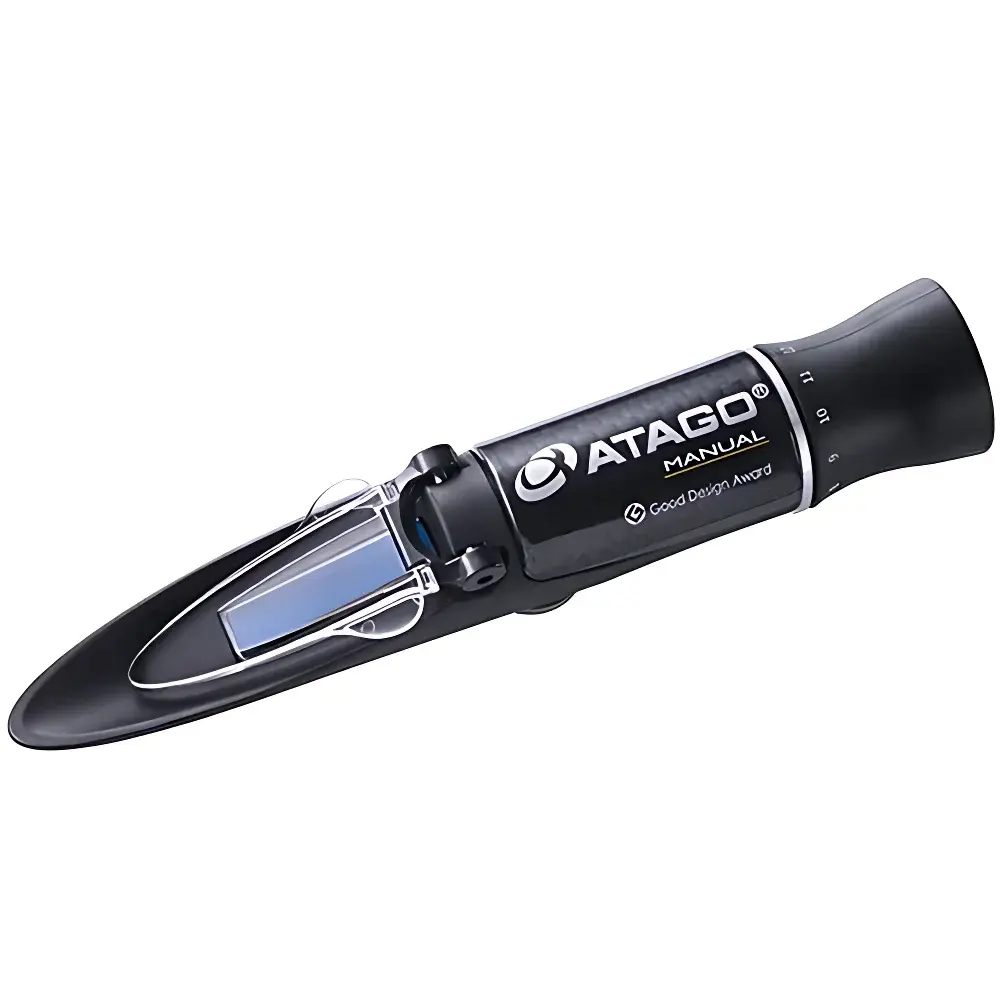
ATAGO MASTER-BR Portable Glycol Refractometer
| Brand | ATAGO |
|---|---|
| Origin | Japan |
| Model | MASTER-BR |
| Product Type | Handheld Refractometer |
| Temperature Compensation | Yes |
| Digital Display | No |
| Measurement Range | Ethylene Glycol: 0–70% w/w, Propylene Glycol: 0–70% w/w |
| Measurement Scale Resolution | 5% for glycol concentration, 5°C for freeze point estimation |
| Dimensions | 3.2 × 3.4 × 16.8 cm |
| Weight | 90 g |
| Compliance | Designed per JIS Z 8805 and ISO 21747 (Refractometric Analysis of Aqueous Glycol Solutions) |
Overview
The ATAGO MASTER-BR Portable Glycol Refractometer is a field-deployable optical instrument engineered for rapid, on-site determination of ethylene glycol (EG) and propylene glycol (PG) concentrations in coolant and heat-transfer fluids—primarily used in automotive radiators, HVAC chillers, industrial glycol loops, and solar thermal systems. Based on the principle of critical-angle refractometry, the device measures the refractive index of aqueous glycol solutions at ambient temperature and applies built-in temperature compensation (ATC) to correct readings to a standardized reference temperature (typically 20 °C), enabling accurate estimation of both glycol mass fraction (%) and corresponding freeze point (°C). Unlike laboratory-grade digital refractometers with Peltier-controlled cells, the MASTER-BR relies on high-precision Abbe-type optics and calibrated scale plates optimized specifically for binary EG/H₂O and PG/H₂O systems. Its compact, ergonomic design and lack of external power requirements make it suitable for routine maintenance checks in workshops, fleet depots, HVAC service vans, and facility engineering teams operating under GLP-aligned field protocols.
Key Features
- Optical measurement principle compliant with ISO 21747:2021 (Determination of glycol concentration in aqueous solutions by refractometry)
- Integrated Automatic Temperature Compensation (ATC) using bimetallic thermal expansion mechanism, covering operational range from 10 °C to 30 °C ambient
- Dual-scale reticle calibrated separately for ethylene glycol (0–70% w/w) and propylene glycol (0–70% w/w), each with freeze-point equivalents (0 °C to –50 °C)
- No-battery, no-electronics optical architecture ensuring long-term reliability, zero calibration drift, and immunity to electromagnetic interference
- Stainless steel prism housing with scratch-resistant optical glass surface; designed for repeated exposure to coolant additives, corrosion inhibitors, and mild solvents
- Compact form factor (3.2 × 3.4 × 16.8 cm) and lightweight construction (90 g) for one-handed operation and integration into standard toolkits
Sample Compatibility & Compliance
The MASTER-BR is validated exclusively for homogeneous, clarified aqueous solutions containing only ethylene glycol or propylene glycol as the primary solute. It is not intended for use with methanol-, ethanol-, or glycerol-based antifreezes, nor with contaminated, turbid, or highly viscous samples (e.g., degraded coolants with precipitated silicates or organic acids). For regulatory alignment, its scale calibration traceability follows JIS Z 8805 (Japanese Industrial Standard for refractometer verification) and supports documentation requirements under ISO/IEC 17025 accredited laboratories when used as a secondary field verification tool. While not FDA 21 CFR Part 11 compliant (as it generates no electronic records), its manual reading process satisfies audit-ready paper-trail practices required in GMP-compliant HVAC validation and automotive service quality systems.
Software & Data Management
The MASTER-BR operates without embedded firmware, software, or data storage capability. All measurements are read directly from the dual-scale eyepiece graticule and recorded manually—ensuring full transparency, eliminating firmware obsolescence risks, and complying with environments where electronic devices are restricted (e.g., explosion-proof zones, cleanrooms with RF-sensitive equipment). Users may integrate readings into existing CMMS or LIMS platforms via manual entry or barcode-assisted logging using companion ATAGO accessories (e.g., MASTER-BR-compatible sample ID labels). Calibration verification is performed using certified NIST-traceable glycol standard solutions (e.g., 20%, 40%, and 60% w/w EG in water), with documented verification logs recommended per ASTM D1120 for coolant testing programs.
Applications
- Routine freeze-point verification of engine coolant in automotive and heavy-duty vehicle maintenance
- Preventive monitoring of glycol concentration loss in closed-loop HVAC chiller systems
- Field validation of heat-transfer fluid integrity in solar thermal collector installations
- Commissioning support for industrial process cooling circuits requiring specified freeze protection margins
- Educational demonstrations of colligative properties and refractive index–concentration relationships in physical chemistry labs
- Quality assurance spot-checks during bulk coolant blending or tank farm transfers
FAQ
Does the MASTER-BR require periodic recalibration?
Yes—annual verification against certified glycol standards is recommended. Field recalibration is not user-serviceable; prism alignment and scale fidelity must be confirmed by an ATAGO-authorized service center.
Can it measure mixed glycol formulations (e.g., EG + PG blends)?
No—the scale is optimized for single-solute systems. Mixed glycols produce non-linear refractive index deviations and will yield inaccurate concentration estimates.
Is the device suitable for measuring glycol in phosphate-free or organic acid technology (OAT) coolants?
Yes, provided the solution remains optically clear and free of suspended solids or phase separation. Additive packages do not interfere if they remain molecularly dissolved and do not alter bulk refractive index beyond calibration tolerance.
What is the minimum sample volume required?
Approximately 0.3 mL is sufficient to fully cover the prism surface. Excess fluid should be wiped cleanly after each measurement to prevent cross-contamination.
How does temperature compensation work without electronics?
The ATC mechanism uses matched thermal expansion coefficients between prism housing and scale plate materials, physically shifting the optical path length to offset ambient-induced refractive index variation—no sensors or circuitry involved.





