
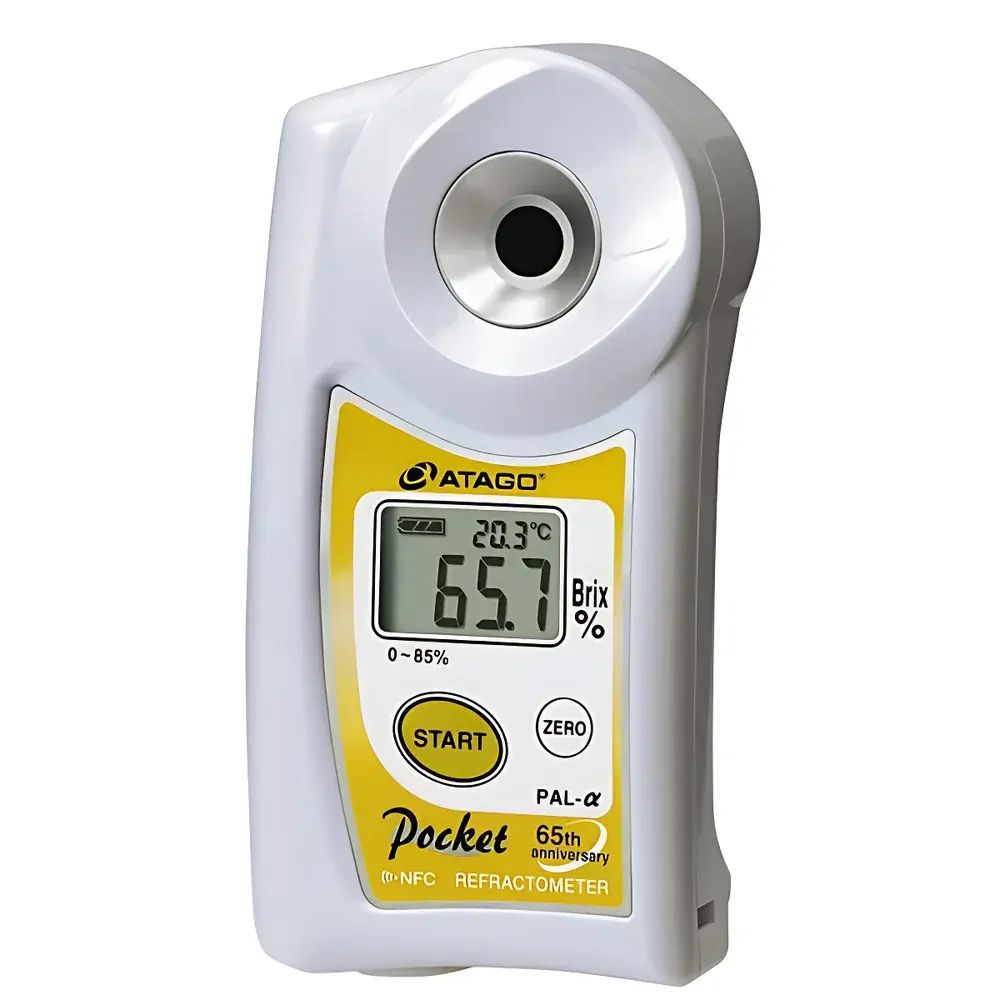
ATAGO PAL-α Portable Digital Refractometer with Wide Brix Range (0.0–85.0%)
| Brand | ATAGO |
|---|---|
| Origin | Japan |
| Model | PAL-α (Catalog No. 3840) |
| Measurement Range | Brix 0.0–85.0% |
| Temperature Range | 10–100°C |
| Accuracy | ±0.2% Brix, ±1°C |
| Resolution | 0.1% Brix |
| Environmental Operating Temperature | 10–40°C |
| Power Supply | Two AAA batteries |
| IP Rating | IP65 |
| Dimensions | 5.5 × 3.1 × 10.9 cm |
| Weight | 100 g (instrument only) |
Overview
The ATAGO PAL-α Portable Digital Refractometer is an optical precision instrument engineered for rapid, on-site determination of soluble solids concentration—expressed as Brix (% w/w)—in liquid and semi-liquid samples across food, dairy, beverage, and industrial fluid applications. It operates on the fundamental principle of critical angle refractometry: light passing from a high-refractive-index prism into a sample undergoes total internal reflection at a specific angle dependent on the sample’s refractive index, which correlates directly with solute concentration. Unlike benchtop laboratory refractometers, the PAL-α integrates temperature-compensated optics and an embedded thermistor to automatically correct Brix readings across its full operational temperature range (10–100°C), eliminating manual correction tables and reducing operator error. Its compact, handheld architecture enables direct field use in production lines, cold storage rooms, or mobile quality control stations—without requiring external power or calibration fluids beyond standard sucrose reference solutions.
Key Features
- Wide dynamic Brix measurement range (0.0–85.0%) supports high-concentration applications including fruit concentrates, honey, molasses, chocolate coatings, and industrial glycol-based coolants.
- Automatic temperature compensation (ATC) with real-time thermistor feedback ensures accurate Brix values across 10–100°C sample temperatures—critical for hot-fill processes and viscous, heat-stable formulations.
- IP65-rated enclosure provides dust-tight and water-jet resistant protection, enabling reliable operation in humid processing environments, washdown zones, and outdoor sampling locations.
- High-resolution 0.1% Brix display with intuitive one-button operation minimizes training requirements and supports GLP-compliant documentation when paired with optional data logging accessories.
- Lightweight (100 g) and ergonomic design allows extended single-hand use; powered by two standard AAA batteries with typical service life exceeding 10,000 measurements per set.
Sample Compatibility & Compliance
The PAL-α is validated for use with aqueous solutions where refractive index correlates linearly with sucrose-equivalent concentration—including dairy-based liquids (e.g., whey permeate, condensed milk, flavored creamers), acidic beverages (juices, syrups), and non-corrosive industrial fluids (water-glycol antifreeze, alkaline cleaning agents, water-soluble cutting oils). It is not suitable for strongly volatile, highly viscous (>10,000 mPa·s), or optically opaque suspensions without prior filtration or dilution. The instrument conforms to JIS K 0064 (Japanese Industrial Standard for refractometers) and meets functional equivalency requirements under ISO 2173:2003 (fruit and vegetable products—determination of soluble solids content). While not FDA 21 CFR Part 11–certified as a standalone unit, its measurement traceability aligns with GMP and HACCP prerequisite programs when used within documented SOPs and routine verification against NIST-traceable sucrose standards.
Software & Data Management
The PAL-α operates as a self-contained, firmware-driven instrument with no onboard memory or USB interface. For traceable data capture, ATAGO recommends integration with the optional PAL-α Data Logger (Model PAL-DL) or third-party RS-232-compatible recording systems. When connected, the device transmits timestamped Brix and temperature values in ASCII format, supporting export to CSV or LIMS-compatible databases. Audit trails—comprising operator ID, sample ID, ambient conditions, and calibration history—must be maintained externally per ISO/IEC 17025:2017 Clause 7.7 (result reporting) and FDA guidance on electronic records (21 CFR Part 11 Subpart B). Firmware updates are performed exclusively via authorized ATAGO service centers to preserve metrological integrity.
Applications
- Dairy processing: Real-time monitoring of lactose content in whey streams, Brix validation during evaporation of milk concentrates, and consistency control in sweetened condensed milk production.
- Beverage manufacturing: In-line verification of syrup-to-water ratios in carbonated soft drink batching and shelf-life stability assessment of juice blends.
- Confectionery & bakery: Quantification of sugar inversion in caramel batches and moisture content estimation in fondant and glazes via empirical Brix–water activity correlations.
- Industrial maintenance: Glycol concentration checks in HVAC chillers and coolant sump management in metalworking facilities to prevent microbial growth and freezing point deviation.
FAQ
Does the PAL-α require recalibration before each use?
No—routine verification using a certified 0% and 30% Brix sucrose standard is recommended at start-up, after temperature shifts >10°C, and every 2 hours during continuous operation. Full recalibration is performed annually or after physical impact.
Can it measure samples below 10°C or above 100°C?
No—the optical system and thermistor are rated strictly for 10–100°C. Samples outside this range must be equilibrated prior to measurement to avoid thermal shock and erroneous ATC compensation.
Is the prism surface chemically resistant to citric acid or sodium hydroxide solutions?
The sapphire prism is resistant to mild acids and alkalis at typical process concentrations (<5% w/w), but prolonged exposure to strong oxidizers (e.g., peracetic acid) or abrasive particulates requires immediate rinsing with deionized water and soft lint-free cloth drying.
How does Brix relate to actual sugar composition in non-sucrose matrices (e.g., lactose-dominant whey)?
Brix reflects total dissolved solids refractivity—not molecular identity. For lactose-rich samples, empirical correlation curves (established via HPLC or enzymatic assay) must be applied to convert PAL-α readings into true lactose % w/w.




