
ATAGO PAL-1 Digital Portable Refractometer
| Brand | ATAGO |
|---|---|
| Origin | Japan |
| Model | PAL-1 |
| Measurement Range | Brix 0.0–53.0% |
| Resolution | 0.1% Brix, 0.1°C |
| Accuracy | ±0.2% Brix, ±1°C |
| Temperature Compensation | Automatic (ATC), 10–100°C |
| Sample Volume | 3 mL |
| Measurement Time | 3 seconds |
| Power Supply | 2 × AAA batteries |
| IP Rating | IP65 |
| Dimensions | 55 × 31 × 109 mm |
| Weight | 100 g (host only) |
| Compliance | HACCP-aligned design, GLP-supportive data handling |
Overview
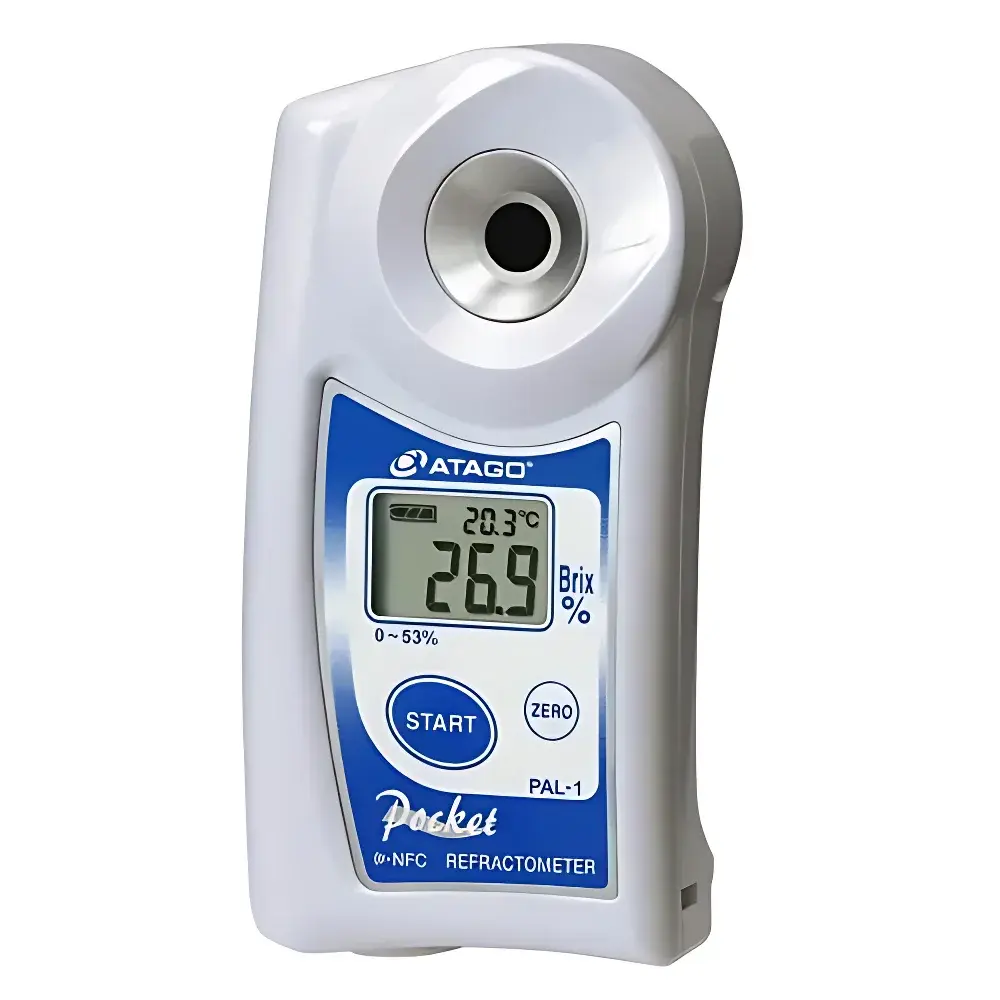
The ATAGO PAL-1 Digital Portable Refractometer is a precision optical instrument engineered for rapid, field-deployable measurement of refractive index–derived concentration values—primarily expressed as Brix (% w/w sucrose equivalent)—in liquid samples. It operates on the fundamental principle of Snell’s law: light passing through a sample–prism interface undergoes refraction proportional to the sample’s solute concentration. The PAL-1 integrates a high-stability Abbe-type prism, temperature-compensated photodiode array, and microprocessor-controlled signal processing to convert refractive index into a digitally displayed Brix value within 3 seconds. Designed for operational robustness in non-laboratory environments, it features an IP65-rated enclosure, eliminating ingress of dust and water jets—critical for use in food processing lines, orchard grading stations, or industrial maintenance bays. Its automatic temperature compensation (ATC) algorithm corrects readings across a 10–100°C sample temperature range using an embedded thermistor, ensuring metrological consistency without external calibration baths.
Key Features
- High-speed digital readout: Stable Brix value displayed in ≤3 seconds after sample application.
- True automatic temperature compensation (ATC): Compensates for thermal drift across 10–100°C without manual input or external reference.
- Rugged handheld architecture: Compact form factor (55 × 31 × 109 mm), lightweight (100 g), and IP65-certified for resistance to dust and low-pressure water jets.
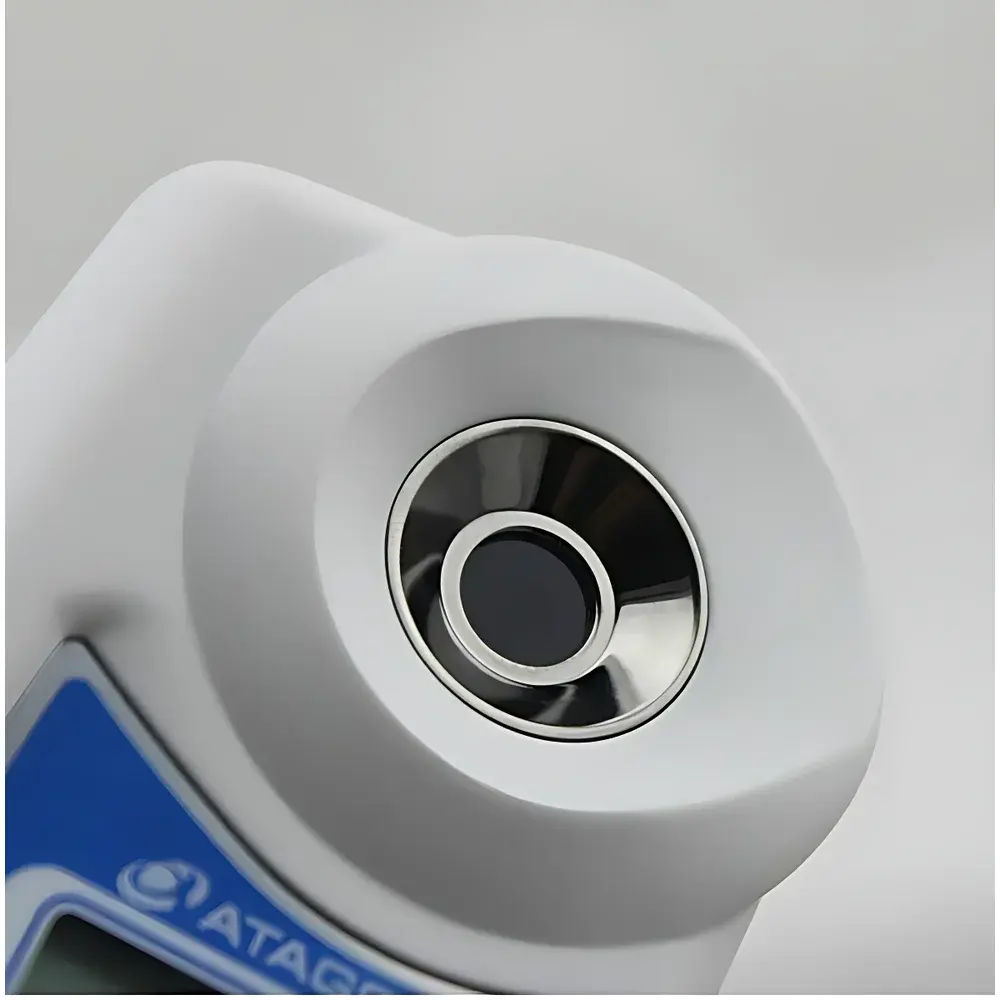
- Optimized optical path: Precision-ground sapphire-coated prism minimizes surface wear and maintains long-term refractive index fidelity.
- Low sample consumption: Requires only 3 mL per measurement—ideal for precious or volume-constrained samples.
- Energy-efficient operation: Powered by two standard AAA batteries with typical service life exceeding 10,000 measurements.
- ELI (External Light Interference) suppression: Optical shielding system mitigates ambient light influence, enabling reliable outdoor or factory-floor use under variable illumination.
Sample Compatibility & Compliance
The PAL-1 is validated for aqueous solutions exhibiting linear refractive index–concentration relationships within its specified Brix range (0.0–53.0%). Common applications include fruit juices, soft drinks, syrups, brines, glycol-based antifreezes, metalworking coolants, and cleaning agents. It is not intended for strongly scattering, highly viscous (>1000 mPa·s), or volatile organic solvents lacking established Brix correlation tables. From a regulatory standpoint, the instrument supports HACCP prerequisite programs through traceable, operator-independent measurements. While the PAL-1 itself does not generate audit trails, its stable repeatability (±0.2% Brix) and documented ATC performance align with GLP documentation requirements when integrated into controlled SOPs. It meets mechanical and environmental specifications referenced in ISO 21748 (guidance on uncertainty estimation for refractometric measurements) and supports routine verification per ASTM D1152 (standard test method for refractive index of formaldehyde).
Software & Data Management
The PAL-1 operates as a standalone instrument with no onboard memory or USB interface. However, its analog output signal (available via optional adapter cable) permits integration with external logging devices. For modern data governance, users may employ third-party mobile applications compatible with ATAGO’s legacy serial protocols to capture timestamped Brix/temperature pairs. Though the PAL-1 lacks native FDA 21 CFR Part 11 compliance features (e.g., electronic signatures, audit trail), its measurement stability and ATC traceability support retrospective validation when paired with procedural controls—such as defined calibration intervals using NIST-traceable sucrose standards and operator logbooks.
Applications
- Agricultural quality control: Determination of harvest readiness in fruits (e.g., mango, grape, apple) via Brix assessment; post-harvest sorting and grade classification.
- Food & beverage manufacturing: In-line monitoring of juice concentrate dilution, syrup blending consistency, and fermentation progress in brewing and winemaking.
- Industrial fluid management: Verification of coolant concentration in CNC machining centers; antifreeze mixture verification in automotive and HVAC maintenance.
- Pharmaceutical excipient preparation: Rapid verification of sugar-based vehicle concentrations in oral liquid formulations during batch release testing.
- Aquaculture and hydroponics: Monitoring nutrient solution strength (as Brix proxy) in recirculating aquaponic systems.
FAQ
Does the PAL-1 require calibration before each use?
No—routine calibration is recommended prior to first use, after extended storage, or following exposure to extreme temperatures. A single-point verification using distilled water (0.0% Brix) or certified 10.0% sucrose standard is sufficient for daily checks.
Can the PAL-1 measure non-sugar solutes like sodium chloride or ethylene glycol?
It displays values in Brix units only. For non-sucrose solutes, users must apply empirically derived conversion factors or refer to ATAGO’s published correlation charts—accuracy depends on solute-specific refractive index linearity.
Is the prism surface chemically resistant?
The sapphire-coated prism withstands mild acids, bases, and alcohols encountered in food and industrial applications. Avoid prolonged contact with strong oxidizers (e.g., nitric acid) or abrasive particulates.
What is the minimum sample temperature for valid ATC operation?
The ATC algorithm is active and validated between 10°C and 100°C. Measurements below 10°C fall outside compensation range and require manual correction or laboratory-grade thermostatted refractometry.
How often should the instrument be serviced?
ATAGO recommends annual verification at an authorized service center, including prism flatness assessment, photodiode response validation, and ATC algorithm verification against reference temperature points.




