
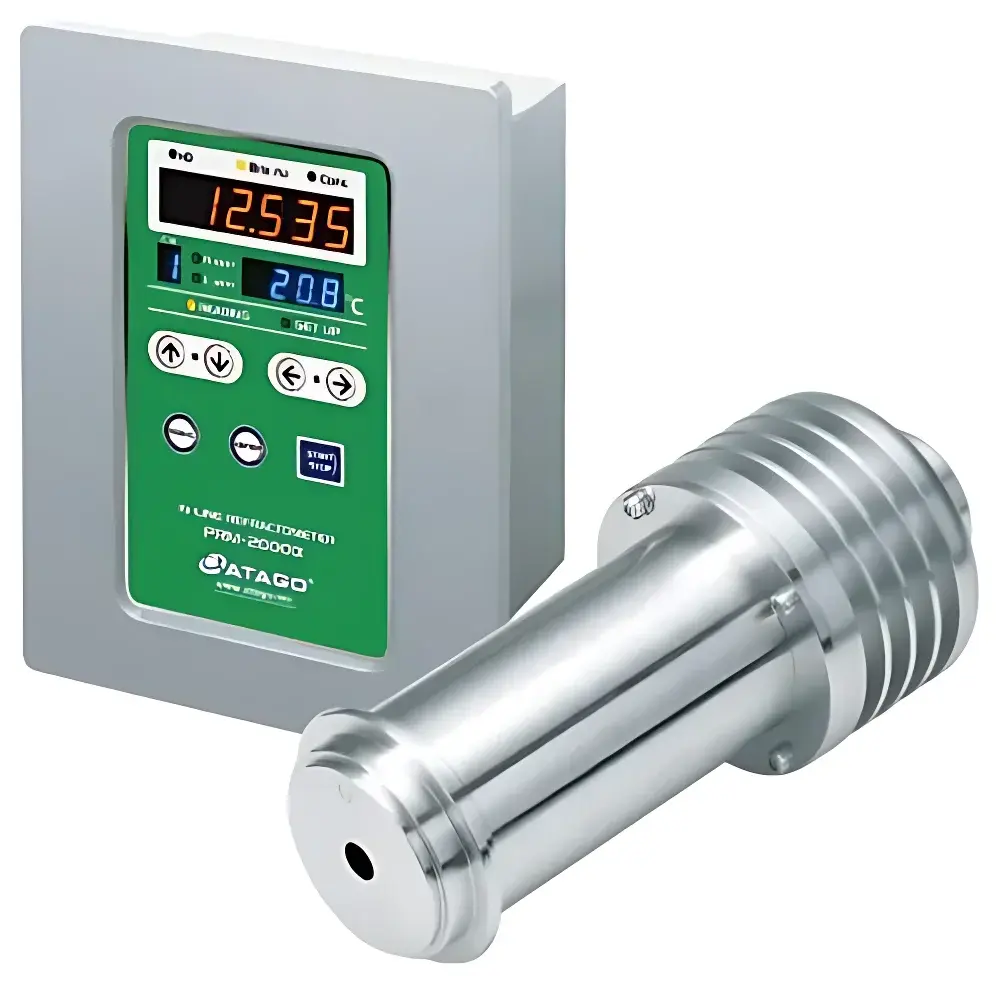
ATAGO PRM-2000α DX High-Precision In-Line Refractometer
| Brand | ATAGO |
|---|---|
| Origin | Japan |
| Model | PRM-2000α DX (High-Precision) |
| Product Type | In-Line Refractometer |
| Temperature Control | Yes |
| Digital Display | Yes |
| Measurement Range | Refractive Index (nD) 1.32069–1.36500 |
| Measurement Accuracy | nD ±0.00001 (1.32069–1.33681), ±0.00010 (1.33682–1.36500) |
| Resolution | nD 0.00001, Brix 0.001% (selectable: 0.001%/0.005%/0.01%) |
| Operating Temperature | −30.0 to +165.0°C |
| Temperature Compensation Range | 5 to 90°C |
| IP Rating | IP67 (both sensor and display unit) |
| Pressure Rating | 0.98 MPa |
| Prism Material | Synthetic Sapphire |
| Sample Cell Material | SUS316L Stainless Steel |
| Output | DC 4–20 mA, RS-232C (optional cables) |
| Response Time | ~1 second |
| Power Supply | AC 100–240 V, 50/60 Hz |
| Cable Length | Standard 15 m (up to 200 m optional) |
| Dimensions (Sensor) | 10.8 × 25.52 × 10.8 cm, 3.2 kg |
| Dimensions (Display Unit) | 19.2 × 10 × 24 cm, 3.3 kg |
Overview
The ATAGO PRM-2000α DX High-Precision In-Line Refractometer is an industrial-grade optical process analyzer engineered for continuous, real-time measurement of refractive index (nD) and soluble solids concentration (Brix %) in flowing liquid streams. Based on the fundamental principle of critical-angle refraction—where incident light undergoes total internal reflection at the interface between a high-refractive-index sapphire prism and the sample—the instrument delivers traceable, temperature-compensated measurements without sample extraction or reagent consumption. Its design targets applications requiring metrological rigor in food & beverage, pharmaceutical, chemical, and precision manufacturing environments—particularly where low-concentration accuracy (<2.000% Brix) and thermal stability across wide process windows (−30°C to +165°C) are critical. The system comprises two physically separated modules: a ruggedized in-pipe sensor head rated IP67 and 0.98 MPa pressure resistance, and a wall- or panel-mounted display/controller unit with identical ingress protection.
Key Features
- Ultra-high resolution refractive index measurement: 0.00001 nD resolution with dual-range accuracy specification (±0.00001 for nD 1.32069–1.33681; ±0.00010 for higher range), enabling reliable quantification of minute compositional shifts in dilute aqueous solutions.
- Automated temperature compensation (ATC) over 5–90°C, integrated via embedded Pt100 RTD in the sapphire prism assembly—ensuring compliance with ISO 21745 and ASTM D1218 standards for temperature-corrected refractometric analysis.
- IP67-rated stainless steel (SUS316L) wetted parts and synthetic sapphire prism—resistant to corrosion, abrasion, and CIP/SIP cycles, supporting validation under FDA 21 CFR Part 11 and EU GMP Annex 11 requirements.
- Configurable Brix output modes: calibrated for sucrose, high-fructose corn syrup (HFCS), and low-sugar beverages (≤2% w/w), with selectable display resolution (0.001%, 0.005%, or 0.01% Brix).
- Real-time analog (4–20 mA) and digital (RS-232C) outputs—compatible with DCS, SCADA, and MES platforms for closed-loop process control and automated batch reconciliation.
- Sub-second measurement cycle (~1 s response time) with stable signal acquisition even under turbulent flow conditions, validated per IEC 61511 functional safety guidelines for SIL-1 capable instrumentation.
Sample Compatibility & Compliance
The PRM-2000α DX is optimized for homogeneous, optically transparent liquids with minimal suspended solids or air entrainment. It is routinely deployed in tea extract concentration, coffee cold-brew monitoring, fruit juice blending, ethanol-water distillation cuts, starch hydrolysate processing, and detergent formulation lines. The sensor’s −30°C to +165°C operational envelope accommodates cryogenic pre-chill stages and high-temperature sterilization-in-place (SIP) protocols. All materials contacting the process stream comply with USP Class VI and FDA 21 CFR 177.2400 for food-contact polymers (where applicable) and EN 10204 3.1 material certification for SUS316L. The system supports audit-ready data integrity through timestamped measurement logs and configurable alarm thresholds aligned with ISO/IEC 17025 calibration management frameworks.
Software & Data Management
While the PRM-2000α DX operates as a standalone hardware analyzer, its RS-232C interface enables integration with ATAGO’s optional PC-based configuration and data logging software (PRM-Link). This tool facilitates remote parameter setup—including Brix calibration curve selection, temperature compensation offset adjustment, and output scaling—without physical access to the field unit. Logged data includes nD, Brix, temperature, and diagnostic flags (e.g., prism fouling alert, signal saturation), stored with ISO 8601 timestamps. For regulated environments, the system supports electronic signature workflows and 21 CFR Part 11-compliant audit trails when paired with validated third-party LIMS or MES platforms.
Applications
- Continuous monitoring of sugar concentration during juice evaporation and syrup standardization.
- In-line verification of ethanol content in fermentation broth and distillate fractions.
- Real-time control of starch hydrolysis degree via dextrose equivalent tracking.
- Concentration consistency checks in alkaline cleaning solutions used in semiconductor wafer rinsing.
- Low-Brix validation (e.g., <0.5% w/w) in purified water loops for pharmaceutical water-for-injection (WFI) systems.
- Process endpoint detection in coffee extract dilution and ready-to-drink beverage blending.
- Quality gate monitoring for incoming raw material syrups in confectionery production.
FAQ
What standards does the PRM-2000α DX comply with for refractive index measurement?
It adheres to the optical principles defined in ISO 21745 (refractometry terminology) and ASTM D1218 (standard test method for refractive index of hydrocarbon liquids), with temperature compensation algorithms traceable to NIST-certified reference materials.
Can the sensor be installed in sanitary piping systems?
Yes—the sensor body features tri-clamp (DIN 11851) or flanged mounting options and meets 3-A Sanitary Standards for dairy and beverage applications when configured with appropriate gasket materials.
Is calibration required before commissioning?
Factory calibration using certified sucrose reference solutions is performed prior to shipment; field verification with NIST-traceable standards is recommended at installation and at scheduled intervals per ISO/IEC 17025 quality management protocols.
How does automatic temperature compensation improve low-concentration accuracy?
By dynamically correcting nD values using real-time prism surface temperature, ATC minimizes thermal drift-induced error—enabling the ±0.007% Brix specification specifically for samples below 2.000% w/w, where temperature sensitivity is highest.
What maintenance is required for long-term reliability?
No routine optical alignment or consumable replacement is needed; periodic visual inspection of the sapphire prism for coating buildup and verification of CIP rinse efficacy are sufficient—validated by daily zero-checks using deionized water.



