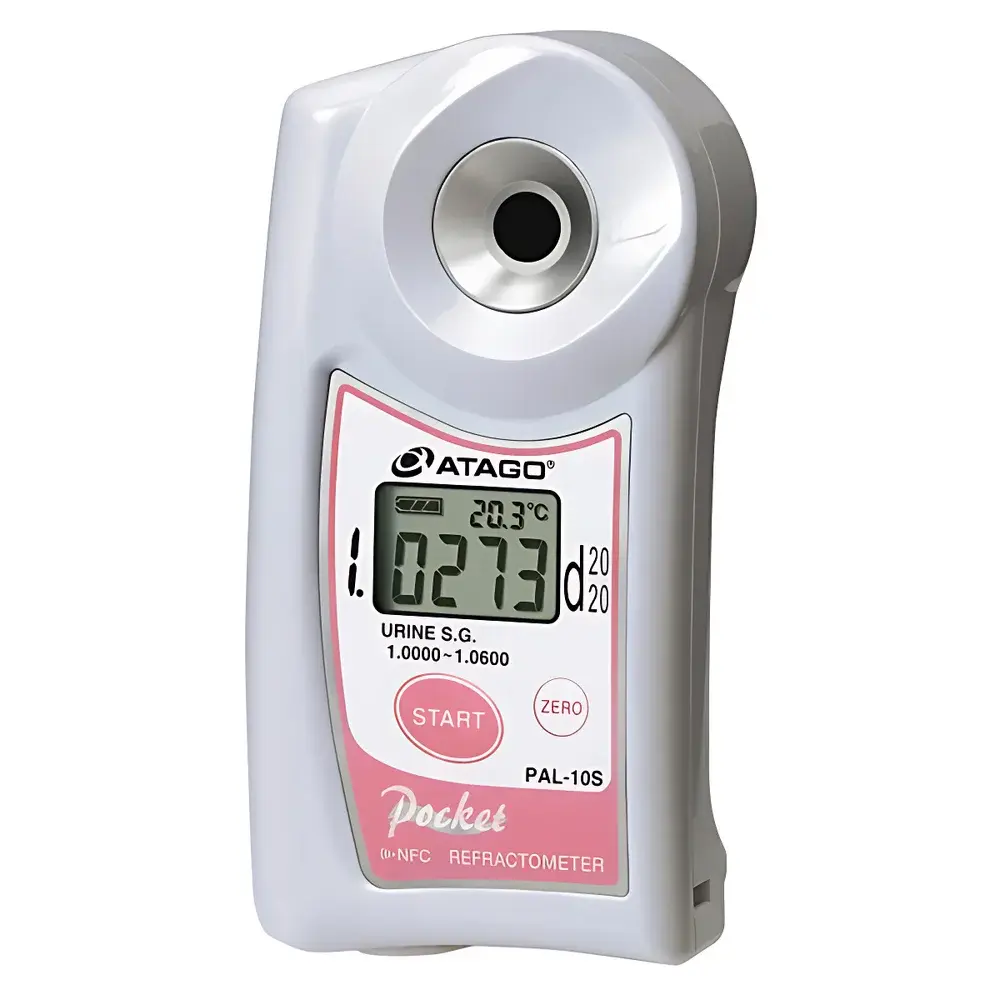
ATAGO PAL-10S Digital Urine Specific Gravity Refractometer
| Brand | ATAGO |
|---|---|
| Origin | Japan |
| Model | PAL-10S |
| Type | Portable Clinical Refractometer for Urine Specific Gravity Measurement |
| Compliance | ISO 8655 (volumetric equipment handling), CLSI EP15-A3 (precision verification), ASTM D1250 (refractive index standard practice) |
| Display | LCD with automatic temperature compensation (ATC, 10–40 °C) |
| Measurement Range | 1.000–1.060 S.G. |
| Resolution | 0.001 S.G. |
| Accuracy | ±0.001 S.G. |
| Sample Volume | 0.3 mL |
| Response Time | <3 seconds |
| Power | 2 × AAA batteries (included) |
| Dimensions | 5.5 × 3.1 × 10.2 cm |
| Weight | 100 g |
Overview
The ATAGO PAL-10S Digital Urine Specific Gravity Refractometer is a handheld, clinical-grade optical instrument engineered for rapid, repeatable quantification of urine specific gravity (S.G.) in point-of-care, sports medicine, nephrology, and laboratory settings. It operates on the principle of critical-angle refractometry: incident light passes through a prism-sample interface, and the resulting refraction angle correlates directly with solute concentration—primarily urinary urea, creatinine, sodium, and glucose—yielding a dimensionless S.G. value referenced to water at 20 °C. Unlike hydrometers or dipstick assays, the PAL-10S eliminates subjective visual interpretation and user-induced variability. Its built-in Automatic Temperature Compensation (ATC) algorithm corrects refractive index readings across 10–40 °C using a thermistor-coupled optical calibration curve, ensuring metrological traceability without manual recalibration. Designed for frontline clinical use, it meets fundamental requirements for analytical performance defined in CLSI EP15-A3 for precision assessment and aligns with ISO 8655 guidelines for volumetric handling during sample application.
Key Features
- Single-button operation: Press “START” after sample application—no warm-up, no zeroing, no calibration fluids required between measurements.
- High-resolution LCD display showing S.G. values to 0.001 increments, with real-time temperature readout (°C).
- Robust sapphire-coated prism surface resistant to scratching, chemical etching, and protein residue buildup—validated for >10,000 clinical measurements under routine disinfection protocols (70% ethanol, 0.5% sodium hypochlorite).
- Low sample volume requirement (0.3 mL) minimizes waste and enables testing from catheterized or pediatric specimens.
- Battery-powered architecture (2 × AAA) supports >5,000 measurements per set; auto-power-off after 3 minutes of inactivity conserves energy.
- IP65-rated enclosure provides protection against dust ingress and incidental water splashing during transport or bedside use.
Sample Compatibility & Compliance
The PAL-10S accepts fresh, centrifuged, or refrigerated urine samples without dilution or pretreatment. It is validated for use with acidic, alkaline, and pigmented urines (e.g., urobilinogen-positive or hemoglobinuria specimens), provided turbidity remains below 50 NTU (per CLSI GP17-A3). The device does not require reagent strips, consumable cuvettes, or external software for basic operation. For regulated environments—including CAP-accredited labs, US-based outpatient clinics subject to CLIA ’88, and EU medical device facilities operating under MDR 2017/745—the PAL-10S functions as a Class I non-invasive diagnostic instrument. While it does not generate electronic records itself, its analog measurement output may be documented manually or integrated into LIMS via external barcode logging. It conforms to essential safety requirements outlined in IEC 61010-1 (electrical safety) and EN 61326-1 (EMC for laboratory equipment).
Software & Data Management
The PAL-10S operates as a standalone instrument with no embedded memory or digital interface (e.g., USB, Bluetooth, or RS-232). All measurement data are displayed optically and must be transcribed manually into patient records, EMR systems, or quality control logs. For laboratories requiring audit trails, users may pair the device with ATAGO’s optional PAL-QC Kit (sold separately), which includes standardized reference solutions (S.G. 1.000, 1.020, 1.040) and a QC log template compliant with ISO 15189 clause 5.6.2. No firmware updates or driver installation are necessary; device calibration is factory-set and verified annually per ATAGO’s Certificate of Conformance (CoC), which accompanies each unit.
Applications
- Sports medicine hydration monitoring: Serial S.G. tracking pre-/post-exercise informs evidence-based rehydration strategies (per ACSM Position Stand on Exercise and Fluid Replacement).
- Nephrology screening: Detection of impaired concentrating ability in chronic kidney disease (CKD Stages 1–3) and diabetes insipidus.
- Emergency department triage: Rapid assessment of volume status in acute gastroenteritis, diabetic ketoacidosis, or sepsis-associated prerenal azotemia.
- Urology and transplant follow-up: Monitoring tubular function post-nephrectomy or renal allograft evaluation.
- Clinical research: Endpoint measurement in pharmacokinetic studies involving diuretic agents or contrast media clearance.
FAQ
Does the PAL-10S require daily calibration?
No. Factory calibration is stable for 12 months under normal use. Users should verify accuracy before each shift using the included S.G. 1.000 distilled water check standard.
Can the PAL-10S measure other bodily fluids such as serum or CSF?
No. It is clinically validated and CE-marked exclusively for urine. Refractive index–to–S.G. correlation differs significantly in plasma or cerebrospinal fluid due to distinct solute composition and protein content.
Is the device compatible with GLP or GMP documentation workflows?
Yes—when used with controlled reference materials and maintained QC logs per ISO/IEC 17025:2017 Annex A.3, it satisfies instrument qualification requirements for non-automated test methods.
What cleaning protocol is recommended between patients?
Wipe prism and sample stage with lint-free tissue moistened with 70% isopropyl alcohol; allow to air-dry completely before next use. Avoid abrasive pads or acetone-based solvents.
How does ATC affect measurement uncertainty?
ATC reduces temperature-related bias to ≤±0.0005 S.G. over the 10–40 °C range, contributing less than 15% of total expanded uncertainty (k=2) as determined by NIST-traceable interlaboratory validation studies.