
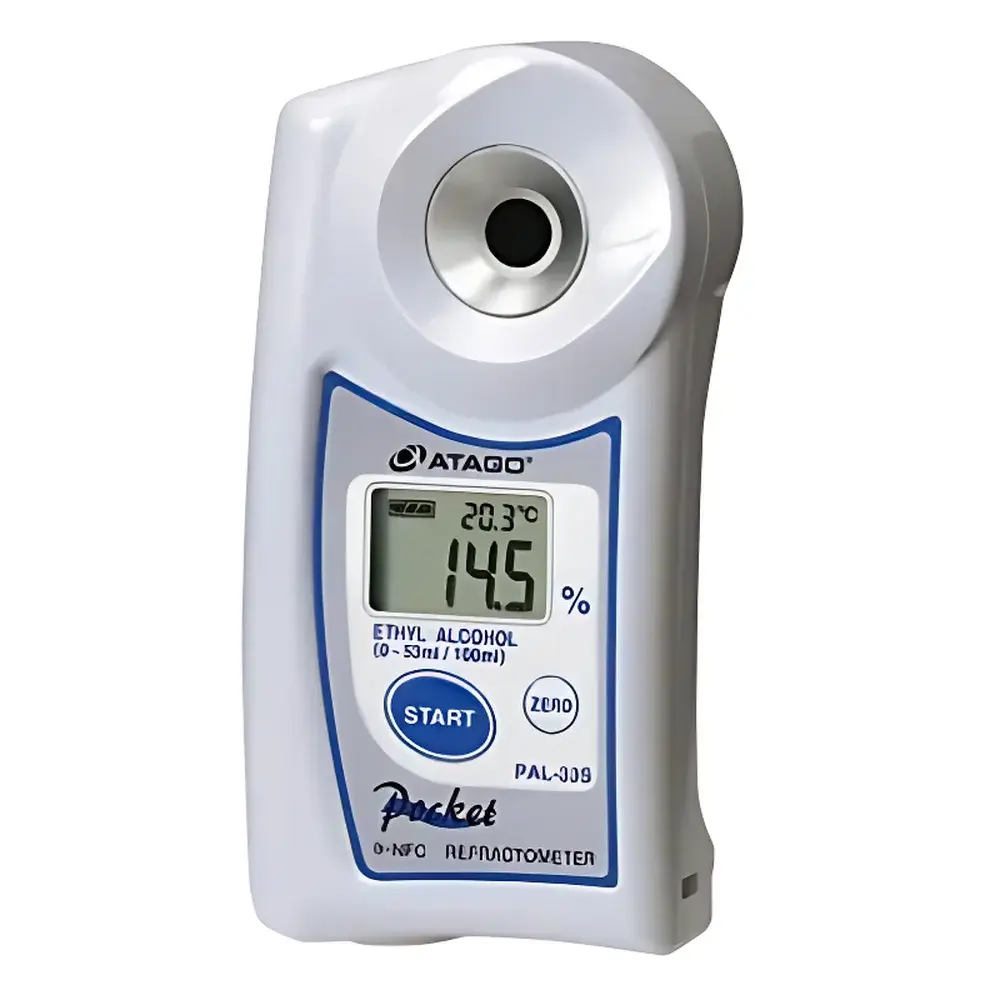
ATAGO PAL-33S Portable Digital Ethanol Refractometer
| Brand | ATAGO |
|---|---|
| Origin | Japan |
| Model | PAL-33S |
| Product Type | Handheld Refractometer |
| Measurement Range | 0.0–53.0% ethanol (v/v) |
| Accuracy | ±1.0% |
| Temperature Range | 10–40°C (ATC compensated) |
| Resolution | 1.0% |
| Display | Digital LCD |
| Power Supply | 2 × AAA batteries |
| IP Rating | IP65 |
| Dimensions | 5.5 × 3.1 × 10.9 cm |
| Weight | 100 g (instrument only) |
Overview
The ATAGO PAL-33S is a compact, handheld digital refractometer engineered for rapid, on-site quantification of ethanol concentration in aqueous solutions—primarily intended for quality control in chemical manufacturing, solvent recovery processes, and laboratory screening of ethanol-containing formulations. It operates on the principle of critical-angle refractometry: light passes through a prism in contact with the sample, and the resulting refraction angle is converted into a refractive index value, which is then translated into ethanol concentration (%) using a pre-calibrated polynomial algorithm optimized for ethanol–water binary systems. The instrument incorporates Automatic Temperature Compensation (ATC) across 10–40°C, eliminating manual correction and ensuring consistent readings under variable ambient conditions. Designed for field and benchtop use, the PAL-33S delivers repeatable results without requiring sample dilution, distillation, or reagent addition—making it suitable for routine verification where speed, portability, and operational simplicity are prioritized over ultra-high resolution.
Key Features
- Optimized optical system with high-stability sapphire prism for long-term measurement integrity and resistance to chemical abrasion
- Digital LCD display with 1.0% resolution and automatic backlight for low-light environments
- ATC (Automatic Temperature Compensation) based on built-in thermistor, referenced to 20°C calibration standard per ISO 21748
- Rugged, IP65-rated housing resistant to dust ingress and water splashes—validated for industrial floor and outdoor deployment
- Low-power operation via two standard AAA alkaline batteries, supporting >5,000 measurements per set under typical usage
- Zero-point calibration function using distilled water, compliant with ATAGO’s internal calibration protocol and traceable to NIST-traceable reference standards
Sample Compatibility & Compliance
The PAL-33S is validated for homogeneous, non-turbid, non-viscous ethanol–water mixtures. It is not intended for samples containing suspended solids, oils, glycols, or high-concentration surfactants, as these may alter refractive index behavior or contaminate the prism surface. While not certified for regulatory submission under USP or ASTM D4052, its measurement methodology aligns with general refractometric principles outlined in ISO 21748 (Guidance for the evaluation of measurement uncertainty) and supports GLP-aligned documentation when used within defined SOPs. Calibration verification is recommended before each analytical session or at 8-hour intervals during continuous use.
Software & Data Management
The PAL-33S is a standalone, firmware-based instrument with no embedded memory or data export capability. All measurements are displayed in real time and must be manually recorded. For traceability, users are advised to integrate the device into paper-based or electronic lab notebooks (ELN) that comply with 21 CFR Part 11 requirements—including user authentication, audit trail logging, and secure data archiving. ATAGO provides calibration certificates (upon request) with serial-number traceability and uncertainty statements aligned with ISO/IEC 17025 guidelines when serviced through authorized calibration centers.
Applications
- Verification of ethanol concentration in industrial solvents prior to reuse or disposal
- Batch release testing of ethanol-based disinfectants and sanitizers (e.g., WHO-recommended formulations)
- In-process monitoring during fermentation broth clarification or distillate collection
- Field inspection of fuel-grade ethanol blends (E10, E85) for gross deviation detection
- Educational labs for teaching fundamental principles of solution density, refractive index, and binary phase behavior
FAQ
Does the PAL-33S require periodic recalibration by an accredited lab?
Yes—while field zeroing with distilled water is sufficient for daily use, annual recalibration against certified ethanol reference standards (e.g., NIST SRM 1823) is recommended to maintain metrological traceability.
Can it measure denatured ethanol or ethanol mixed with methanol?
No—the calibration curve is specific to ethanol–water systems; co-solvents such as methanol, isopropanol, or denaturants introduce nonlinear refractive deviations and invalidate reported values.
Is the prism surface chemically resistant to 95% ethanol?
Yes—the sapphire prism exhibits negligible erosion or hazing after repeated exposure to undiluted ethanol, as verified per ATAGO’s 1,000-cycle durability test protocol.
What does IP65 rating mean for operational safety?
IP65 indicates full protection against dust ingress and resistance to low-pressure water jets from any direction—suitable for wet-lab countertops and production floors but not submersion or high-pressure washdown.
How does ATC affect measurement uncertainty?
ATC reduces temperature-induced bias to ≤±0.3% across the 10–40°C range; however, total measurement uncertainty remains ±1.0% due to sample homogeneity, operator technique, and prism cleanliness—per ATAGO’s published validation report Rev. 4.2 (2023).




