
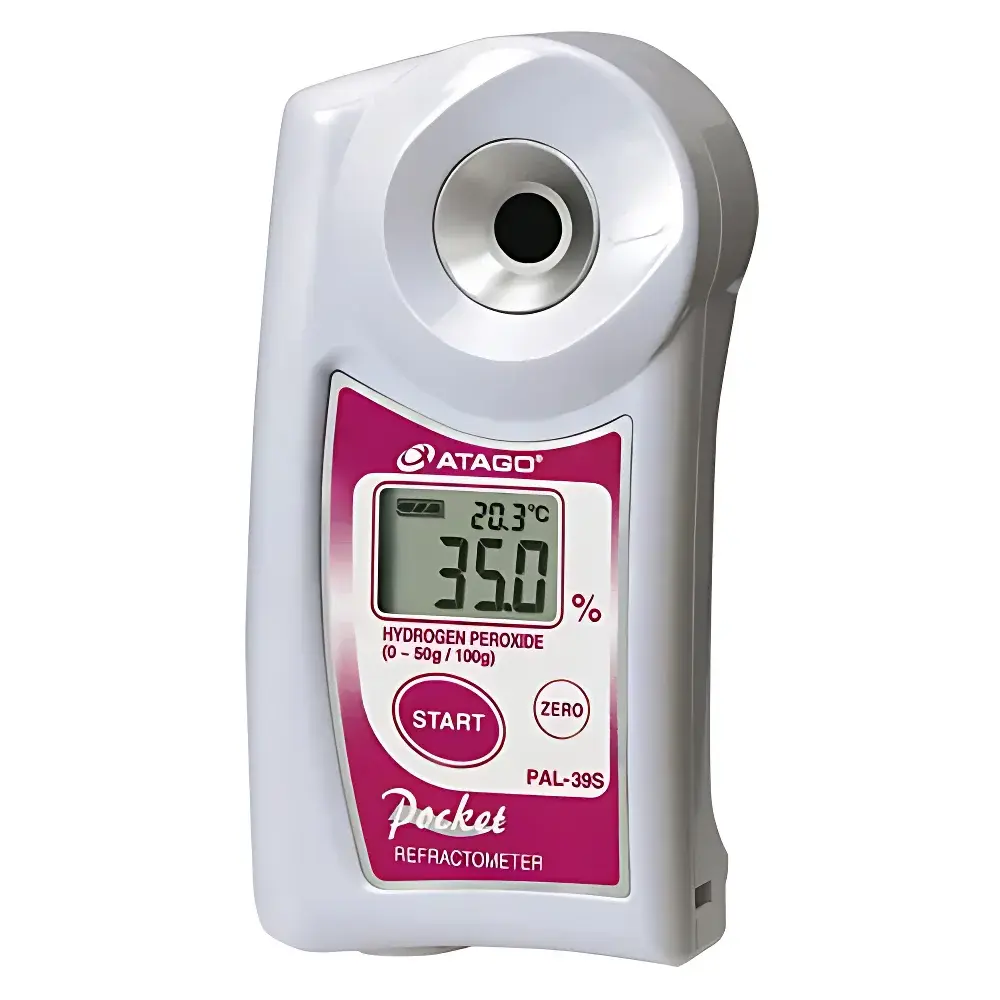
ATAGO PAL-39S Hydrogen Peroxide Refractometer
| Brand | ATAGO |
|---|---|
| Origin | Japan |
| Model | PAL-39S |
| Measurement Principle | Refractive Index (RI) |
| Range | 0.0–50.0% w/w H₂O₂ |
| Resolution | 0.002% |
| Accuracy | ±0.6% |
| ATC Range | 10–40°C |
| IP Rating | IP65 |
| Weight | 100 g |
| Dimensions | 5.5 × 3.1 × 10.9 cm |
| Sample Volume | ~0.5 mL |
| Measurement Time | ~3 seconds |
| Zeroing Method | Distilled Water Calibration |
| E.L.I. (External Light Interference) Technology | Yes |
| Portability | Handheld, Hook-Mounted Design |
Overview
The ATAGO PAL-39S Hydrogen Peroxide Refractometer is a handheld, precision optical instrument engineered for rapid, field-deployable quantification of hydrogen peroxide (H₂O₂) concentration in aqueous solutions. It operates on the fundamental principle of refractometry—measuring the refractive index (RI) of a sample and converting it to % w/w H₂O₂ concentration via a pre-calibrated polynomial algorithm traceable to NIST-traceable reference standards. Unlike electrochemical or titrimetric methods, this approach requires no reagents, electrodes, or consumables, delivering repeatable results within three seconds using only 0.5 mL of sample. Its compact architecture integrates temperature-compensated optics and solid-state photodetection, making it suitable for routine QC checks in pharmaceutical manufacturing, sterilization validation, medical device reprocessing, and industrial cleaning process monitoring—environments where speed, portability, and operational robustness are critical.
Key Features
- High-precision refractive index detection with ±0.6% accuracy across the full 0.0–50.0% w/w H₂O₂ range
- Automatic Temperature Compensation (ATC) over 10–40°C, eliminating manual correction and minimizing thermal drift
- E.L.I. (External Light Interference) optical shielding system—blocks ambient light contamination during outdoor or high-glare measurements without requiring a dark enclosure
- IP65-rated enclosure ensures resistance to dust ingress and low-pressure water jets, supporting use in wet or controlled non-sterile environments
- One-handed operation enabled by ergonomic form factor (5.5 × 3.1 × 10.9 cm), integrated measurement trigger, and intuitive LCD interface
- Distilled water zeroing function allows rapid recalibration between samples; no proprietary calibration fluids required
- Integrated lanyard hook and sub-100 g mass facilitate hands-free suspension or belt-clip mounting during extended field use
Sample Compatibility & Compliance
The PAL-39S is validated for use with clear, non-turbid, non-viscous aqueous H₂O₂ solutions—including those used in vapor-phase sterilization (VHP), surface disinfection, and contact lens solution formulation. It is not intended for emulsions, suspensions, or highly colored matrices that scatter or absorb visible light at the 589 nm sodium-D line wavelength. While the instrument itself does not carry formal regulatory certification, its measurement methodology aligns with ASTM D1293 (Standard Test Method for Refractive Index of Water) and supports GLP-compliant documentation when paired with external audit trails. Users deploying it in FDA-regulated environments (e.g., ISO 13485-certified facilities) typically integrate it into SOPs referencing USP particulate matter guidance and internal calibration logs maintained per ISO/IEC 17025 requirements.
Software & Data Management
The PAL-39S operates as a standalone, firmware-based instrument with no onboard data logging or Bluetooth/Wi-Fi connectivity. All measurements are displayed in real time on a high-contrast monochrome LCD. For traceability, users manually record readings alongside batch IDs, operator initials, and environmental conditions (ambient temperature/humidity). When integrated into digital QA workflows, the device is commonly paired with LIMS or ELN systems via secondary entry—or with optional ATAGO RS-232-compatible data transfer modules (sold separately) enabling ASCII output to PCs or PLCs for automated log capture. Audit-ready calibration records must include date, technician ID, reference standard lot number, and deviation from nominal value—consistent with FDA 21 CFR Part 11 expectations for electronic records when such interfaces are deployed.
Applications
- Routine verification of H₂O₂ concentration in sterilant reservoirs prior to vapor-phase sterilization cycles
- On-site validation of disinfectant dilutions in healthcare facility housekeeping protocols
- In-process concentration checks during pharmaceutical active ingredient synthesis where H₂O₂ serves as oxidant
- Quality control of commercial antiseptic formulations (e.g., wound cleansers, contact lens care solutions)
- Field testing of wastewater treatment oxidant dosing systems prior to discharge compliance sampling
- Education and training labs demonstrating colligative property relationships between solute concentration and refractive index
FAQ
Does the PAL-39S require periodic factory recalibration?
Yes—ATAGO recommends annual recalibration against certified refractive index standards to maintain metrological traceability; intervals may be adjusted per internal risk assessment or regulatory requirements.
Can it measure hydrogen peroxide in the presence of stabilizers like phosphoric acid or sodium stannate?
Accuracy may degrade if stabilizers significantly alter the solution’s refractive index profile; users should verify performance against gravimetrically prepared standards containing representative stabilizer concentrations.
Is the prism surface resistant to H₂O₂ corrosion?
The sapphire prism is chemically inert to typical working concentrations (≤50% w/w) and exhibits no measurable etching after repeated exposure under normal handling conditions.
What is the minimum detectable change in concentration?
With 0.002% resolution and ±0.6% accuracy, the smallest reliably distinguishable step is approximately ±0.6%—not 0.002%—due to combined systematic and random uncertainty components.
How does E.L.I. differ from conventional light-shield designs?
E.L.I. employs a multi-angle baffling geometry and spectrally selective aperture masking to attenuate off-axis ambient photons before they reach the photodiode array—reducing measurement variance by up to 70% under direct sunlight compared to legacy handheld refractometers.





