
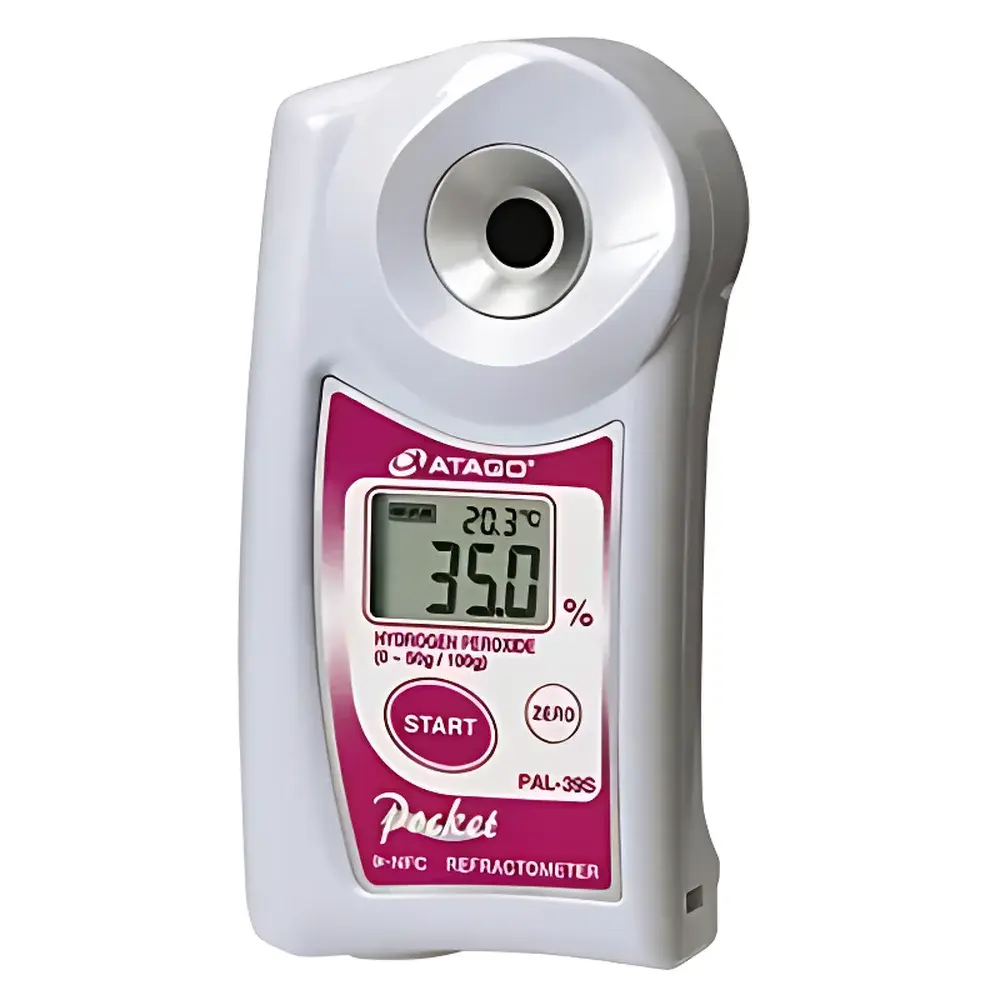
ATAGO PAL-39S Portable Hydrogen Peroxide Refractometer
| Brand | ATAGO |
|---|---|
| Origin | Japan |
| Model | PAL-39S |
| Product Type | Handheld Digital Refractometer |
| Measurement Range | 0.0–50.0% w/w H₂O₂ |
| Accuracy | ±0.6% |
| Resolution | 0.2% |
| Temperature Range (with ATC) | 10–35°C |
| Display | Digital LCD |
| IP Rating | IP65 |
| Power Supply | 2 × AAA batteries |
| Dimensions | 5.5 × 3.1 × 10.9 cm |
| Weight | 100 g (main unit only) |
| E.L.I. (External Light Interference) Function | Yes |
| Auto Zero with Distilled Water | Yes |
| Temperature Compensation | Automatic (ATC) |
| Enclosure | Dust- and water-resistant, washable under running water |
Overview
The ATAGO PAL-39S is a compact, handheld digital refractometer engineered specifically for the rapid, on-site quantification of hydrogen peroxide (H₂O₂) concentration in aqueous solutions. It operates on the principle of critical-angle refractometry: incident light passes through a prism in contact with the sample, and the resulting refraction angle—dependent on the solution’s refractive index—is converted into a mass concentration value (% w/w) using a pre-calibrated H₂O₂-specific optical dispersion curve. This method eliminates the need for chemical reagents or titration, delivering immediate results without sample dilution or laboratory infrastructure. Designed for routine quality control in disinfection validation, pharmaceutical manufacturing, medical device sterilization, and industrial cleaning processes, the PAL-39S delivers field-deployable accuracy compliant with standard refractometric practice per ISO 21748 and ASTM D1218. Its measurement range (0.0–50.0% w/w) covers common working concentrations used in low-level surface disinfection (3–6%), high-level instrument sterilization (7.5–35%), and concentrated stock solutions (up to 50%).
Key Features
- Optimized optical system calibrated exclusively for hydrogen peroxide solutions—no cross-sensitivity to ethanol, glycerol, or other common excipients
- Integrated Automatic Temperature Compensation (ATC) across 10–35°C, eliminating manual correction and ensuring traceable repeatability under ambient lab or production-floor conditions
- E.L.I. (External Light Interference) optical shielding—prevents ambient daylight or overhead lighting from distorting prism illumination, enabling reliable outdoor or uncontrolled-light measurements
- IP65-rated enclosure: fully protected against dust ingress and low-pressure water jets; instrument body is safe for thorough rinsing with deionized or tap water after each use—critical for H₂O₂ residue management
- One-hand operation with ergonomic grip and large backlit LCD display; zero calibration performed rapidly using distilled or deionized water
- Lightweight (100 g) and pocket-portable with integrated lanyard hook—designed for continuous use across multiple stations in GMP-regulated cleanrooms or hospital central sterile supply departments (CSSD)
Sample Compatibility & Compliance
The PAL-39S is validated for direct measurement of unstabilized and stabilized aqueous H₂O₂ solutions containing common stabilizers such as sodium stannate, phosphoric acid, or acetanilide at typical commercial concentrations. It is not intended for viscous gels, emulsions, or organic-phase peroxide formulations. As a Class I optical measuring device under IEC 61010-1, it meets electrical safety requirements for non-hazardous environments. While refractometry itself is not a primary method for regulatory release testing under USP or EP 2.2.41, the PAL-39S supports in-process verification aligned with FDA guidance on process analytical technology (PAT) and Annex 11 principles for equipment qualification. Its ATC algorithm and factory calibration traceability (NIST-traceable reference standards) support IQ/OQ documentation for audit readiness.
Software & Data Management
The PAL-39S operates as a standalone instrument with no embedded data logging or PC connectivity. All measurements are displayed in real time on the integrated LCD; no external software, drivers, or cloud platforms are required. This architecture ensures deterministic response time (<1 second), immunity to firmware vulnerabilities, and full compliance with environments restricting USB devices or networked peripherals—such as ISO Class 5 cleanrooms or secure healthcare IT zones. For laboratories requiring record retention, users may manually transcribe readings into electronic lab notebooks (ELNs) or LIMS systems. Calibration records (date, operator, reference standard lot number) should be maintained per GLP/GMP documentation practices.
Applications
- Routine verification of H₂O₂ concentration prior to vaporized hydrogen peroxide (VHP®) sterilization cycles in isolators and transfer hatches
- Concentration checks of prepared disinfectant solutions in hospital environmental services and endoscopy reprocessing units
- In-line batch verification during pharmaceutical active ingredient synthesis where H₂O₂ serves as oxidant
- Field validation of onsite-generated H₂O₂ for wastewater treatment or food-contact surface sanitation
- Preventive maintenance monitoring of H₂O₂ stability in storage tanks subject to thermal degradation or catalytic decomposition
FAQ
Does the PAL-39S require periodic recalibration by an accredited lab?
No—field recalibration using distilled water is sufficient for daily use. However, annual verification against certified H₂O₂ reference standards (e.g., NIST SRM 3129a) is recommended for regulated environments.
Can it measure H₂O₂ in the presence of surfactants or chelating agents?
Yes, within typical formulation limits (≤0.5% w/w non-volatile additives); significant deviations from the calibration matrix require empirical verification with matched reference samples.
Is the prism surface chemically resistant to concentrated H₂O₂?
Yes—the sapphire prism and stainless-steel sample stage are rated for repeated exposure to ≤50% w/w H₂O₂ at ambient temperature; avoid prolonged contact with >35% solutions above 30°C.
How does ATC affect measurement uncertainty?
The built-in thermistor reduces temperature-related bias to <±0.1%/°C deviation within the 10–35°C operating range, contributing to the stated ±0.6% total accuracy specification.
What is the expected service life under daily clinical use?
With proper cleaning and storage, the optical path and electronics typically exceed 5 years of continuous operation; battery life averages 10,000 measurements per set of AAA cells.




