
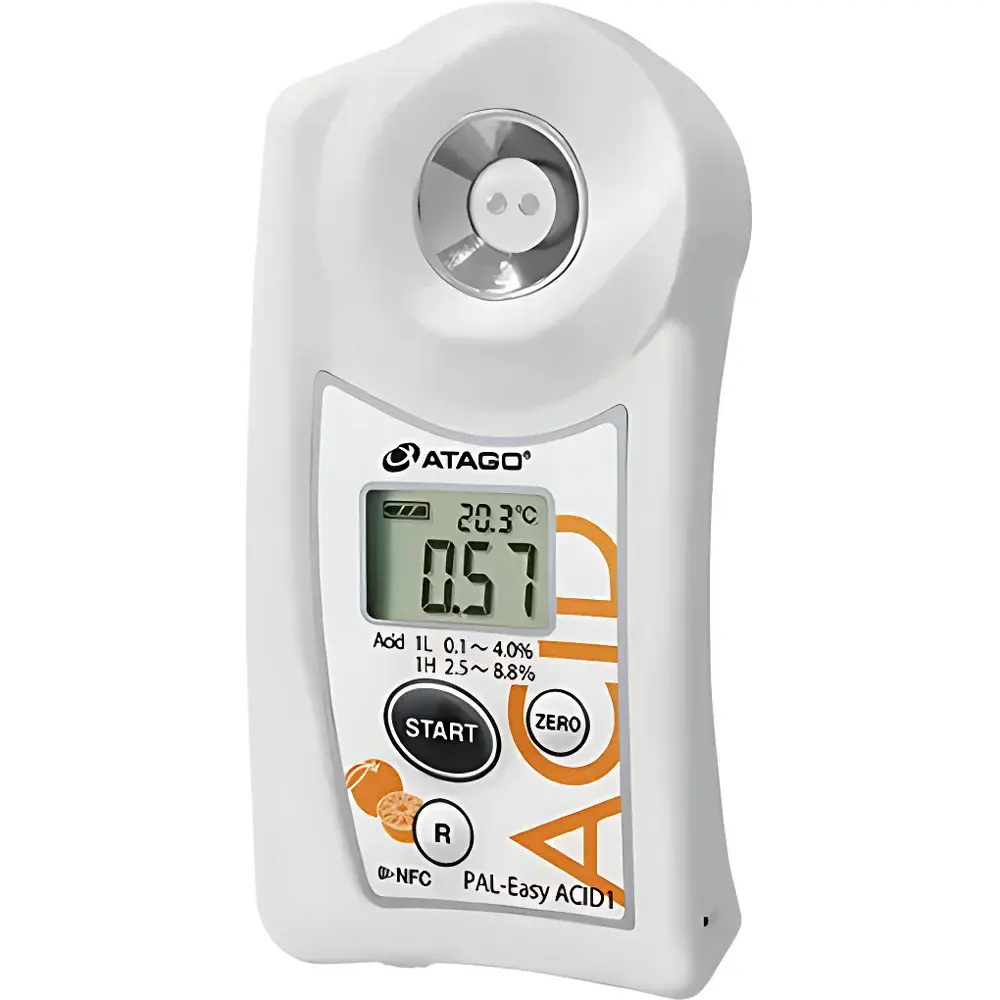
ATAGO PAL-Easy ACID1 Portable Citric Acid Meter
| Brand | ATAGO |
|---|---|
| Origin | Japan |
| Model | PAL-Easy ACID1 |
| Instrument Type | Portable |
| Parameter Type | Single-Parameter (Total Acidity as Citric Acid) |
| Measurement Range | 0.10–4.00% (Low-Acid Citrus), 2.50–8.80% (High-Acid Citrus) |
| Resolution | 0.01% (0.00–9.99%), 0.1% (≥10.0%) |
| Accuracy | ±0.10% (0.10–1.00%), ±10% relative (1.01–8.80%) |
| Temperature Compensation | 10–40°C (Automatic) |
| Protection Rating | IP65 |
| Dimensions | 5.5 × 3.1 × 10.9 cm |
| Weight | 100 g (instrument only) |
| Power | 2 × AAA alkaline batteries |
| Calibration Solution | RE-130004 |
Overview
The ATAGO PAL-Easy ACID1 is a handheld, temperature-compensated refractometric acid meter engineered for rapid, field-deployable quantification of total titratable acidity in fresh fruits, fruit juices, and related horticultural commodities. Unlike conventional pH meters or potentiometric titrators, the PAL-Easy ACID1 employs a calibrated optical refractive index–acidity correlation algorithm specifically developed for citrus matrices, enabling direct readout of total acidity expressed as citric acid mass percentage (w/w%). This correlation is empirically validated across representative juice extracts from oranges, lemons, limes, tangerines, and grapefruits — where citric acid constitutes >90% of the organic acid pool. The instrument operates on the principle that changes in dissolved solids concentration — particularly protonated organic acids — induce measurable shifts in solution refractive index under controlled thermal conditions. Built-in automatic temperature compensation (10–40°C) ensures measurement stability across ambient harvesting, processing, or laboratory environments without manual correction.
Key Features
- Optical refractometric sensing platform optimized for citric acid–dominant matrices, eliminating electrode drift, calibration frequency, and sample filtration requirements typical of electrochemical methods
- Dual-range measurement capability: high-resolution low-acid mode (0.10–4.00%) for mature citrus and juice blends; extended high-acid mode (2.50–8.80%) for unripe fruit, concentrated extracts, or sour varieties
- IP65-rated enclosure providing dust-tight and water-jet resistant operation — suitable for orchard-side use, packinghouse QC stations, and mobile sensory evaluation teams
- Compact form factor (5.5 × 3.1 × 10.9 cm, 100 g) with ergonomic single-hand operation and intuitive button interface — no external software or PC required for routine measurement
- Factory-calibrated using ATAGO’s certified reference standard RE-130004; user recalibration supported via dedicated calibration mode to maintain traceability in multi-shift or multi-user environments
- Auto-power-off after 3 minutes of inactivity; battery life exceeds 10,000 measurements per set of two AAA alkaline cells
Sample Compatibility & Compliance
The PAL-Easy ACID1 is validated for homogeneous liquid samples including freshly squeezed citrus juice (filtered through ≤100 µm mesh), clarified juice concentrates (diluted to 0.98) with standardized NaOH titration results when applied within its defined matrix scope. Device firmware and calibration documentation support audit readiness under GLP-aligned internal SOPs; however, it does not provide electronic audit trails or 21 CFR Part 11-compliant data logging.
Software & Data Management
The PAL-Easy ACID1 operates as a standalone instrument with no embedded memory or USB/Bluetooth connectivity. All measurements are displayed in real time on a high-contrast LCD screen with dual-unit readability (citric acid %, temperature in °C). No proprietary software, drivers, or cloud integration is required or supported. Users manually record results in paper-based logbooks or export to spreadsheets via transcription. For laboratories requiring digital data capture, ATAGO recommends pairing the device with external barcode-scanned sample ID systems or integrating readings into LIMS via manual entry protocols. Firmware updates are not field-upgradable; calibration verification and performance checks must be performed using RE-130004 at intervals defined by organizational QA procedures.
Applications
- On-tree maturity assessment in citrus groves: rapid determination of acid decline during ripening to optimize harvest windows
- In-line quality assurance in juice processing facilities: monitoring batch-to-batch acidity consistency prior to pasteurization and blending
- R&D screening of breeding lines: high-throughput phenotyping of acid accumulation traits across germplasm collections
- Academic teaching labs: demonstrating empirical correlations between optical properties and organic acid concentration in food chemistry curricula
- Export certification support: generating preliminary acidity data for phytosanitary or grade-standard documentation (e.g., USDA Grade Standards for Orange Juice)
FAQ
Does the PAL-Easy ACID1 measure pH?
No. It measures total acidity expressed as citric acid percentage via refractometry, not hydrogen ion activity. It is not interchangeable with pH meters.
Can it be used for grapes or apples?
It is calibrated for citric acid–dominant matrices. For grapes (tartaric acid–dominant) or apples (malic acid–dominant), readings will reflect citric acid–equivalent values and require empirical cross-validation against titration.
Is RE-130004 the only authorized calibration solution?
Yes. Use of alternative standards invalidates factory calibration and may compromise accuracy. RE-130004 is traceable to JCSS-certified reference materials.
What is the recommended cleaning procedure for the prism?
Wipe gently with lens tissue moistened with distilled water after each sample. Avoid alcohol, acetone, or abrasive cloths to preserve anti-reflective coating integrity.
How often should calibration be verified?
Before first use each day, after exposure to extreme temperature shifts (>5°C), and following any physical impact — per ISO/IEC 17025-aligned internal calibration management procedures.




