
ATAGO PAL-HIKARI 10 Non-Destructive Near-Infrared Refractometer for Peach Brix Measurement
| Brand | ATAGO |
|---|---|
| Origin | Japan |
| Model | PAL-HIKARI 10 (Peach-Specific) |
| Measurement Principle | Near-Infrared Absorption at ~940 nm |
| Measurement Range | Brix 8.0–20.0% |
| Temperature Range | 5.0–35.0°C |
| Brix Resolution | 0.1% |
| Temperature Resolution | 0.1°C |
| Brix Accuracy | ±1.5% (Brix), ±1.0°C (Temperature) |
| IP Rating | IP64 |
| Power | 2×AAA Alkaline Batteries |
| Dimensions | 6.1 × 4.4 × 11.5 cm |
| Weight | 120 g (main unit only) |
| Automatic Temperature Compensation | 5.0–35.0°C |
| Data Offset Correction Function | Yes |
| Sample Interface | Contact-type optical probe with integrated temperature sensor |
Overview
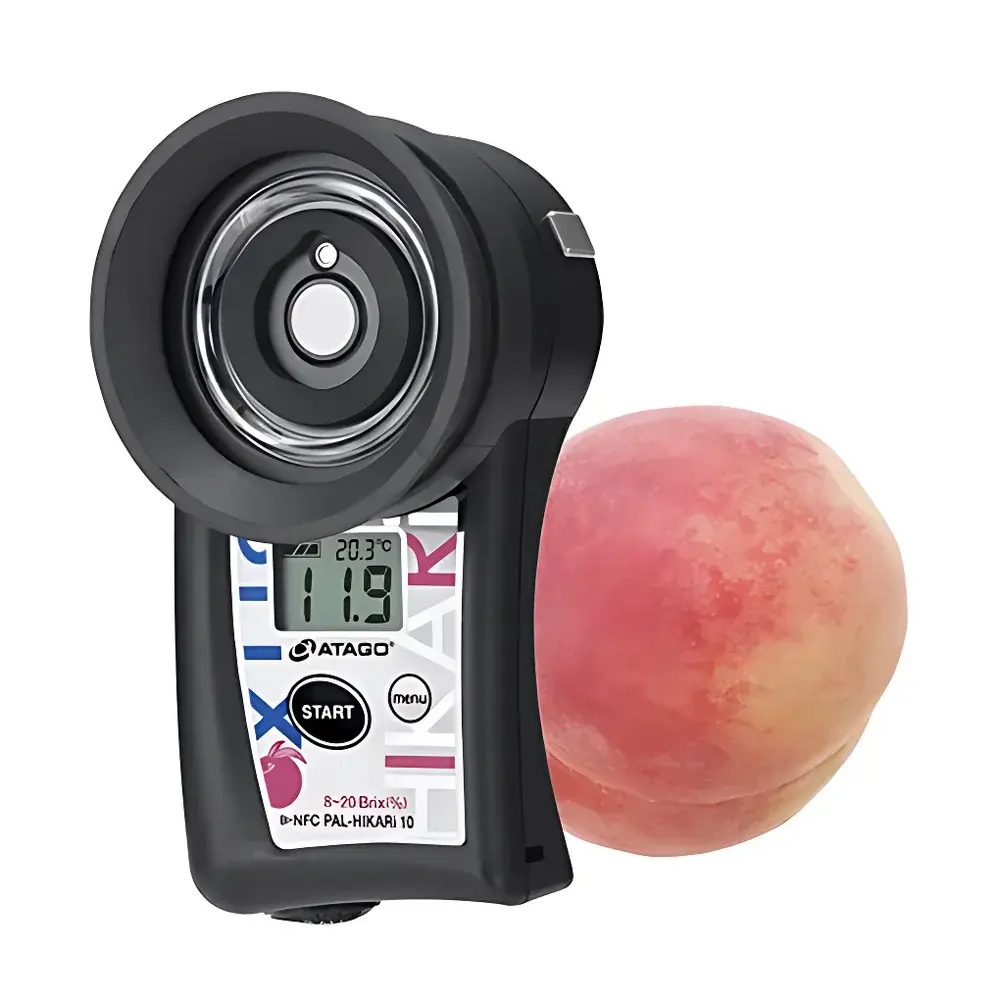
The ATAGO PAL-HIKARI 10 is a handheld, non-destructive near-infrared (NIR) refractometer engineered specifically for rapid, in-situ Brix measurement of intact peaches without sample preparation. Unlike conventional destructive refractometers requiring juice extraction, the PAL-HIKARI 10 employs calibrated NIR absorption spectroscopy centered at approximately 940 nm—a wavelength region sensitive to C–H and O–H vibrational overtones in sucrose, glucose, and fructose. The device integrates an optical contact probe with a built-in thermistor to enable real-time temperature compensation across the full operational range (5.0–35.0°C), ensuring consistent readings under variable field conditions. Designed for agricultural science, postharvest quality assurance, and supply chain traceability, it delivers repeatable Brix values in ≤3 seconds per measurement—enabling high-throughput individual-fruit assessment while preserving fruit integrity for subsequent ripening, storage, or sale.
Key Features
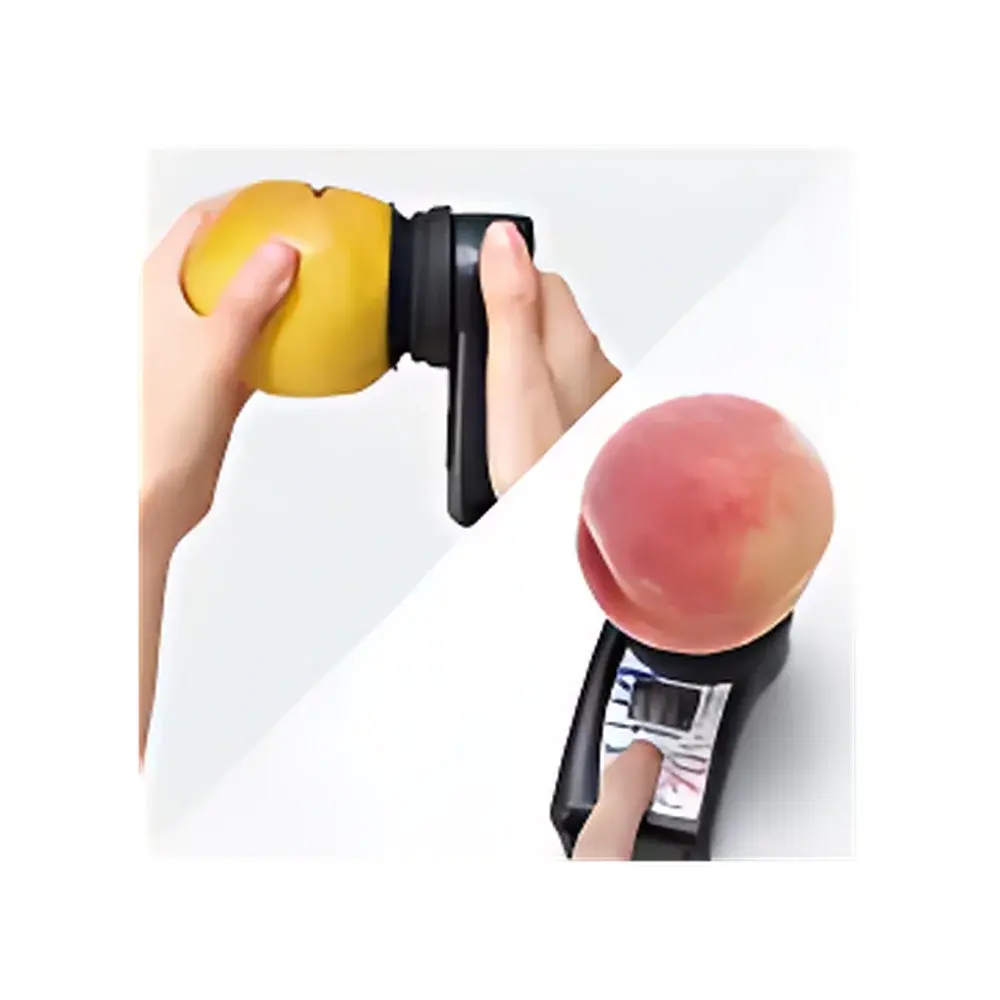
- Contact-based NIR sensing: No cutting, no juicing—measure directly on the intact peach skin surface with minimal pressure.
- Optimized optical path and spectral calibration for peach-specific tissue density, skin thickness, and water-sugar matrix interference.
- Integrated dual-sensor architecture: Simultaneous Brix and surface temperature acquisition with automatic compensation (5.0–35.0°C).
- On-device data offset correction: Allows user-defined calibration adjustment to align with laboratory reference methods (e.g., digital benchtop refractometer or HPLC-derived soluble solids content).
- Rugged, portable form factor: IP64-rated enclosure resists dust ingress and incidental water splashes; lightweight (120 g) and ergonomically shaped for extended field use.
- Low-power operation: Powered by two standard AAA alkaline batteries with typical service life exceeding 10,000 measurements per set.
- Real-time averaging function: Supports up to 10 consecutive measurements per fruit, automatically computing mean Brix and standard deviation for statistical confidence.
Sample Compatibility & Compliance
The PAL-HIKARI 10 is validated exclusively for mature, commercially grown peach cultivars (Prunus persica), including but not limited to ‘O’Henry’, ‘Red Haven’, ‘Flordaking’, and ‘UFO’. It is not intended for use on immature fruit, nectarines, plums, or other drupes without revalidation. Measurements assume uniform skin contact, absence of surface moisture or wax residues, and ambient acclimation of fruit to measurement environment for ≥15 minutes prior to testing. While not certified to ISO/IEC 17025 or ASTM D7725 (Standard Test Method for Determination of Soluble Solids in Fruits and Vegetables Using Digital Handheld Refractometers), the instrument adheres to ATAGO’s internal metrological control protocols aligned with JIS Z 8015 and ISO 2173 for refractometric sugar analysis. Its design supports GLP-aligned documentation workflows when paired with external logging systems.
Software & Data Management
The PAL-HIKARI 10 operates as a standalone instrument with no onboard memory or wireless connectivity. All measurement data remain local to the LCD display and are not stored internally. For traceability, users are advised to record results manually or integrate with third-party field data capture platforms (e.g., FarmLogs, AgriWebb) via manual entry. The offset correction function enables alignment with laboratory-grade reference values derived from AOAC 932.12 or USP compliant benchtop refractometers, supporting method equivalence verification during QA/QC audits. Though lacking FDA 21 CFR Part 11-compliant electronic signatures or audit trails, its simplicity and deterministic output support paper-based GMP-compliant recordkeeping in packinghouse and nursery settings.
Applications
- Orchard maturity monitoring: Enables pre-harvest Brix mapping across tree rows to determine optimal harvest windows and reduce postharvest losses.
- Postharvest grading & sorting: Facilitates real-time lot-level quality screening at packhouses, supporting automated pricing tiers based on Brix stratification (e.g., ≥14.0%, 12.0–13.9%, <12.0%).
- Plant breeding programs: Provides rapid phenotypic screening of sugar accumulation kinetics across peach germplasm collections under controlled or field trials.
- Import/export inspection: Used by phytosanitary and quality assurance officers at border facilities for rapid compliance checks against contractual Brix specifications (e.g., U.S. Grade A requires minimum 10.0% Brix for clingstone peaches).
- Culinary R&D: Assists pastry chefs and food product developers in selecting fruit batches with target sweetness profiles for preserves, coulis, and dessert formulations.
FAQ
Can the PAL-HIKARI 10 be used on fruits other than peaches?
No—its optical calibration, probe geometry, and temperature compensation algorithm are optimized exclusively for peach tissue optical properties. Use on apples, pears, or citrus may yield non-representative or biased Brix values.
Does the device require periodic recalibration by the user?
No field recalibration is supported. ATAGO recommends annual verification against NIST-traceable sucrose standards (e.g., 10.00% and 15.00% w/w solutions at 20°C) using a certified laboratory refractometer.
How does surface condensation or fruit wax affect measurement accuracy?
Moisture films or commercial wax coatings attenuate NIR signal transmission and must be removed prior to measurement. Wipe fruit surface gently with a lint-free cloth before placing on the probe.
Is the PAL-HIKARI 10 suitable for cold-chain environments below 5°C?
Operation below 5.0°C is outside the specified temperature compensation range and may result in thermal drift and reduced repeatability. Allow fruit and instrument to equilibrate within 5.0–35.0°C prior to use.
What is the expected lifetime of the NIR LED source?
The 940 nm NIR emitter is rated for ≥50,000 measurement cycles under normal operating conditions, with no field-replaceable optical components.



