
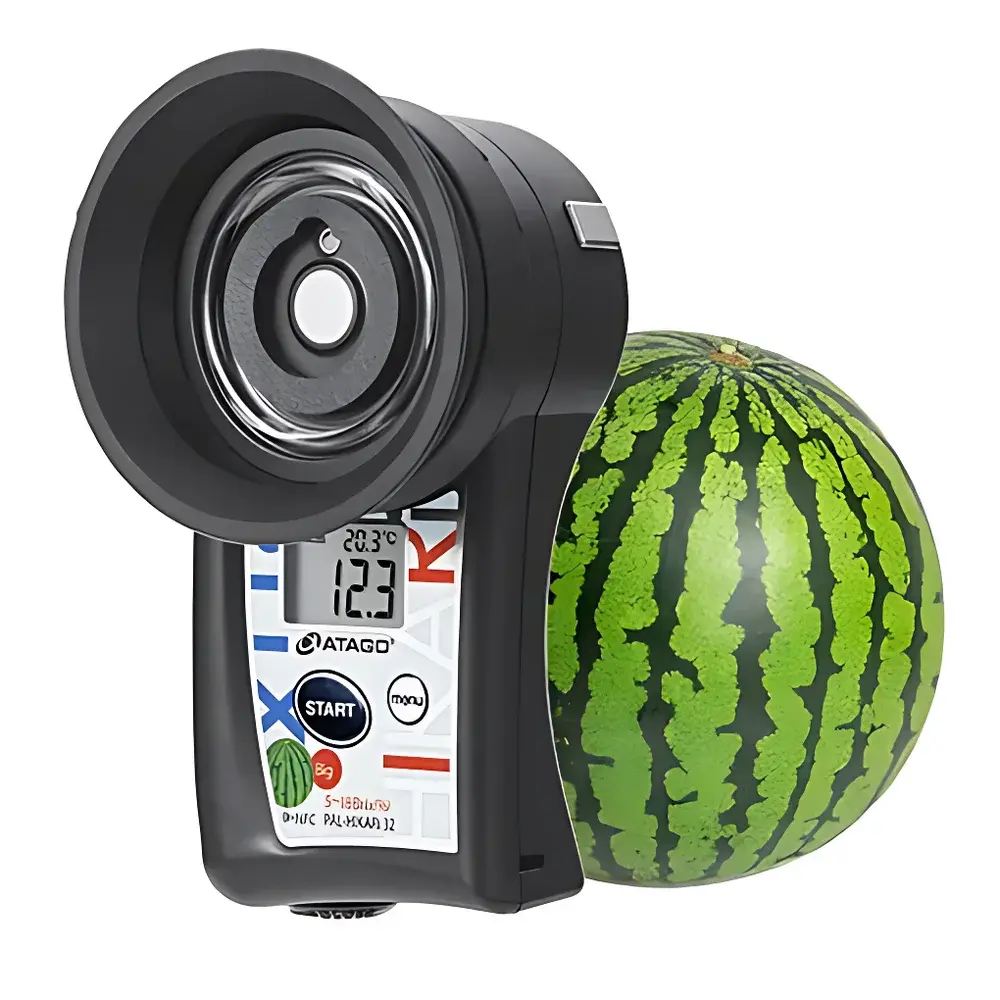
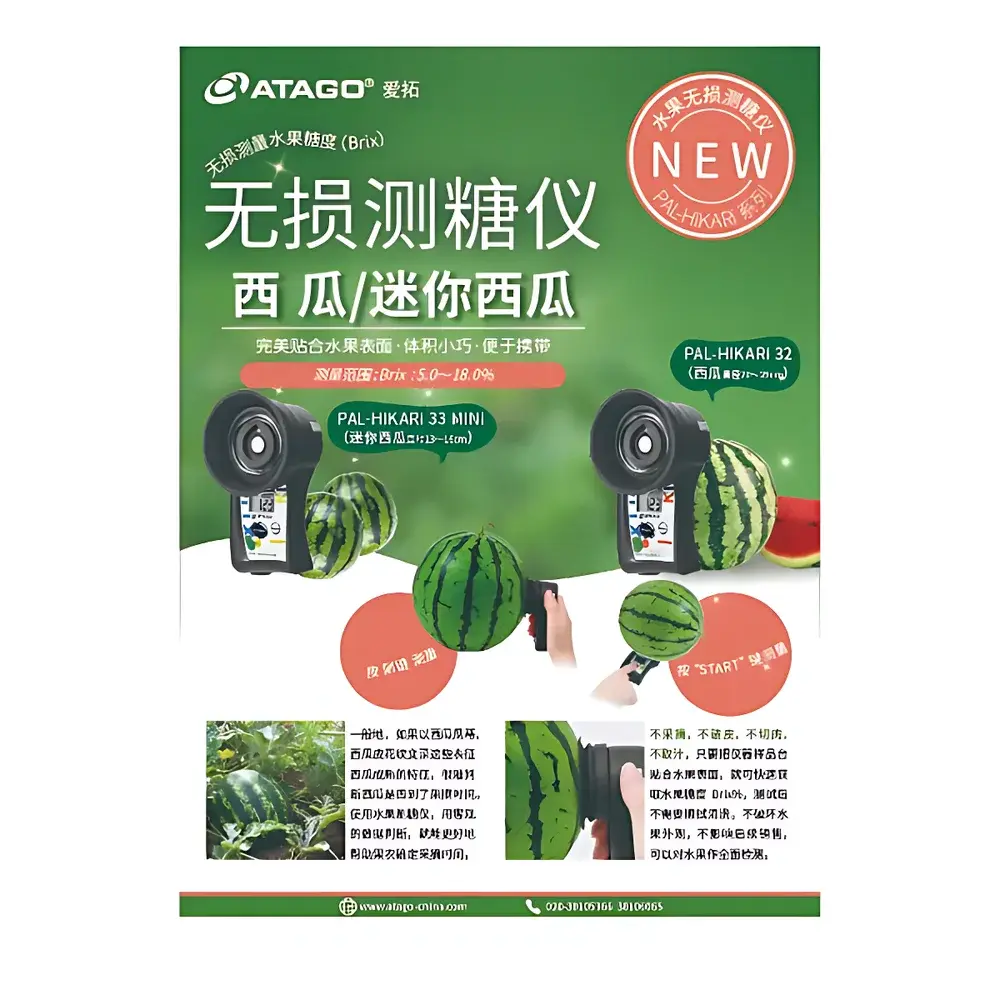
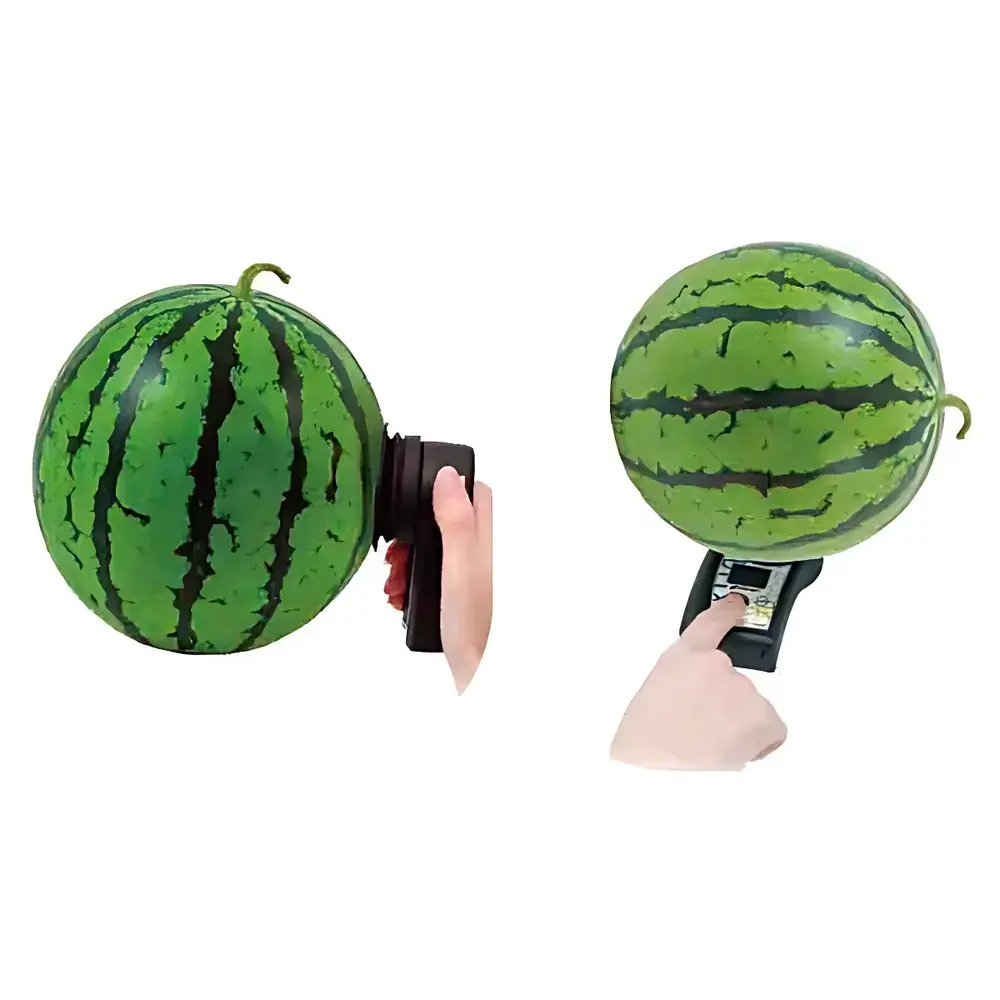
ATAGO PAL-HIKARi 32 Non-Destructive Watermelon Brix Meter
| Brand | ATAGO |
|---|---|
| Origin | Japan |
| Model | PAL-HIKARi 32 |
| Instrument Type | Non-Destructive |
| Application-Specific Design | Watermelon (Diameter 20–25 cm) |
| Measurement Range | 5.0–18.0% Brix |
| Accuracy | ±2.0% Brix (varies by cultivar and ambient conditions) |
| Resolution | 0.1% Brix |
| Automatic Temperature Compensation | 10.0–40.0°C |
| IP Rating | IP64 |
| Power | Two AAA alkaline batteries |
| Dimensions | 6.1 × 4.4 × 11.5 cm |
| Weight | 120 g (instrument only) |
Overview
The ATAGO PAL-HIKARi 32 is a handheld, non-destructive Brix meter engineered specifically for in-field and post-harvest assessment of watermelon maturity and quality. Unlike conventional refractometers requiring juice extraction or destructive sampling, the PAL-HIKARi 32 employs near-infrared (NIR) reflectance spectroscopy to estimate soluble solids content (SSC) — reported as degrees Brix — directly through intact rind. The instrument emits NIR light (typically in the 700–1100 nm range) onto the fruit surface; internal scattering and absorption characteristics—correlated with sugar concentration—modulate the spectral signature of the reflected signal. A calibrated algorithm translates this optical response into a quantitative Brix value, enabling rapid, repeatable, and statistically meaningful measurements without compromising fruit integrity, marketability, or storage stability.
Key Features
- True non-destructive operation: Measures Brix on intact watermelons (20–25 cm diameter) without cutting, puncturing, or juicing—preserving sample viability for ripening studies, shelf-life trials, or commercial sale.
- Fruit-optimized optical interface: Features a proprietary soft silicone gasket that conforms to curved rind surfaces, minimizing ambient light ingress and ensuring consistent probe-to-skin contact—critical for reproducibility across variable field conditions.
- On-device temperature compensation: Automatically corrects for sample temperature drift within 10.0–40.0°C, reducing systematic error from thermal variation during orchard or greenhouse deployment.
- Field-rugged design: IP64-rated enclosure resists dust ingress and incidental water splashing; compact form factor (6.1 × 4.4 × 11.5 cm) and 120 g mass enable single-hand operation—even on elevated vines or in humid packing houses.
- High-throughput measurement: Delivers stable Brix readings in ≤3 seconds per measurement; supports sequential acquisition and on-unit averaging across up to 10 consecutive readings to improve statistical confidence.
Sample Compatibility & Compliance
The PAL-HIKARi 32 is validated exclusively for watermelon (Citrullus lanatus) with typical diameters of 20–25 cm and standard rind thicknesses (0.8–1.5 cm). Its calibration model accounts for common cultivar-specific optical properties—including rind color, surface wax content, and internal density gradients—but does not extend to other melon species (e.g., cantaloupe, honeydew) or non-melon fruits without revalidation. While not certified to ISO/IEC 17025 or ASTM D7932 (Standard Test Method for Determination of Soluble Solids in Fruits Using Portable Refractometers), the instrument meets general requirements for field-grade quality assurance under Good Agricultural Practice (GAP) and Good Distribution Practice (GDP) frameworks. Its non-invasive methodology aligns with USDA Organic and GlobalG.A.P. guidelines prohibiting destructive sampling during pre-harvest monitoring.
Software & Data Management
The PAL-HIKARi 32 operates as a standalone, embedded-system device with no Bluetooth, USB, or cloud connectivity. All data remain local to the unit: users may view real-time values on the LCD display and manually record results in external logbooks or LIMS-compatible spreadsheets. Though it lacks FDA 21 CFR Part 11-compliant audit trails or electronic signature capability, its deterministic measurement logic, fixed firmware, and absence of user-modifiable calibration parameters support traceable manual documentation workflows required for internal QC audits and third-party certification reviews (e.g., BRCGS, IFS Fresh Produce). For laboratories requiring digital data capture, ATAGO recommends pairing the PAL-HIKARi 32 with validated external data loggers or mobile apps compliant with GLP documentation standards.
Applications
- Pre-harvest maturity scheduling: Enables repeated longitudinal Brix tracking on individual fruits across growth stages—supporting data-driven harvest window determination and minimizing premature or overripe picking.
- Post-harvest grading and sorting: Facilitates rapid lot-level assessment for retail-tier classification (e.g., premium vs. commodity grades) based on objective SSC thresholds.
- Storage and transport optimization: Monitors Brix stability during cold chain logistics to identify early signs of fermentation, chilling injury, or dehydration-related sugar concentration shifts.
- Varietal development and rootstock evaluation: Provides high-sample-number phenotyping data for breeding programs assessing sugar accumulation kinetics under controlled irrigation or nutrient regimes.
- Quality assurance in wholesale distribution: Verifies contractual SSC specifications at receiving docks without delaying throughput or inducing physical damage.
FAQ
Can the PAL-HIKARi 32 be used on fruits other than watermelon?
No. Its optical calibration and mechanical interface are optimized exclusively for watermelon rind morphology and spectral response. Cross-application to other fruits requires independent validation and is not supported by ATAGO.
Does the instrument require periodic recalibration by the user?
No. The PAL-HIKARi 32 uses factory-set, non-user-adjustable calibration. ATAGO recommends annual verification against NIST-traceable sucrose reference standards in accredited service centers.
How does ambient lighting affect measurement accuracy?
The integrated gasket and recessed sensor geometry minimize stray-light interference. However, direct sunlight exposure on the measurement site should be avoided; shaded or indoor conditions yield optimal repeatability.
Is the device suitable for use in high-humidity environments such as greenhouses?
Yes. The IP64 rating ensures reliable operation at relative humidity levels up to 95% non-condensing, provided the optical window remains free of condensation or debris.
What is the expected battery life under typical field use?
With two fresh AAA alkaline cells, the instrument supports approximately 10,000 measurements before replacement—equivalent to ~6 months of daily use in a mid-sized orchard operation.



