
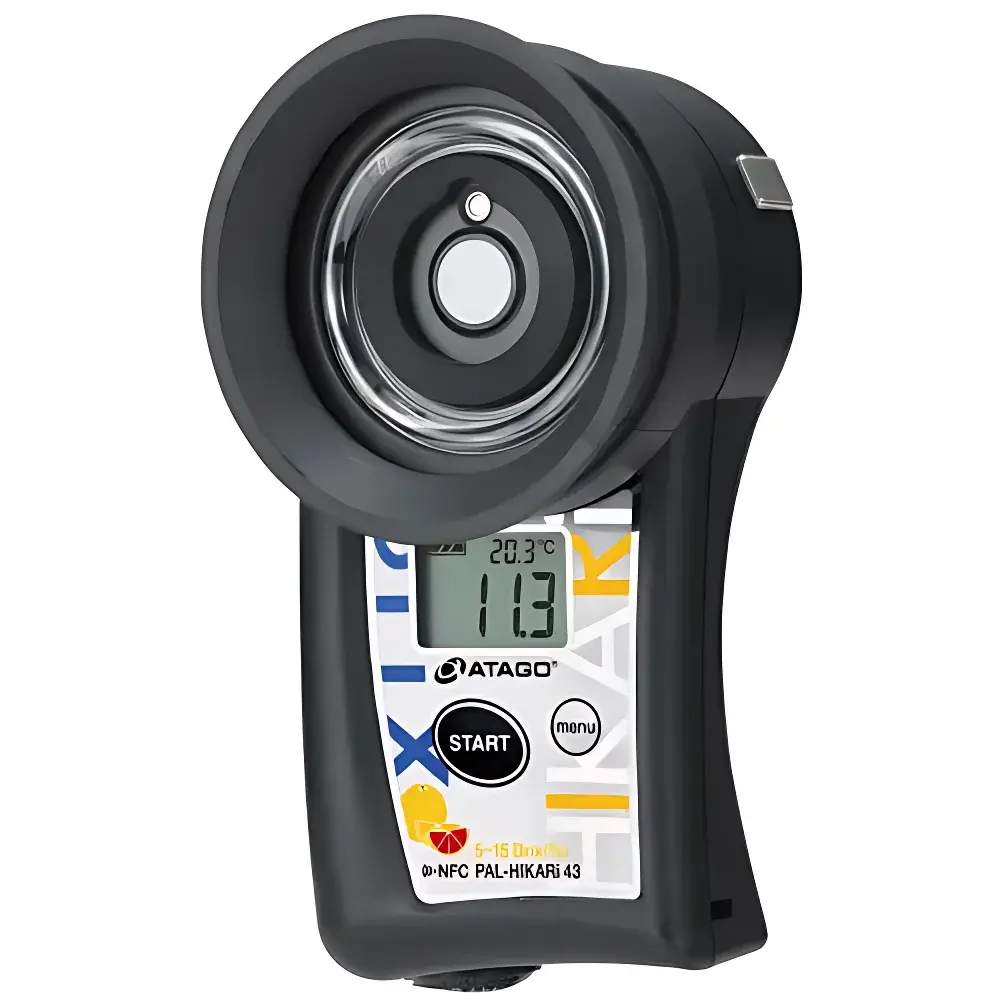
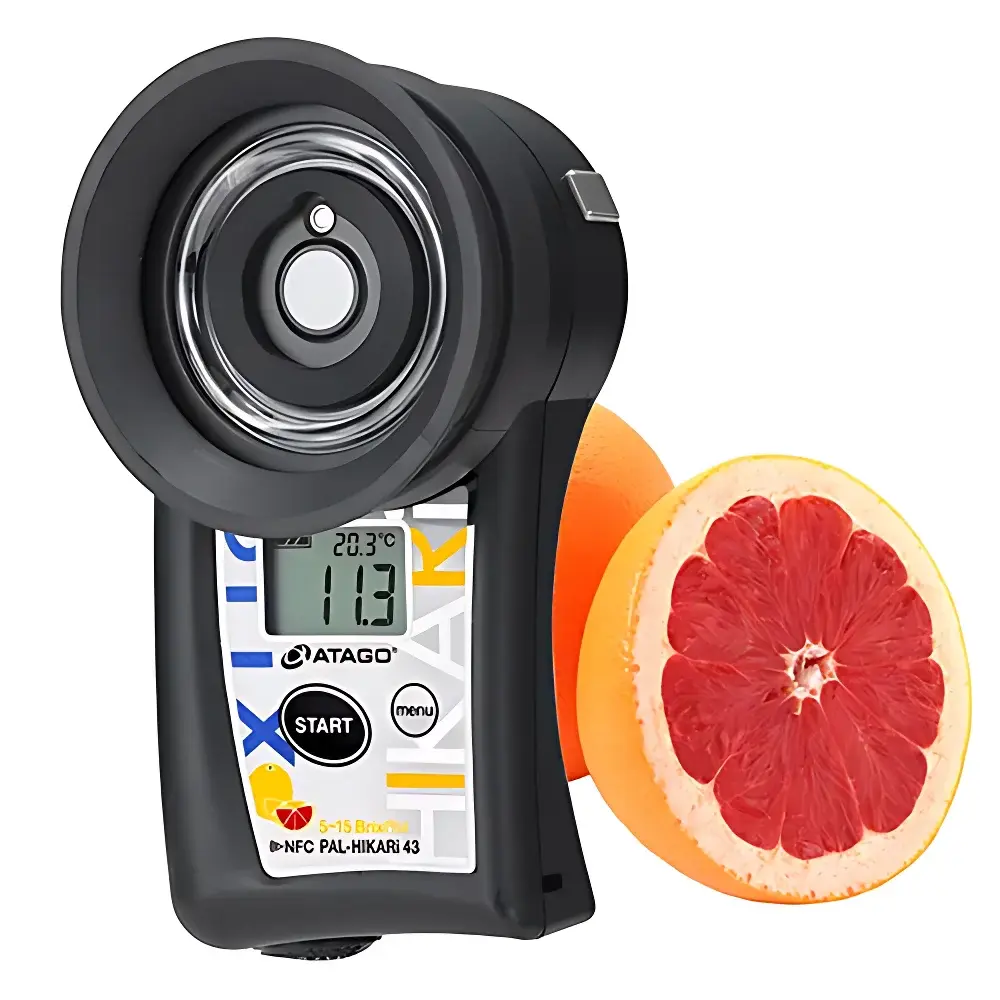
ATAGO PAL-HIKARi 43 Non-Destructive Citrus Fruit Refractometer for Grapefruit
| Brand | ATAGO |
|---|---|
| Origin | Japan |
| Model | PAL-HIKARi 43 (Grapefruit-Specific) |
| Measurement Principle | Near-Infrared (NIR) Transmittance Spectroscopy |
| Instrument Type | Non-Destructive Saccharimeter |
| Measurement Range | 5.0–15.0 °Brix |
| Accuracy | ±2.0 °Brix (species- and environment-dependent) |
| Resolution | 0.1 °Brix |
| Automatic Temperature Compensation | 10.0–35.0 °C |
| IP Rating | IP64 |
| Power Supply | Two AAA Alkaline Batteries |
| Dimensions (L×W×H) | 6.1 × 4.4 × 11.5 cm |
| Weight | 120 g (instrument only) |
Overview
The ATAGO PAL-HIKARi 43 is a handheld, non-destructive refractometer engineered specifically for in-situ Brix measurement of intact grapefruit (Citrus paradisi) on the tree or post-harvest without mechanical penetration, skin incision, or juice extraction. Unlike conventional destructive refractometers that require juice expression and optical cell filling, the PAL-HIKARi 43 employs near-infrared (NIR) transmittance spectroscopy at optimized wavelengths to quantify soluble solids concentration through the fruit rind. Its optical architecture is calibrated exclusively for grapefruit’s characteristic peel thickness, density, and spectral absorption profile—ensuring higher measurement consistency across heterogeneous orchard conditions compared to generic NIR fruit meters. Designed for field-deployable quality assurance, it supports pre-harvest maturity assessment, harvest scheduling, and post-harvest lot segregation—enabling traceability-driven supply chain decisions aligned with commercial Brix specifications (e.g., USDA Grade A grapefruit ≥9.0 °Brix).
Key Features
- Grapefruit-specific optical calibration validated across multiple cultivars including Ruby Red, Marsh, and Star Ruby under varying canopy microclimates.
- Non-contact NIR transmittance measurement: no surface preparation, no calibration fluid, no sample degradation—preserves fruit integrity for continued ripening or market sale.
- Integrated temperature sensor with automatic compensation (10.0–35.0 °C), minimizing thermal drift during diurnal field use.
- Ruggedized housing rated IP64—dust-tight and resistant to water splashes from any direction—suitable for humid grove environments and wash-down handling.
- Low-power operation using two standard AAA alkaline batteries; typical battery life exceeds 5,000 measurements per set under ambient conditions.
- Ergonomic form factor (6.1 × 4.4 × 11.5 cm, 120 g) designed for one-handed operation and extended field surveys without operator fatigue.
Sample Compatibility & Compliance
The PAL-HIKARi 43 is validated exclusively for intact, mature grapefruit with intact, unblemished rind and no surface moisture. It is not suitable for other citrus species (e.g., oranges, lemons) or damaged, overripe, or frost-affected fruit due to altered NIR scattering properties. While not certified to ISO 21527 or AOAC Official Method 932.12 (which pertain to destructive juice-based refractometry), its measurement protocol aligns with Good Agricultural Practice (GAP) documentation requirements for pre-harvest quality monitoring. Data outputs meet baseline traceability standards for internal quality management systems (QMS); however, for regulatory submissions (e.g., FDA import alerts, EU MRL compliance), confirmatory destructive testing remains mandatory per 21 CFR §110.80(a)(3) and Codex Alimentarius CAC/GL 20-1995.
Software & Data Management
The PAL-HIKARi 43 operates as a standalone instrument with no embedded memory or Bluetooth/Wi-Fi connectivity. All measurements are displayed in real time on a high-contrast LCD screen with backlighting. For data aggregation, users manually record readings into external digital logs (e.g., Excel, LIMS, or farm management software). While ATAGO does not provide proprietary PC software for this model, the device’s consistent output format (°Brix ±0.1 resolution, timestamped via external logging) supports integration into GLP-compliant audit trails when paired with validated electronic notebooks or CSV-import workflows. No firmware updates or calibration certificate revalidation are required during normal service life—calibration is factory-sealed and traceable to NIST-traceable sucrose reference standards.
Applications
- Pre-harvest maturity mapping: systematic scanning of orchard blocks to identify optimal harvest windows based on spatial Brix gradients.
- Post-harvest quality sorting: rapid screening of incoming lots to segregate fruit by sweetness tier prior to packing or cold storage.
- Varietal performance evaluation: longitudinal tracking of Brix accumulation kinetics across rootstock/scion combinations in breeding trials.
- Supply chain transparency: generating field-level Brix reports for retailer-facing quality dashboards or sustainability certifications (e.g., GlobalG.A.P. Section 4.3.2).
- Research applications: non-invasive phenotyping of sugar metabolism under drought or nutrient stress treatments—minimizing experimental artifact from sampling bias.
FAQ
Can the PAL-HIKARi 43 be used on fruits other than grapefruit?
No. Its optical calibration is strictly limited to grapefruit (Citrus paradisi). Using it on oranges, pomelos, or other citrus will yield inaccurate and non-reproducible results due to differences in rind structure and NIR absorption spectra.
Does the instrument require periodic recalibration?
No. The unit is factory-calibrated against NIST-traceable sucrose solutions and sealed against user adjustment. Recalibration is neither supported nor recommended under standard operating conditions.
How does ambient light affect measurement accuracy?
The PAL-HIKARi 43 uses modulated NIR emission and synchronous detection, rendering it insensitive to ambient visible or UV light. Measurements remain stable under full sun, shade, or artificial grow lights.
Is the device compliant with FDA 21 CFR Part 11 for electronic records?
Not directly—the device lacks audit trail, electronic signature, or secure data export capabilities. To meet Part 11 requirements, integrate readings into a validated third-party system with appropriate controls.
What is the minimum fruit size for reliable measurement?
Fruit must have a minimum equatorial diameter of 85 mm and rind thickness ≥3.5 mm. Smaller or thinner-rinded specimens fall outside the validated operating range and may produce outliers.




