
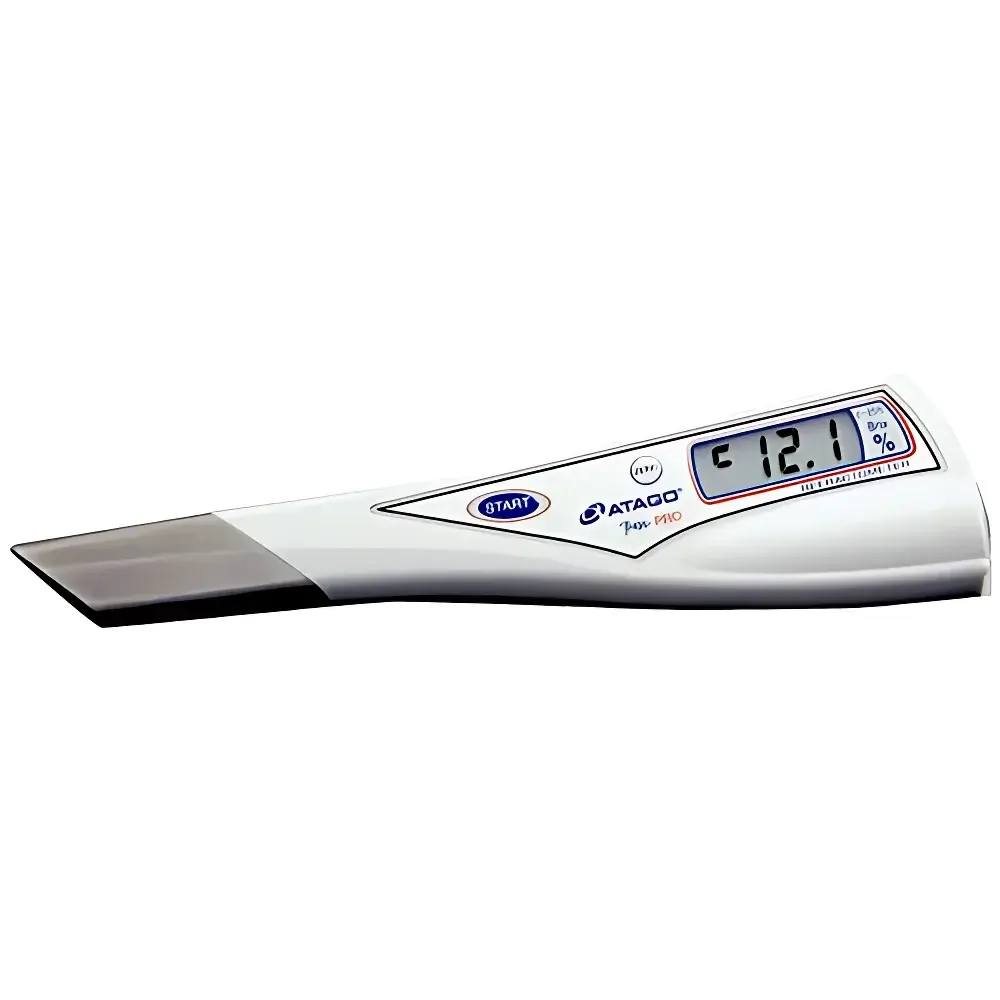
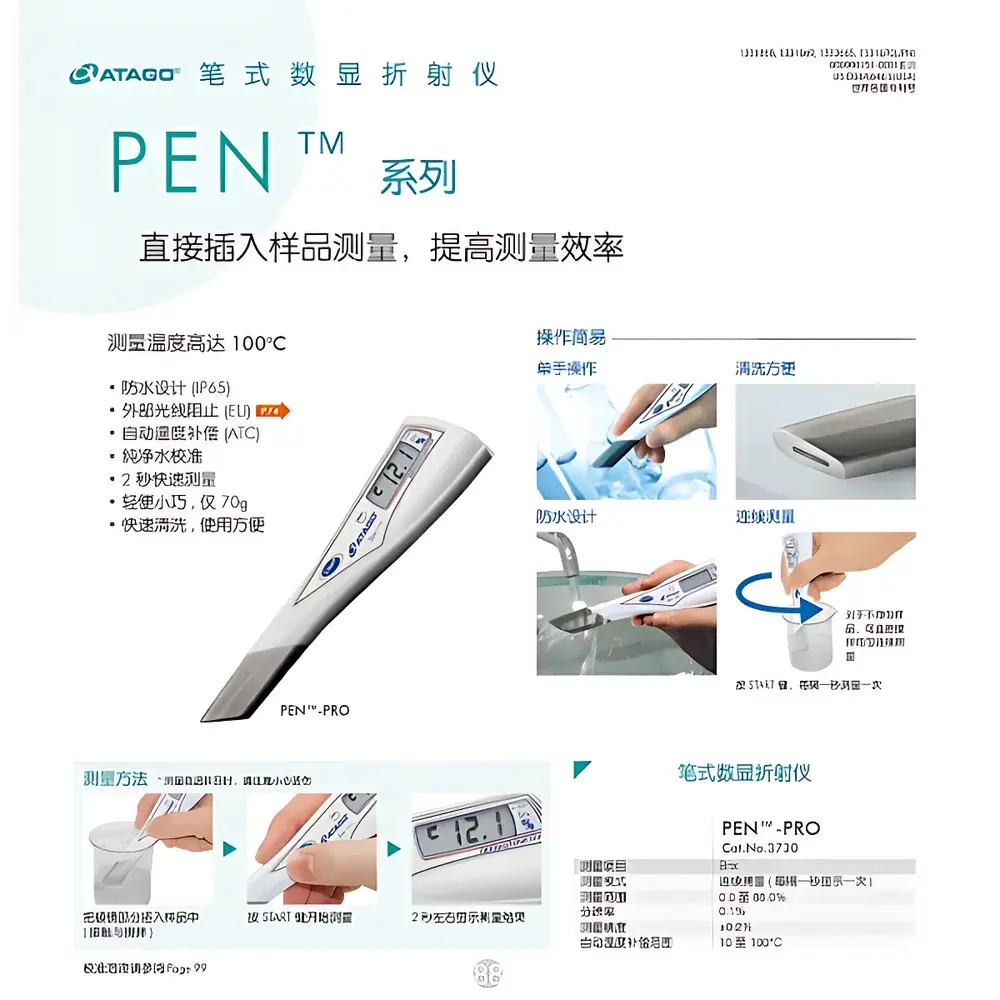
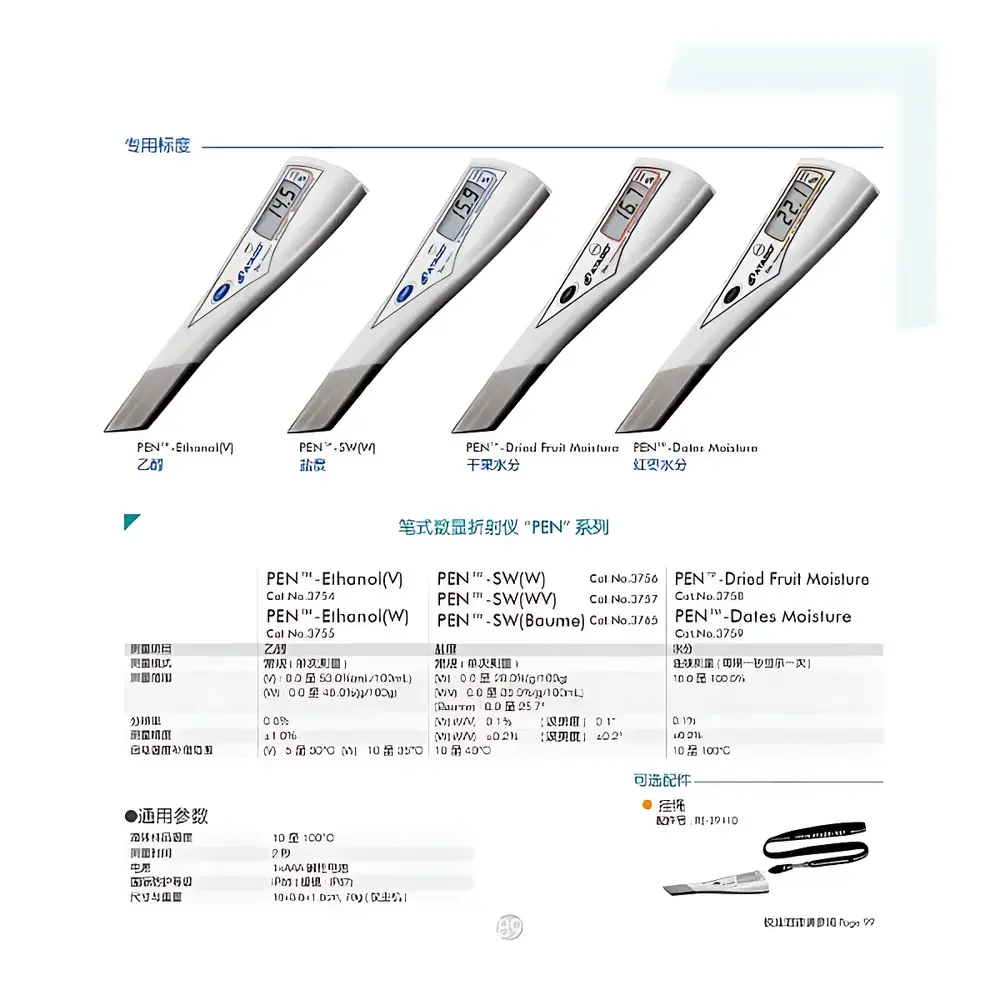
ATAGO PEN-PRO Digital Pocket Refractometer
| Brand | ATAGO |
|---|---|
| Origin | Japan |
| Model | PEN-PRO |
| Product Type | Handheld Digital Refractometer |
| Temperature Compensation | Yes |
| Display | Digital LCD with EL backlight |
| Measurement Range | 0.0–85.0% Brix |
| Accuracy | ±0.2% Brix |
| Resolution | 0.1% Brix |
| Sample Volume | 0.3 mL |
| Measurement Time | ~2 seconds |
| Operating Temperature Range | 10–100 °C |
| IP Rating | IP65 (instrument), IP67 (prism chamber) |
| Power Source | 1× AAA alkaline battery |
Overview
The ATAGO PEN-PRO Digital Pocket Refractometer is a compact, precision-engineered handheld instrument designed for rapid, field-deployable measurement of refractive index–derived concentration values—primarily expressed as % Brix—in aqueous and semi-aqueous solutions. It operates on the fundamental optical principle of total internal reflection at the prism–sample interface: incident light undergoes critical angle shift proportional to the sample’s refractive index, which correlates directly with solute concentration under controlled temperature conditions. Engineered for robustness and repeatability in non-laboratory environments, the PEN-PRO integrates automatic temperature compensation (ATC) across 10–100 °C using an embedded thermistor, eliminating manual correction and ensuring metrological consistency regardless of ambient thermal drift. Its optical path is sealed and calibrated against NIST-traceable sucrose standards, supporting traceable, GLP-compliant routine analysis without requiring recalibration between measurements.
Key Features
- True pocket-sized form factor (148 × 38 × 38 mm) with ergonomic rubberized grip for one-handed operation in production lines, orchards, or QC checkpoints.
- Electroluminescent (EL) backlight display ensures legibility under direct sunlight, low-light warehouses, or outdoor harvesting conditions—no reliance on ambient illumination.
- IP65-rated housing and IP67-sealed prism chamber enable resistance to dust ingress and temporary submersion during cleaning; sample residue can be rinsed under running water without disassembly.
- Low sample volume requirement (0.3 mL) minimizes waste—critical when testing high-value extracts, pharmaceutical intermediates, or limited biological fluids.
- Dual measurement modes: “Dip-and-Read” (insert prism, then press START) or “Pre-Start” (press START first, then immerse)—optimized for viscous or foaming samples where surface tension may delay equilibration.
- Auto-power-off after 3 minutes of inactivity extends battery life; typical operational lifetime exceeds 10,000 measurements per AAA cell.
Sample Compatibility & Compliance
The PEN-PRO is validated for use with transparent to mildly turbid liquid-phase samples exhibiting refractive indices within the 1.330–1.490 range—covering fruit juices, soft drinks, syrups, coolants, antifreeze glycol solutions, cutting fluids, detergent concentrates, and brine-based preservatives. It is not intended for strongly absorbing, highly viscous (>500 mPa·s), or particulate-laden suspensions without prior filtration. While not certified to ISO/IEC 17025 for accredited calibration, its factory calibration adheres to ATAGO’s internal quality system aligned with ISO 9001 and supports compliance with ASTM D1218 (Standard Test Method for Refractive Index of Hydrocarbon Liquids) and AOAC Official Methods 932.12 and 936.02 for Brix determination in food matrices. The device meets CE marking requirements for electromagnetic compatibility (EMC Directive 2014/30/EU) and RoHS 2011/65/EU restrictions on hazardous substances.
Software & Data Management
The PEN-PRO operates as a standalone, firmware-controlled instrument with no onboard data logging or USB connectivity. All measurement results are displayed in real time and retained only visually—consistent with its design intent as a rapid pass/fail or trending tool rather than a regulated data acquisition system. For laboratories requiring audit trails, users integrate the PEN-PRO into documented workflows by manually recording readings in paper logbooks or electronic systems compliant with FDA 21 CFR Part 11 (when paired with validated SOPs and reviewer sign-offs). ATAGO provides optional traceable calibration certificates (NIST-traceable sucrose standards) upon request, supporting GMP/GLP documentation requirements for instrument qualification (IQ/OQ).
Applications
- Food & Beverage: Monitoring Brix in orange juice concentrate, maple syrup, wine must, dairy whey, and sports drink formulations pre-bottling.
- Industrial Fluids: Verifying glycol concentration in HVAC chillers, ethylene glycol/water ratios in automotive antifreeze, and triethanolamine content in metalworking emulsions.
- Agriculture: Field assessment of fruit ripeness (e.g., mango, grape, tomato) via soluble solids content correlated to harvest timing decisions.
- Chemical Manufacturing: Quick-checking active ingredient concentration in cleaning agent batches or pH-adjusted rinse solutions prior to release.
- Education & Training: Demonstrating colligative properties and refractive index–concentration relationships in undergraduate physical chemistry labs.
FAQ
Does the PEN-PRO require periodic recalibration?
No—factory calibration is stable under normal handling. However, verification using ATAGO-certified 0% and 30% Brix reference solutions is recommended before each shift or daily in regulated environments.
Can it measure non-sucrose solutions like sodium chloride or ethanol?
It displays % Brix by default; for non-sugar solutes, users must apply conversion factors or refer to ATAGO’s application-specific calibration tables (e.g., NaCl % w/w or ethylene glycol % v/v).
Is the prism surface scratch-resistant?
Yes—the sapphire-coated glass prism resists abrasion from routine cleaning with soft tissue and distilled water; avoid abrasive cloths or organic solvents.
What is the minimum measurable sample temperature?
10 °C—below this, viscosity increases may cause incomplete prism coverage and erroneous readings; pre-warm chilled samples to ≥10 °C before measurement.
How does ATC affect measurement uncertainty?
ATC reduces thermal error to <±0.05% Brix per °C deviation from 20 °C baseline, contributing to the overall ±0.2% Brix accuracy specification across the full 10–100 °C operating range.




