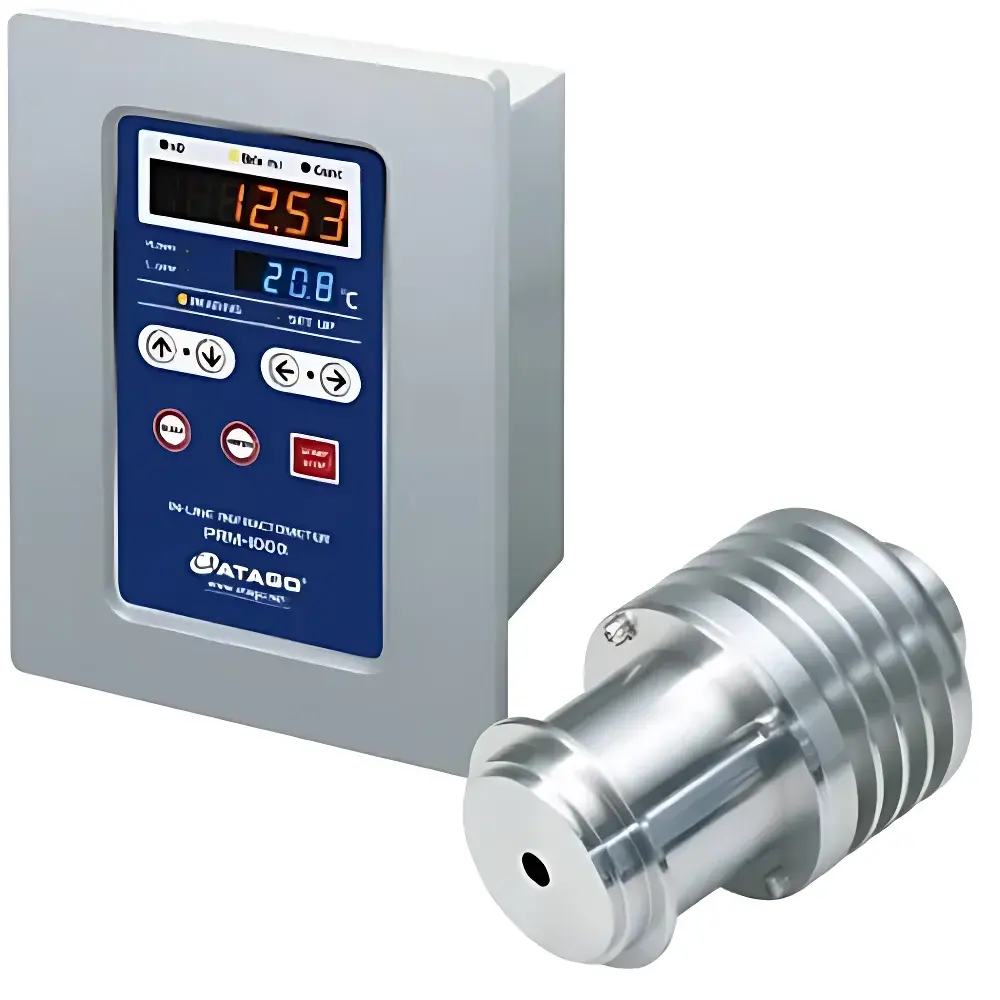
ATAGO PRM-100α DX High-Precision Online Refractometer
| Brand | ATAGO |
|---|---|
| Origin | Japan |
| Model | PRM-100α DX |
| Measurement Range | nD 1.32000–1.55700, Brix 0.00–100.00% |
| Resolution | nD 0.0001 / 0.00001, Brix 0.1% / 0.01% |
| Accuracy | ±0.00010 (nD), ±0.05% (Brix) |
| Operating Temperature | 5–100°C |
| Output | RS-232C, 4–20 mA |
| IP Rating | IP67 |
| Power Supply | AC 100–240 V, 50/60 Hz |
| Display Unit Dimensions | 19.2 × 10 × 24 cm, 3.3 kg |
| Sensor Unit Dimensions | 10.8 × 17.26 × 10.8 cm, 2.6 kg |
Overview
The ATAGO PRM-100α DX is a high-precision online refractometer engineered for continuous, real-time measurement of liquid concentration in industrial process streams. It operates on the principle of critical-angle refractometry—a non-invasive optical method that determines the refractive index (nD) of a process fluid by analyzing the angle at which light undergoes total internal reflection at the sensor prism–liquid interface. This fundamental physical property correlates directly with solute concentration (e.g., sucrose, NaCl, ethanol, glycols, acids, alkalis) across a wide compositional range. Unlike offline sampling or titration-based methods, the PRM-100α DX delivers stable, drift-free readings without consumables, moving parts, or reagent dependency—making it ideal for integration into closed-loop control systems in hygienic and hazardous environments.
Key Features
- High-resolution optical detection with dual selectable resolution modes: nD up to 0.00001 and Brix to 0.01%, supporting both routine monitoring and R&D-grade validation.
- Robust dual-unit architecture: a compact, IP67-rated sensor head designed for direct insertion into pipes or tanks (wetted materials: sapphire prism, SUS316L stainless steel body), and a separate display/control unit with a high-contrast color LCD for clear visibility at distances up to 5 meters.
- Wide operating temperature range (5–100°C) with integrated Peltier-assisted temperature stabilization, ensuring measurement stability even under fluctuating process conditions.
- Comprehensive analog and digital outputs: isolated 4–20 mA current loop for PLC/DCS integration and RS-232C serial interface for data logging, remote configuration, and firmware updates.
- User-configurable alarm thresholds with relay output for out-of-specification events—enabling immediate corrective action during blending, dilution, cleaning-in-place (CIP), or concentration steps.
- Factory-calibrated traceability to NIST-traceable standards; optional user calibration verification using certified reference solutions (e.g., sucrose standards per ISO 21527).
Sample Compatibility & Compliance
The PRM-100α DX is compatible with aqueous, alcoholic, acidic, alkaline, and many organic solvent-based solutions—including cleaning agents (NaOH, HNO3, citric acid), food syrups, fermentation broths, pharmaceutical buffers, textile sizing agents, and metalworking fluids. Its sapphire prism resists abrasion and chemical attack, enabling long-term deployment in aggressive media. The instrument complies with IEC 61000-6-2 (EMC immunity) and IEC 61000-6-4 (EMC emissions). While not intrinsically safe certified, its design supports use in Zone 2/Class I, Div 2 environments when installed per local electrical codes. For regulated industries, the device supports audit-ready operation when paired with compliant SCADA or MES platforms—meeting foundational requirements for GLP, GMP, and FDA 21 CFR Part 11 data integrity (when used with validated software systems providing electronic signatures and change history).
Software & Data Management
The PRM-100α DX does not include embedded software but interfaces seamlessly with industry-standard process automation infrastructure. Its RS-232C port supports ASCII protocol for bidirectional communication, allowing configuration of measurement units (Brix, nD, % w/w, % w/v), alarm setpoints, damping time, and temperature compensation algorithms. When connected to a historian or LIMS via Modbus RTU (via optional converter), it contributes timestamped, linearized concentration data for statistical process control (SPC), batch record generation, and trend analysis. All analog outputs are linear and fully scalable—facilitating direct integration into PID controllers for automated dosing or dilution feedback loops.
Applications
- Food & Beverage: Real-time Brix monitoring in juice concentration, syrup blending, dairy evaporation, and CIP rinse water recovery—ensuring consistent product solids and minimizing over-concentration waste.
- Pharmaceuticals: In-process concentration control of API solutions, buffer preparation, and sterile filtration monitoring—supporting QbD and PAT initiatives per ICH Q8/Q9 guidelines.
- Chemicals & Plastics: Continuous tracking of monomer concentration in polymerization feeds, caustic strength in scrubber circuits, and glycol concentration in heat transfer fluids.
- Electronics & Semiconductors: Monitoring of photoresist developer concentration, CMP slurry composition, and ultrapure water (UPW) conductivity surrogate metrics where refractive index serves as a rapid proxy.
- Metalworking & Automotive: Control of cutting fluid sump concentration, electroplating bath density, and passivation solution strength—reducing corrosion risk and extending tool life.
- Environmental & Water Treatment: Detection of salinity intrusion in desalination pre-treatment, wastewater organic load estimation (COD/BOD surrogates), and antifreeze leakage in closed-loop cooling systems.
FAQ
What concentration units does the PRM-100α DX support?
It natively reports refractive index (nD) and Brix (% sucrose w/w), with linear conversion capability to custom % w/w or % w/v scales via user-defined calibration curves.
Can it measure turbid or suspended-fluid samples?
It requires optically clear or mildly scattering liquids; heavy particulates, emulsions, or air bubbles will degrade accuracy and require inline filtration or flow conditioning.
Is temperature compensation automatic?
Yes—integrated Pt100 RTD provides real-time temperature measurement, and built-in algorithms apply material-specific temperature coefficients (configurable per application).
How often does it require recalibration?
Under stable installation and clean process conditions, annual verification against traceable standards is typical; more frequent checks are recommended after maintenance, sensor replacement, or process chemistry changes.
Does it support HART or Foundation Fieldbus protocols?
No—the native outputs are 4–20 mA and RS-232C; HART or FF integration requires external protocol converters compliant with ISA-50.00.02.
Related Products