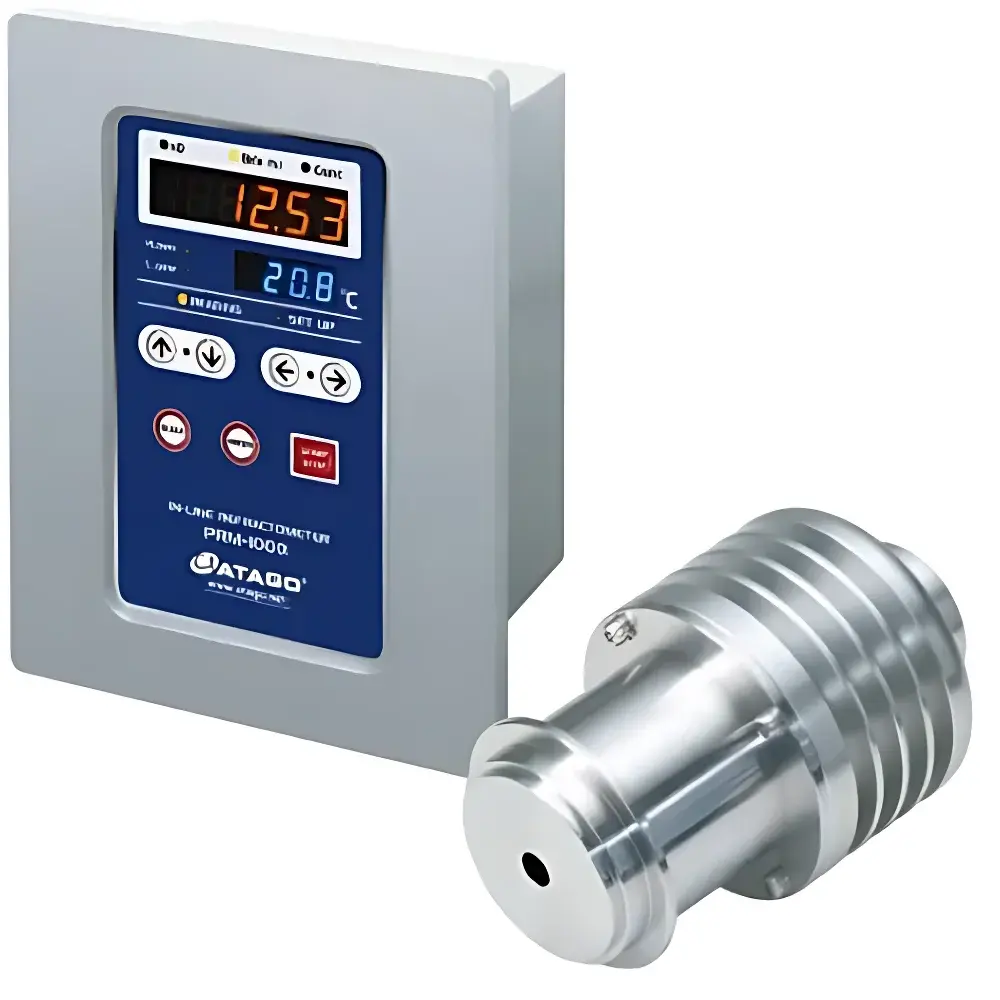
ATAGO PRM-100α DX Online Refractometer for Metalworking Cleaning Fluid Monitoring
| Brand | ATAGO |
|---|---|
| Origin | Japan |
| Model | PRM-100α DX |
| Measurement Principle | Critical-angle refractometry |
| Measuring Range | nD 1.32000–1.55700 |
| Accuracy | nD ±0.00010, Brix ±0.05% |
| Temperature Range | -5.0–160.0°C (sensor), 5–40°C (ambient) |
| ATC Range | 5–100°C |
| Resolution (default) | nD 0.00001, Brix 0.01% |
| Output | DC 4–20 mA, RS-232C |
| Max Pressure Rating | 0.98 MPa |
| Enclosure Rating | IP67 |
| Wetted Materials | SUS316L sample chamber, sapphire prism |
| Power Supply | AC 100–240 V, 50–60 Hz |
| Sensor Dimensions | 10.8 × 17.26 × 10.8 cm, 2.6 kg |
| Display Unit Dimensions | 19.2 × 10 × 24 cm, 3.3 kg |
| Standard Cable Length | 15 m (extendable to 200 m) |
| Measurement Interval | ~1 sec |
Overview
The ATAGO PRM-100α DX is a high-precision online refractometer engineered for continuous, real-time monitoring of refractive index (nD) and concentration—expressed as Brix or user-defined concentration units—in metalworking cleaning fluids and other aqueous industrial process streams. It operates on the principle of critical-angle refractometry: a collimated light beam passes through a sapphire prism in direct contact with the process fluid; the angle at which total internal reflection occurs is precisely measured and converted into refractive index, then linearly correlated to solute concentration via pre-calibrated polynomial functions. This optical method delivers inherently stable, non-invasive, and maintenance-free measurement—free from electrode drift, fouling-related calibration shifts, or consumable replacement. Designed for permanent installation in pressurized pipelines (up to 0.98 MPa), the PRM-100α DX enables closed-loop process control in CNC machining, grinding, and parts washing lines where consistent cleaning efficacy, rinse water recovery optimization, and chemical dosing accuracy are critical to part quality, corrosion prevention, and wastewater compliance.
Key Features
- High-resolution optical sensing with sapphire prism (Mohs hardness 9) and SUS316L wetted surfaces for exceptional resistance to abrasion, caustic cleaners, and chlorinated solutions.
- Automatic temperature compensation (ATC) across 5–100°C using integrated Pt100 RTD, ensuring traceable accuracy even under rapid thermal transients typical in heat-generating machining environments.
- Dual-display architecture: rugged sensor head for hazardous area mounting (IP67 rated) and separate display unit with 7-segment LED—optimized for legibility at distances up to 15 meters in noisy, high-bay production facilities.
- Configurable output resolution: default nD 0.00001 / Brix 0.01%, with optional coarse mode (nD 0.0001 / Brix 0.1%) for legacy PLC integration.
- Industrial-grade analog (4–20 mA) and digital (RS-232C) outputs support seamless integration into DCS, SCADA, and MES platforms—enabling automated alarm triggering, trend logging, and batch record generation.
- Calibration traceability supported via NIST-traceable standard sucrose solutions; no field recalibration required under stable operating conditions per ISO 21527-1 and ASTM D1078 protocols.
Sample Compatibility & Compliance
The PRM-100α DX is validated for continuous measurement of transparent to mildly turbid aqueous cleaning formulations—including alkaline degreasers, acidic descalers, neutral pH surfactant blends, and semi-synthetic metalworking fluids—provided suspended solids remain below 50 µm and absorbance at 589 nm is ≤0.3 AU. It complies with IEC 61000-6-2 (immunity) and IEC 61000-6-4 (emissions) for industrial electromagnetic environments. The device supports GLP/GMP-aligned operation through audit-ready calibration logs (when paired with ATAGO’s optional data acquisition software), and its analog output meets requirements for FDA 21 CFR Part 11-compliant systems when implemented with appropriate electronic signature and data integrity controls.
Software & Data Management
While the PRM-100α DX operates autonomously without host software, ATAGO provides optional PC-based configuration and data logging tools compatible with Windows OS. These utilities enable full parameter setup (e.g., custom concentration curves, alarm thresholds, output scaling), time-stamped CSV export of nD, Brix, and temperature readings at user-defined intervals (1–60 sec), and export of calibration history with operator ID and timestamp. Raw data files adhere to ASTM E1447-22 metadata conventions, facilitating import into LIMS or statistical process control (SPC) platforms such as Minitab or InfinityQS.
Applications
- Real-time verification of cleaning solution concentration during CIP (Clean-in-Place) cycles in precision machining cells—ensuring removal of oils, chips, and biofilm without over-concentration that accelerates tank corrosion.
- Feedback control of make-up dosing pumps in central coolant systems, maintaining optimal saponification balance in alkaline cleaners used for aluminum or stainless steel processing.
- Monitoring dilution ratios of concentrated cleaners in multi-stage wash tunnels—reducing variability in surface tension and residue levels on finished components.
- Quantitative assessment of rinse water carryover contamination by correlating post-rinse Brix drift with conductivity or TOC trends.
- Supporting QS-9000 and IATF 16949 process validation by providing objective, time-synchronized concentration data for PPAP documentation and control plan execution.
FAQ
Can the PRM-100α DX measure opaque or highly viscous cleaning fluids?
No. It requires optical clarity at the sodium D-line (589 nm); emulsions, slurries, or fluids with >5% suspended solids will yield unreliable readings due to light scattering.
Is field recalibration possible without sending the unit to a service center?
Yes—using certified reference standards (e.g., ATAGO SR-100 series sucrose solutions), users may perform two-point calibration in situ following ISO 5725-2 guidelines; procedure is documented in the English-language operator manual.
How does the instrument handle thermal shock from hot workpiece rinse water?
The sapphire prism and integrated Pt100 RTD provide rapid thermal equilibration; ATC algorithm compensates effectively within the specified 5–100°C range—validated per JIS Z 8015 Annex B.
What is the maximum allowable flow velocity past the sensor window?
For optimal signal stability and minimal boundary layer interference, recommended flow velocity is 0.3–3.0 m/s; higher velocities require upstream straight-pipe run ≥10× pipe diameter.
Does the PRM-100α DX support Modbus RTU or Profibus DP communication?
No—only RS-232C serial and 4–20 mA analog outputs are natively supported; protocol conversion requires third-party gateways compliant with IEC 61158.
Related Products