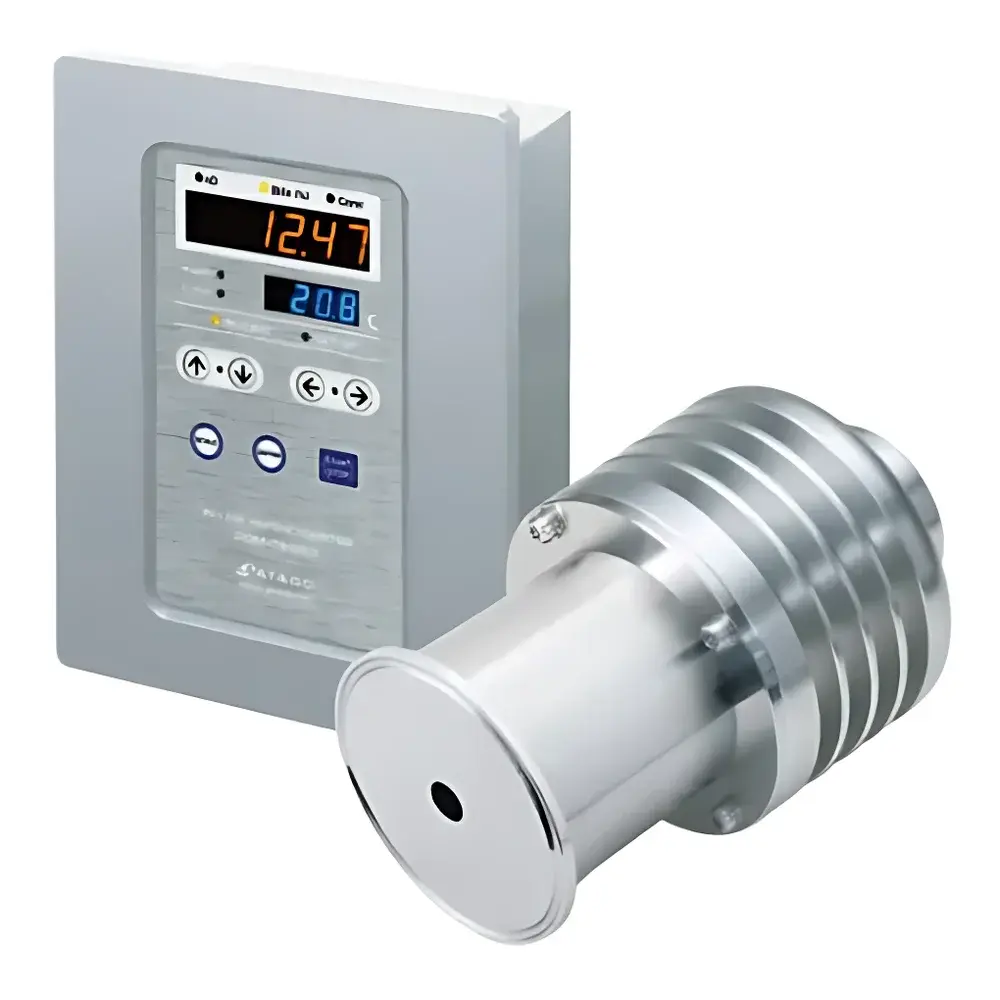
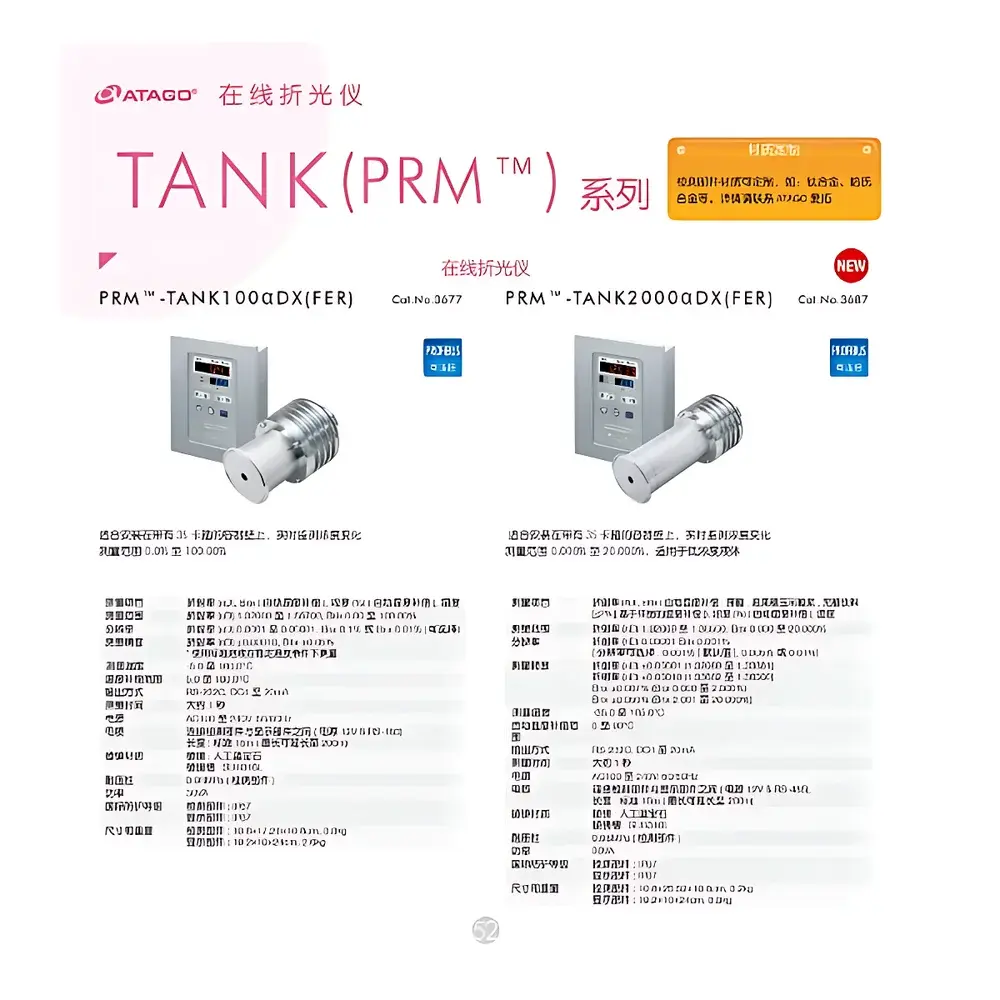
ATAGO PRM-TANK 100α DX High-Precision Online Refractometer
| Brand | ATAGO |
|---|---|
| Origin | Japan |
| Model | PRM-TANK 100α DX |
| Measurement Range | nD 1.32000–1.55700 |
| Accuracy | ±0.00010 (nD), ±0.05% (Brix) |
| ATC Range | 5.0–100.0 °C |
| Output | RS-232C, 4–20 mA DC |
| Cable Length | 15 m (extendable to 200 m) |
| Power | 12 V DC |
| Communication | RS-485 |
Overview
The ATAGO PRM-TANK 100α DX is a high-precision, in-line process refractometer engineered for continuous, real-time measurement of refractive index (nD), Brix, and concentration in liquid streams under industrial operating conditions. Based on the principle of critical-angle refraction—where a collimated light beam passes through a sapphire prism in direct contact with the process fluid—the instrument delivers stable, drift-free optical measurements independent of flow rate, color, turbidity, or suspended solids. Its robust stainless-steel wetted parts (316L SS housing, sapphire measuring surface) and IP67-rated electronics ensure long-term reliability in demanding environments including food processing lines, pharmaceutical clean-in-place (CIP) systems, chemical dilution loops, and bioreactor nutrient feed control. Designed specifically for tank-side and pipe-mounted installation, the PRM-TANK 100α DX integrates seamlessly into existing PLC/DCS architectures without requiring sample extraction or bypass loops—minimizing maintenance, eliminating dead-leg contamination risks, and supporting continuous process verification per FDA 21 CFR Part 11 and EU Annex 11 requirements.
Key Features
- High-resolution optical detection with ±0.00010 refractive index accuracy and ±0.05% Brix repeatability across full range (0.00–100.00%)
- Integrated Pt1000 temperature sensor with automatic temperature compensation (ATC) from 5.0 to 100.0 °C, ensuring traceable thermometric correction per ISO 21542
- Wide operational temperature tolerance: −5.0 to +160.0 °C at the prism interface, enabling use in sterilization-in-place (SIP) and hot-fill applications
- Modular architecture: separate sensor head and remote display/data unit connected via shielded 12 V DC power and RS-485 communication cable (standard 15 m, extendable to 200 m)
- Dual analog output (4–20 mA) configurable for any measured parameter (nD, Brix, or temperature) with HART-compatible signal conditioning
- Programmable upper/lower limit alarms with relay output and digital notification via RS-232C serial interface
- Sapphire prism surface (Mohs hardness 9) resistant to abrasion, corrosion, and chemical attack—validated for repeated CIP/SIP cycles using NaOH, HNO3, and peracetic acid solutions
Sample Compatibility & Compliance
The PRM-TANK 100α DX is validated for direct contact with aqueous solutions, syrups, juices, dairy concentrates, ethanol-water blends, glycol-based heat transfer fluids, caustic cleaning agents, and acidic rinse formulations. It complies with IEC 61000-6-2 (EMC immunity) and IEC 61000-6-4 (EMC emissions), carries CE marking for industrial equipment, and meets ATEX II 2G Ex db IIB T4 Gb classification when installed with approved barrier systems. For regulated industries, the device supports audit-trail-capable data logging (when paired with ATAGO’s optional PRM-DX Data Logger), satisfies ALCOA+ data integrity principles, and enables configuration lockout to prevent unauthorized parameter changes—facilitating compliance with USP , ASTM D1218, and ISO 21542 for refractometric analysis.
Software & Data Management
While the PRM-TANK 100α DX operates autonomously as a standalone field instrument, it interfaces bidirectionally with supervisory systems via RS-232C ASCII protocol or 4–20 mA analog signals. Optional integration with ATAGO’s PRM-DX Configuration & Monitoring Software (Windows-based, USB/RS-232) allows for calibration verification, alarm threshold setup, firmware updates, and export of time-stamped measurement logs in CSV format. All stored configurations include date/time stamps and user ID fields—supporting GLP/GMP documentation requirements. When deployed in validated environments, the system can be configured to generate electronic signatures and maintain immutable change logs compliant with 21 CFR Part 11 Subpart B.
Applications
- Real-time Brix monitoring during juice concentration, sugar syrup blending, and jam cooking to optimize evaporation energy use and batch consistency
- In-line concentration control of cleaning solutions (e.g., 1–3% NaOH) in CIP systems to ensure microbiological efficacy while minimizing chemical overuse
- Continuous verification of glycol concentration in HVAC coolant loops and cryogenic process fluids
- Monitoring alcohol content in fermentation broth pre-distillation and post-dilution in beverage production
- Concentration tracking of active pharmaceutical ingredients (APIs) in solvent-based crystallization and purification steps
- Refractive index trending for early detection of phase separation, emulsion breakdown, or unintended dilution in multi-component process streams
FAQ
What materials are in contact with the process fluid?
The wetted components consist of 316L stainless steel body and a polished sapphire prism—both chemically inert and compliant with USP Class VI and FDA 21 CFR 177.1550 for food-contact surfaces.
Can the sensor be installed in pressurized pipelines?
Yes—the PRM-TANK 100α DX supports static line pressures up to 10 bar (145 psi) at 25 °C; pressure rating decreases linearly to 5 bar at 100 °C per manufacturer’s mechanical design specifications.
Is factory calibration traceable to NIST or other national standards?
Each unit ships with a certificate of calibration traceable to JCSS (Japan Calibration Service System), which maintains mutual recognition agreements (MRA) with NIST, PTB, and NPL under the ILAC framework.
How often does the instrument require recalibration?
Under stable process conditions and routine CIP/SIP cycles, annual verification against certified sucrose reference standards (e.g., NIST SRM 84d) is recommended; frequency may increase based on risk assessment per ICH Q9 guidelines.
Does the system support Modbus RTU or Ethernet/IP protocols?
Native Modbus RTU is not embedded; however, third-party protocol converters (e.g., Moxa EDS-G205A) can translate RS-485 ASCII output to Modbus RTU or EtherNet/IP for integration into Rockwell or Siemens automation platforms.