
ATAGO REPO-1 A Combined Refractometer and Polarimeter Kit (Sugar Industry Dedicated)
| Brand | ATAGO |
|---|---|
| Origin | Japan |
| Model | REPO-1 A Combined Refractometer and Polarimeter Kit (Sugar Industry Dedicated) |
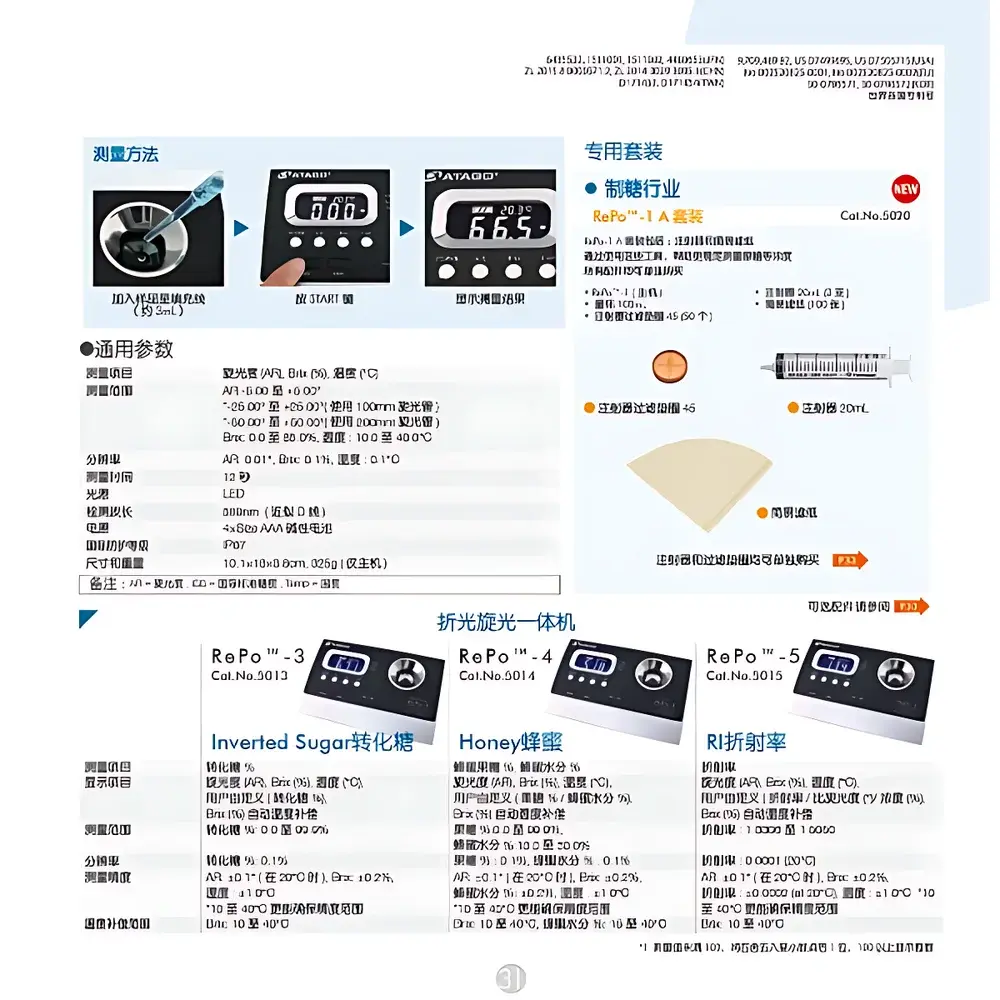
| Measurement Range | Optical Rotation: −5.00 to +5.00° |
| Brix | 0.0 to 85.0% |
| ICUMSA Sugar Scale (°Z) | −130 to +130°Z |
| Temperature | 15 to 40°C |
| Resolution | Optical Rotation: 0.01° |
| Brix | 0.1% |
| °Z | 0.1°Z |
| Temperature | 0.1°C |
| Accuracy | Optical Rotation: ±0.1° at 20°C |
| Brix | ±0.2% |
| °Z | ±3°Z at 20°C |
| Wavelength | 589 nm (Na-D line) |
| Sample Volume | 3 mL |
| Measurement Time | ≤12 s |
| Light Source | LED |
| Temperature Compensation | Automatic (Brix: 15–40°C |
| °Z & Purity | 18–40°C) |
| Dimensions | 101 × 160 × 38 mm |
| Weight | 325 g |
| IP Rating | IP67 |
| Power | 4 × AAA alkaline batteries |
Overview
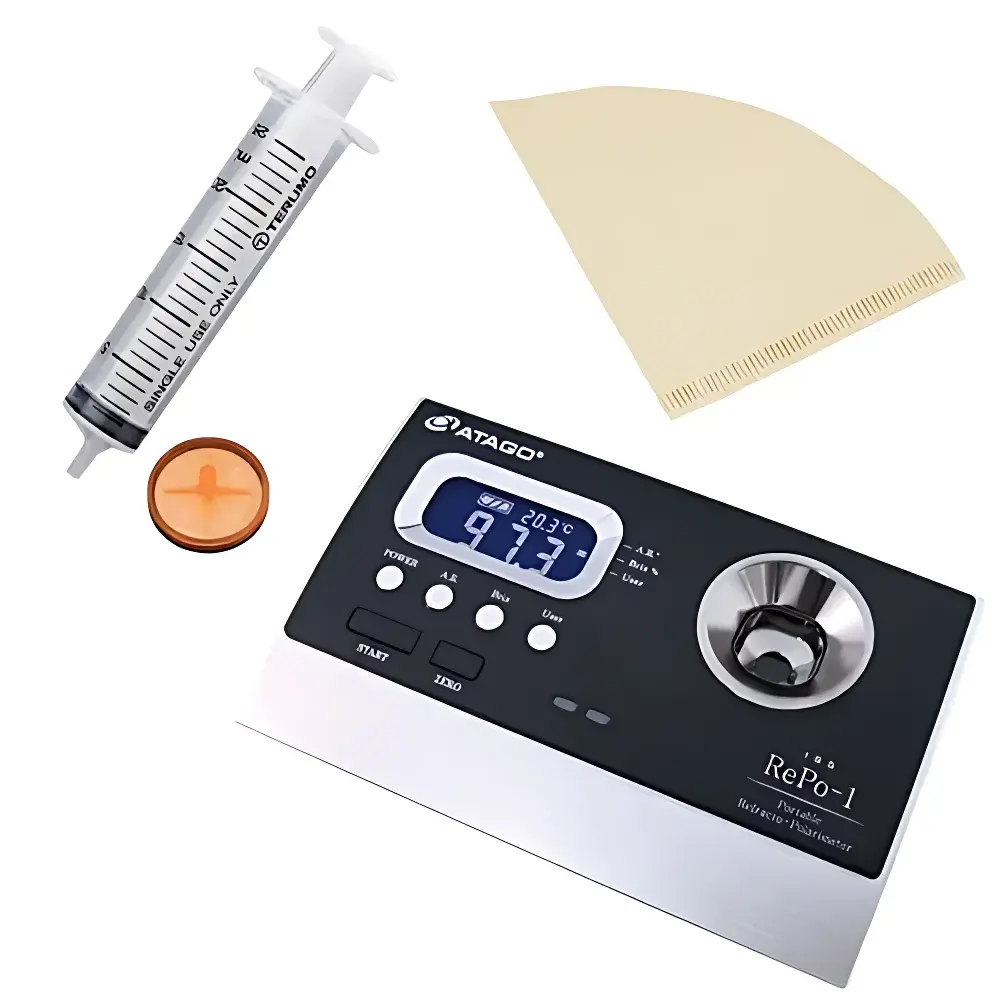
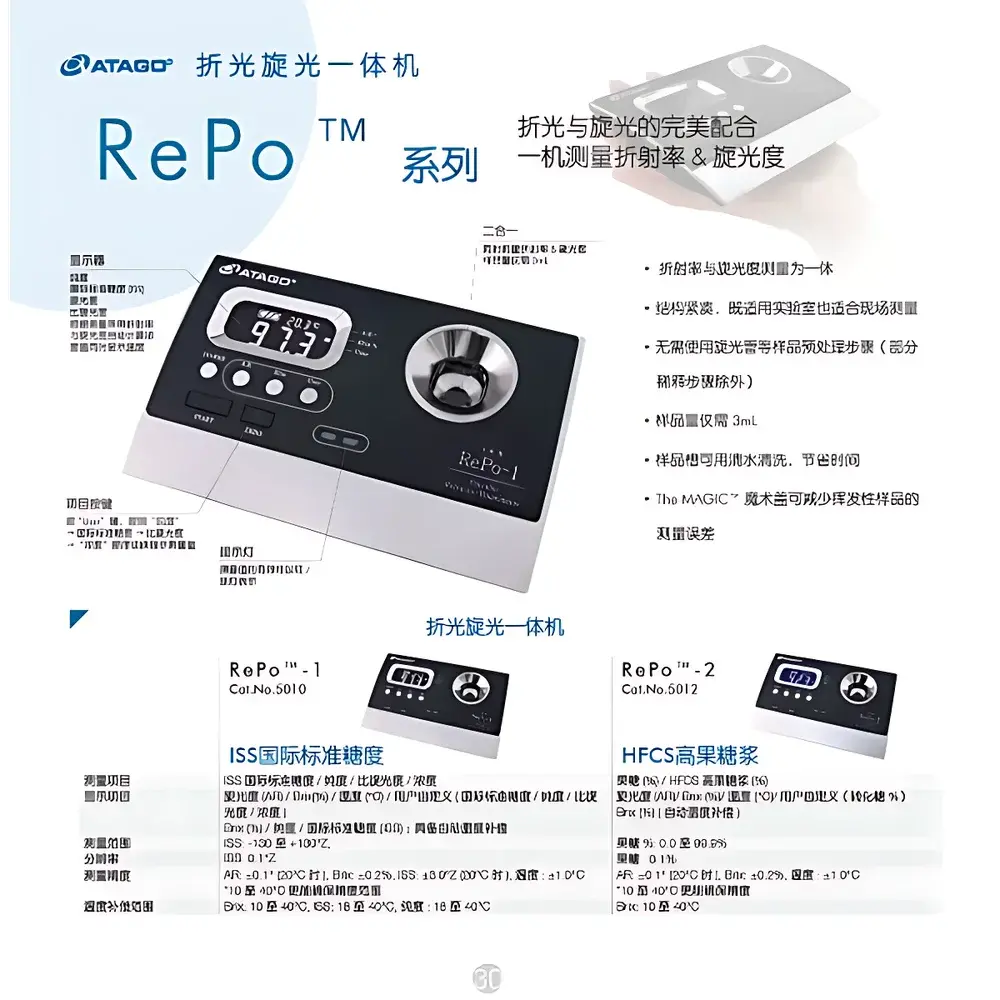
The ATAGO REPO-1 A Combined Refractometer and Polarimeter Kit is an integrated, field-deployable optical instrument engineered for rapid, simultaneous quantification of optical rotation and refractive index in raw sugarcane juice and related sugar process streams. Unlike conventional standalone polarimeters or refractometers requiring sample clarification or chemical pretreatment, the REPO-1 A leverages dual-path optical detection—based on the principles of sodium D-line (589 nm) polarimetry and critical-angle refractometry—to deliver correlated measurements of optical rotation (°), Brix (% w/w sucrose equivalent), ICUMSA-standardized sugar scale (°Z), specific rotation ([α]), purity ratio, and temperature—all from a single 3 mL unclarified sample. Its design directly addresses a critical workflow bottleneck in sugarcane milling and raw sugar quality control: the need to avoid time-consuming, chemically disruptive decolorization steps (e.g., activated carbon treatment or lead acetate precipitation) that alter sucrose equilibrium and compromise Brix accuracy. By enabling direct measurement of turbid, particulate-laden juice—without filtration beyond coarse paper or syringe-based particulate removal—the REPO-1 A supports real-time, non-destructive assessment aligned with ISO 20480-1 (sugar analysis), ICUMSA Method GS 2/3-14 (raw juice polarization), and AOAC Official Method 932.12 (refractometric solids).
Key Features
- Simultaneous dual-parameter output: Optical rotation (−5.00 to +5.00°), Brix (0.0–85.0%), ICUMSA sugar scale (−130 to +130°Z), specific rotation, purity ratio, and temperature—all calculated and displayed within ≤12 seconds.
- Integrated LED light source at 589 nm (Na-D line), compliant with international polarimetric standard wavelength requirements and eliminating mercury-vapor lamp hazards or warm-up delays.
- Automatic temperature compensation across three independent ranges: Brix (15–40°C), °Z and purity (18–40°C), ensuring metrological traceability under variable field conditions.
- Rugged, portable architecture: IP67-rated enclosure, 325 g mass, and compact footprint (101 × 160 × 38 mm) optimized for use in cane fields, mill houses, and mobile QC labs.
- On-device alarm system: Configurable upper/lower limits per parameter trigger visual LED alerts—enabling immediate pass/fail decisions during harvest or transport verification.
- Battery-powered operation (4 × AAA), supporting >5,000 measurements per set—ideal for off-grid locations where AC power is unavailable or unreliable.
Sample Compatibility & Compliance
The REPO-1 A is validated for direct measurement of untreated, freshly pressed sugarcane juice containing suspended solids up to ~200 µm, provided coarse particulate removal is performed using the included 45 mm orange filter disc and 20 mL syringe assembly. It does not require centrifugation, chemical decolorization, or thermal clarification—preserving native sucrose concentration and avoiding hydrolysis artifacts common in acid-treated samples. The instrument conforms to ICUMSA GS 2/3-14 for raw juice polarization reporting and supports calculation of °Z values traceable to ICUMSA Standard Solutions. Its Brix calibration is referenced to NIST-traceable sucrose standards, and temperature compensation algorithms adhere to ISO 2173:2003 (fruit juices) and adapted for high-viscosity sucrose solutions. While not designed for GLP-regulated archival environments, its measurement repeatability (RSD < 0.3% for Brix, < 0.5% for °Z across triplicate raw juice samples) meets routine QC thresholds for ISO/IEC 17025-accredited sugar testing laboratories.
Software & Data Management
The REPO-1 A operates as a stand-alone, embedded-system instrument with no external software dependency. All calculations—including conversion from observed rotation to °Z using the ICUMSA-defined formula (°Z = [α] × c × l / 100), Brix-to-purity ratio derivation, and temperature-corrected specific rotation—are executed in real time by onboard firmware. Results are displayed on a high-contrast LCD with simultaneous multi-parameter readout. No data export interface (USB, Bluetooth, or RS-232) is included; however, the device supports manual transcription into LIMS or Excel via standardized field reporting templates aligned with ICUMSA Form 12A (Raw Juice Analysis Report). For audit readiness, users may document measurement conditions (ambient temperature, sample ID, operator initials) alongside printed or handwritten records—a practice consistent with FDA 21 CFR Part 11–compliant documentation when paired with controlled logbooks and signature protocols.
Applications
- Real-time assessment of cane maturity and harvest readiness via combined °Z and Brix trends across field lots.
- In-mill quality gate monitoring: Rapid verification of juice clarity index, sucrose-to-brix ratio, and purity loss during diffusion or extraction stages.
- Recovery optimization: Correlating °Z depression with invert sugar formation to adjust liming and sulfitation parameters.
- Transport and storage QA: Detection of microbial inversion or fermentation onset through anomalous rotation/Brix divergence.
- Contractual settlement: Field-level verification of ICUMSA-grade compliance prior to delivery to refineries—reducing disputes over purity penalties.
- Educational and extension use: Demonstrating fundamental relationships between optical activity, refractive index, and carbohydrate composition in agricultural science curricula.
FAQ
Can the REPO-1 A measure clarified syrup or molasses?
Yes, but calibration must be verified against matrix-matched standards; high-color or high-ash samples may require periodic prism cleaning and validation per ICUMSA GS 2/3-14 Annex B.
Is temperature control available?
No—the instrument features automatic temperature compensation but lacks active thermostatic regulation; ambient operating range is strictly 15–40°C.
What is the minimum sample volume required?
Exactly 3 mL is required to fully cover the prism surface and ensure optical path integrity; under-filling yields invalid refractive index readings.
Does it comply with FDA or EU regulatory requirements for sugar labeling?
It provides measurement data aligned with ICUMSA and ISO methods used in regulatory submissions; however, final label claims require verification in an accredited laboratory per EU Regulation (EU) No 1169/2011 or 21 CFR 101.9.
How often does the prism require cleaning or recalibration?
Prism cleaning is recommended after each sample batch using lint-free tissue and ethanol; factory calibration is stable for ≥12 months under normal use—recalibration is advised annually or after mechanical shock.




