
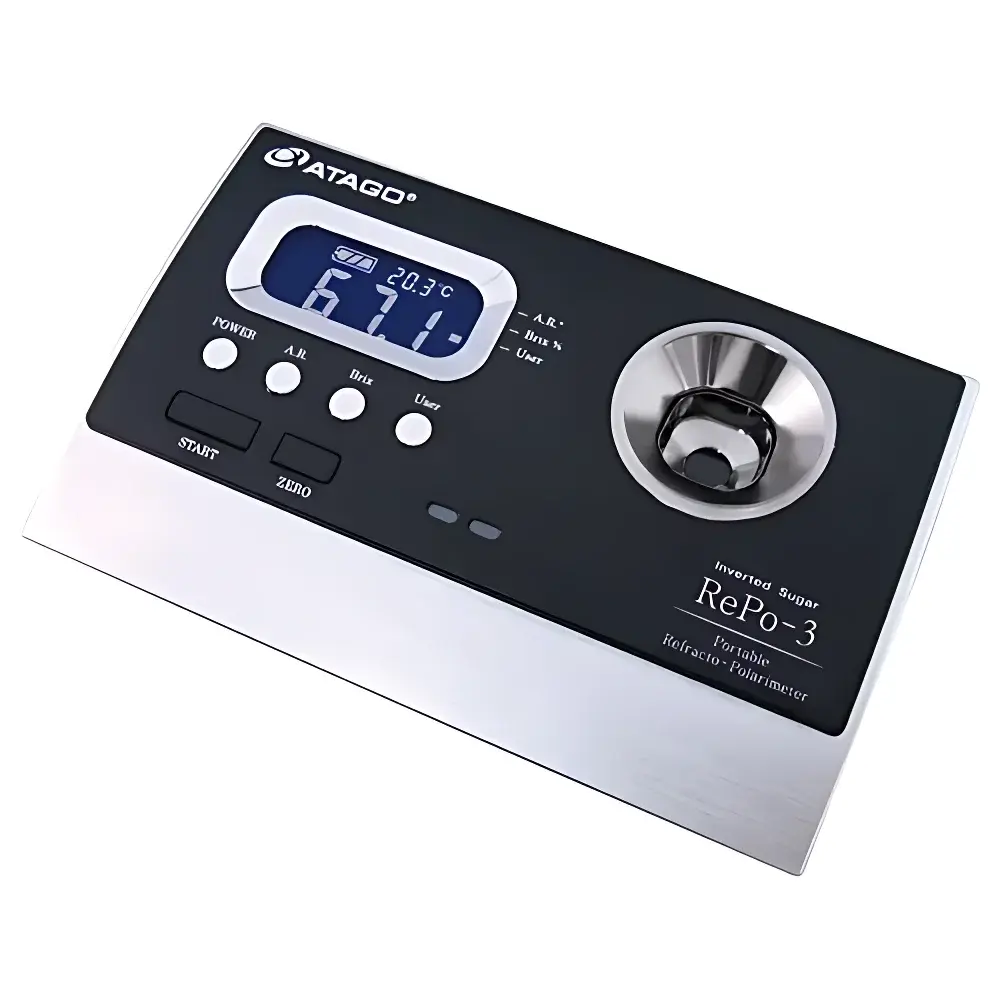
ATAGO RePo-3 Combined Refractometer and Polarimeter for Invert Sugar Analysis
| Brand | ATAGO |
|---|---|
| Origin | Japan |
| Model | RePo-3 (Invert Sugar) |
| Product Type | Automatic Temperature-Compensated Combined Refractometer & Polarimeter |
| Temperature Control | Yes (ATC 10–40°C) |
| Display | Digital LCD |
| Light Source | LED (589 nm, approx. sodium D-line) |
| Measurement Range | Invert Sugar: 0.0–99.9% |
| Accuracy | Optical Rotation: ±0.1° at 20°C |
| Brix | ±0.2% |
| Temperature | ±1.0°C |
| Resolution | Optical Rotation: 0.01° |
| Brix | 0.1% |
| Invert Sugar % | 0.1% |
| Temp | 0.1°C |
| Measurement Time | 12 s |
| IP Rating | IP67 |
| Dimensions | 10.1 × 16.0 × 3.8 cm |
| Weight | 325 g (host only) |
| Path Length | 20 mm standard (compatible with 100 mm / 200 mm cells for extended AR range) |
Overview
The ATAGO RePo-3 is a compact, handheld combined refractometer and polarimeter engineered specifically for quantitative analysis of invert sugar—defined as the equimolar mixture of glucose and fructose formed by acid- or enzyme-catalyzed hydrolysis of sucrose. Unlike conventional single-mode instruments, the RePo-3 integrates two orthogonal optical measurement principles in one platform: Abbe-type refractometry (based on critical angle measurement at the prism-sample interface) and polarimetry (based on rotation of plane-polarized light at 589 nm, near the sodium D-line). This dual-sensor architecture enables simultaneous, correlated determination of Brix (refractive index-derived soluble solids content), optical rotation (α), and calculated invert sugar concentration (%)—all traceable to internationally recognized sugar metrology standards including ISO 5775, ICUMSA Methods GS4/3-11 and GS4/3-12, and AOAC Official Method 932.12. Designed for use in production lines, QC labs, and field applications, the RePo-3 operates without external power supply (4×AAA alkaline batteries), features IP67-rated ingress protection, and delivers stable readings across ambient temperatures from 15°C to 40°C via integrated automatic temperature compensation (ATC).
Key Features
- Simultaneous dual-parameter acquisition: Brix (%) and optical rotation (°) measured in a single 12-second cycle, eliminating sequential instrument switching and cross-sample variability.
- Integrated ATC system calibrated for Brix over 10–40°C and temperature monitoring with ±1.0°C accuracy, ensuring compliance with ISO 2173 and USP requirements for temperature-dependent sugar assays.
- Dedicated invert sugar calculation algorithm compliant with ICUMSA-defined specific rotation values for sucrose (+66.5°), glucose (+52.7°), and fructose (−92.0°) at 20°C, enabling direct % invert sugar output without manual interpolation.
- LED light source (589 nm) provides stable, drift-free illumination with >10,000-hour lifetime—eliminating mercury-vapor lamp hazards and warm-up delays inherent in traditional polarimeters.
- Programmable pass/fail limits with visual status indication: Green LED confirms in-spec result; red LED triggers on deviation from user-defined thresholds for any measured parameter (Brix, α, or invert %).
- Rugged, portable form factor (325 g, 10.1 × 16.0 × 3.8 cm) certified to IP67 for dust-tightness and immersion resistance up to 1 m for 30 minutes—suitable for humid processing environments and mobile field testing.
Sample Compatibility & Compliance
The RePo-3 accepts aqueous liquid samples with minimal preparation: only 3 mL required per measurement, compatible with clarified syrups, hydrolysates, honey blends, soft drink concentrates, and pharmaceutical excipient solutions. Its optical design accommodates turbidity up to 5 NTU without significant scattering error, validated per ASTM D1293 for refractive index stability in low-clarity matrices. All measurement outputs—including Brix, optical rotation, invert sugar %, and temperature—are digitally logged with timestamp and operator ID (via optional PC interface), supporting audit-ready documentation under FDA 21 CFR Part 11 and GLP/GMP frameworks. The instrument conforms to IEC 61000-4 electromagnetic compatibility standards and carries CE marking for conformity with EU Directive 2014/30/EU (EMC) and 2014/35/EU (LVD).
Software & Data Management
While fully functional as a standalone device, the RePo-3 supports optional USB data export to ATAGO’s proprietary LogView software (Windows-compatible), enabling batch reporting, statistical process control (SPC) charting, and export to CSV or PDF formats. All stored measurements retain full metadata: date/time stamp, ambient temperature, battery level, and measurement mode identifier. Audit trail functionality records every parameter change, calibration event, and limit adjustment—fully compliant with ALCOA+ data integrity principles. No cloud connectivity or remote access capabilities are implemented, preserving data sovereignty and simplifying validation for regulated industries.
Applications
- Real-time monitoring of sucrose inversion kinetics during thermal or enzymatic hydrolysis in confectionery and beverage manufacturing.
- QC release testing of invert sugar syrups against ICUMSA specifications for color, purity, and dextrose equivalent (DE) correlation.
- Verification of honey authenticity and adulteration screening via deviation from expected invert/sucrose ratio profiles.
- Pharmaceutical excipient qualification where invert sugar serves as stabilizer or bulking agent (e.g., in lyophilized biologics formulations).
- R&D optimization of yeast fermentation media by tracking real-time glucose/fructose balance during fed-batch processes.
- Academic teaching labs demonstrating chiral analysis fundamentals, optical activity, and colligative property interrelationships.
FAQ
What sample volume is required for a valid measurement?
Only 3 mL of clarified liquid sample is needed. Viscous or particulate samples should be filtered through a 0.45 µm membrane prior to loading.
Can the RePo-3 measure pure sucrose or glucose solutions?
Yes—it reports Brix and optical rotation independently; however, the dedicated “invert sugar %” mode requires both parameters and assumes hydrolytic equilibrium between glucose and fructose.
Is calibration traceable to national standards?
Factory calibration uses NIST-traceable sucrose reference standards and quartz rotatory dispersion plates; users may perform verification with ATAGO-certified calibration kits (Cat. No. 5013-CAL).
Does the instrument support longer pathlength cells?
Yes—optional 100 mm and 200 mm precision glass cells extend optical rotation range to ±25.00° and ±50.00° respectively, maintaining full ATC functionality.
How is temperature uniformity ensured across the prism and sample interface?
A Peltier-stabilized thermal block maintains ±0.2°C homogeneity across the sapphire prism surface during measurement, verified per ISO 17025 internal validation protocols.




