
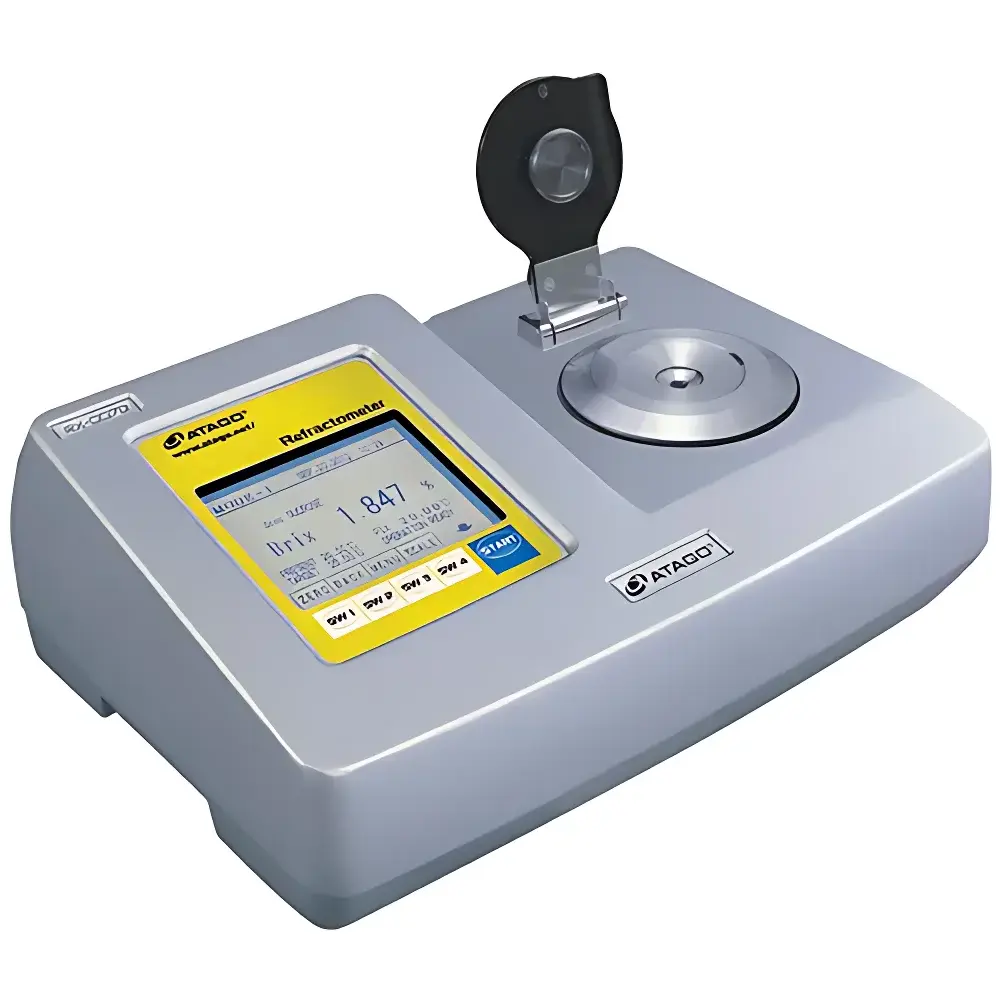
ATAGO RX-007α Low-Concentration High-Precision Automatic Digital Refractometer
| Brand | ATAGO |
|---|---|
| Origin | Japan |
| Model | RX-007α (Low-Concentration, High-Precision) |
| Type | Benchtop Refractometer |
| Temperature Control | Yes |
| Digital Display | Yes |
| Refractive Index Range | 1.330150–1.341500 |
| Brix Range | 0.000–5.000% (ATC) |
| Refractive Index Accuracy | ±0.000010 |
| Brix Accuracy | ±0.005% |
| Resolution | RI: 0.000001, Brix: 0.001%, Temp: 0.01°C |
| Sample Cell Material | SUS316 Stainless Steel |
| Prism Material | Synthetic Sapphire + Optical Glass |
| Power Supply | AC 100–240 V, 50/60 Hz |
| Power Consumption | 65 VA |
| Interface | RS-232C (Printer & PC Connectivity) |
| Dimensions | 37 × 26 × 14 cm |
| Weight | 6.7 kg (Main Unit Only) |
Overview
The ATAGO RX-007α is a benchtop automatic digital refractometer engineered for high-precision measurement of low-concentration aqueous solutions—specifically targeting samples with Brix values ≤5.000% and requiring metrological repeatability at the ±0.005% level. It operates on the principle of total internal reflection at the prism-sample interface, where the critical angle of incident light is measured and converted into refractive index (nD) using calibrated optical path geometry and temperature-compensated algorithms. The instrument integrates a Peltier-based thermostatic system to maintain sample temperature within 15.00–30.00°C (with ambient operation down to −5°C), ensuring compliance with ISO 21745:2020 and ASTM D1218 standards for refractometric analysis under controlled thermal conditions. Its design prioritizes long-term stability in QC laboratories handling sensitive formulations such as tea infusions, low-sugar functional beverages, surfactant-based cleaning agents, water-soluble rust inhibitors, and pharmaceutical excipient solutions.
Key Features
- Precision optical architecture featuring a synthetic sapphire prism coupled with optical glass—resistant to chemical erosion from weak acids, alkaline detergents, and organic solvents commonly encountered in surface treatment and beverage R&D.
- High-resolution detection system delivering 0.000001 refractive index resolution and 0.001% Brix resolution—enabling discrimination between closely spaced concentration gradients in dilute systems.
- Integrated Peltier temperature control with real-time monitoring (0.01°C resolution) and automatic temperature compensation (ATC) across the full operating range—eliminating manual correction and minimizing inter-laboratory variability.
- Stainless steel (SUS316) sample well designed for rapid cleaning, minimal carryover, and compatibility with GLP-compliant documentation workflows.
- RS-232C serial interface supporting direct data export to LIMS, Excel, or validated laboratory software—configured for ASCII output with timestamp, temperature, nD, and Brix fields.
- Robust mechanical construction (6.7 kg mass, vibration-damped chassis) optimized for continuous use in regulated environments including ISO 17025-accredited testing labs and GMP manufacturing support zones.
Sample Compatibility & Compliance
The RX-007α is validated for homogeneous, transparent, non-volatile aqueous solutions with viscosity <50 mPa·s and no suspended particulates. It is routinely deployed in applications governed by USP General Chapter <731> Refractive Index, JP XVIII Refractometry, and ISO 21527-1 for microbiological culture media preparation verification. While not intrinsically compliant with FDA 21 CFR Part 11, its RS-232C output supports integration into Part 11–validated data acquisition systems when paired with audit-trail-enabled software and user-access controls. The instrument meets CE marking requirements per Directive 2014/30/EU (EMC) and 2014/35/EU (LVD), and conforms to IEC 61010-1:2010 safety standards for electrical equipment used in laboratory environments.
Software & Data Management
No proprietary software is bundled with the RX-007α; instead, it delivers raw ASCII-formatted output via RS-232C at 9600 baud rate (8N1), allowing seamless ingestion into third-party platforms including LabWare LIMS, Thermo Fisher SampleManager, and custom Python- or LabVIEW-based automation scripts. Each data packet includes UTC timestamp, measured temperature (°C), refractive index (nD), Brix (% w/w), and status flags (e.g., “ATC Active”, “Prism Dry”). For traceability, users may configure external logging systems to capture operator ID, sample ID, and instrument serial number alongside each measurement—supporting ALCOA+ data integrity principles in regulated quality assurance processes.
Applications
- Quality control of ready-to-drink (RTD) teas and herbal infusions during concentration standardization prior to bottling.
- Batch release testing of low-Brix surfactant blends used in metalworking fluid formulations and semiconductor wafer cleaning chemistries.
- Monitoring glycol-based corrosion inhibitors in closed-loop HVAC systems where concentrations below 3% w/w must be maintained within ±0.01% tolerance.
- Verification of osmotic agent concentration in ophthalmic rinse solutions and topical hydrogel bases per pharmacopoeial monographs.
- R&D screening of novel sweetener blends (e.g., stevia-rebaudioside M + erythritol) where subtle refractive shifts correlate with molecular hydration state and solubility limits.
- Calibration verification of inline process refractometers in dairy ultrafiltration streams where permeate Brix typically falls between 0.2–1.8%.
FAQ
What is the minimum detectable Brix change the RX-007α can resolve?
The instrument resolves Brix increments of 0.001%, with measurement repeatability of ±0.005% under stabilized thermal conditions (±0.1°C) and proper prism cleaning protocol.
Can the RX-007α measure ethanol-water mixtures?
No—it is calibrated exclusively for aqueous sucrose-equivalent solutions. Ethanol alters dispersion characteristics and invalidates the built-in ATC algorithm; dedicated alcohol refractometers (e.g., RX-5000α) are required.
Is the sample well compatible with aggressive cleaners like sodium hydroxide or nitric acid?
Yes—the SUS316 chamber withstands brief exposure to ≤1 mol/L NaOH and ≤10% v/v HNO3; however, prolonged contact with halide-containing acids requires post-rinse with deionized water to prevent pitting.
Does the unit support external temperature probes for validation?
No—the internal Pt100 sensor is factory-calibrated and sealed; NIST-traceable verification must be performed using certified refractive index standards (e.g., Cargille Labs Series 14) at defined temperatures.
How often does the prism require recalibration?
ATAGO recommends annual calibration verification using certified reference liquids; no user-accessible recalibration routine exists—service must be performed by authorized ATAGO technical centers.





