
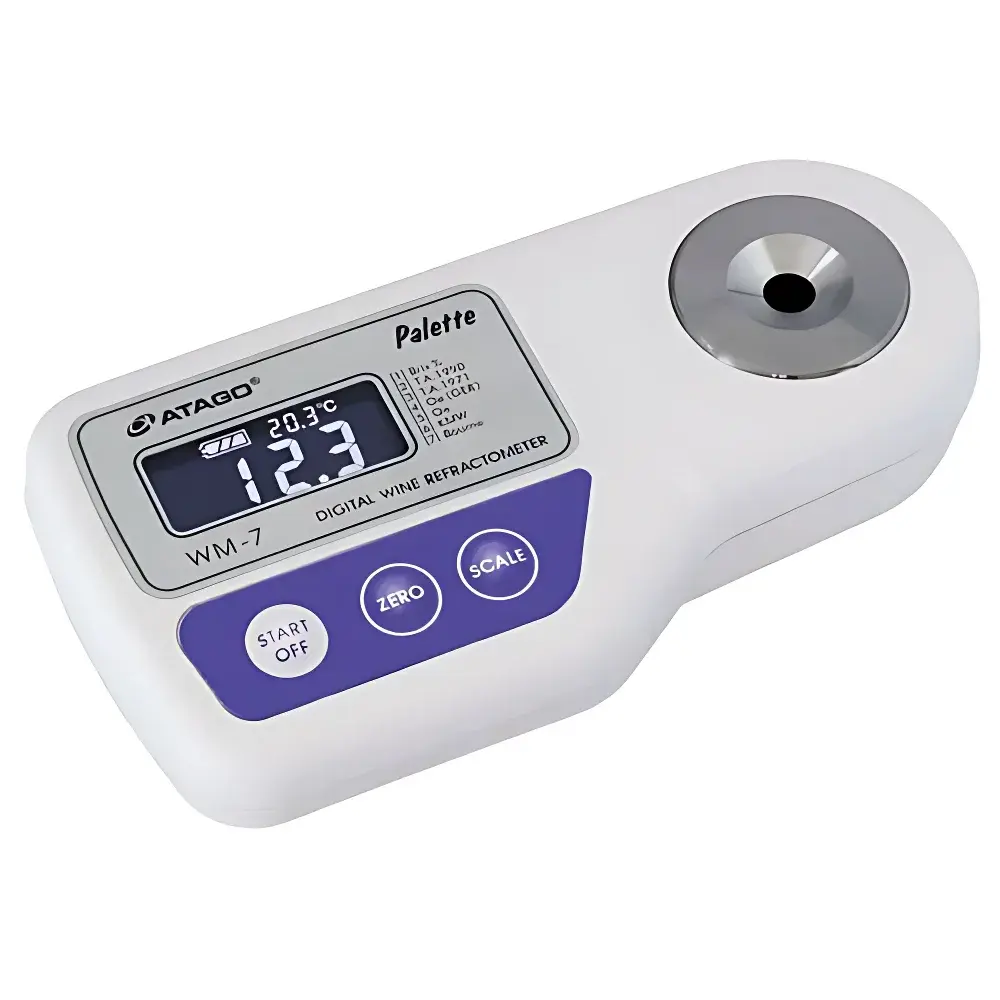
ATAGO WM-7 Digital Wine Refractometer
| Brand | ATAGO |
|---|---|
| Origin | Japan |
| Model | WM-7 |
| Product Type | Handheld Refractometer |
| Brix Range | 0.0–45.0% |
| Brix Resolution | 0.1% |
| Brix Accuracy | ±0.1% |
| Temperature Compensation | Automatic (5–40°C) |
| Measurement Time | 3 seconds |
| Display Scales | 7 (Brix, TA-1990, TA-1971, °Oe GER, °Oe, °KMW, °Bé) |
| IP Rating | IP65 |
| Power | 9V alkaline battery (006P) |
| Dimensions | 17 × 9 × 4 cm |
| Weight | 270 g (instrument only) |
Overview
The ATAGO WM-7 Digital Wine Refractometer is a precision handheld optical instrument engineered for rapid, field-deployable measurement of soluble solids concentration—primarily expressed as Brix—in grape must and wine-related liquids. It operates on the fundamental principle of critical-angle refractometry: light passing from a high-refractive-index prism into a liquid sample undergoes total internal reflection at a specific angle inversely proportional to the sample’s refractive index. This index correlates directly with dissolved sugar concentration under standardized conditions. Designed specifically for enology applications, the WM-7 enables winemakers and viticulturists to assess grape maturity pre-harvest, monitor fermentation progression, and verify juice standardization—all without laboratory infrastructure. Its automatic temperature compensation (ATC) algorithm conforms to the ICUMSA-standardized relationship between refractive index and temperature across the operational range of 5–40°C, ensuring consistent readings regardless of ambient or sample thermal drift.
Key Features
- Seven programmable display scales: Brix (ICUMSA), Titratable Acidity (TA-1990 and TA-1971), Oechsle (°Oe, German and general fruit juice standards), KMW (Klosterneuburger Mostwaage), and Baumé (°Bé), supporting international winemaking protocols and regional regulatory reporting requirements.
- High-resolution digital LCD with backlighting for legibility in variable lighting conditions—including vineyard rows, cellar environments, and mobile lab settings.
- Robust, ergonomic housing rated IP65—dust-tight and protected against low-pressure water jets—ensuring reliability during outdoor sampling and wet processing environments.
- True 3-second measurement cycle: minimal sample volume (0.3 mL), no warm-up time, and immediate stabilization post-application.
- Integrated ATC system compliant with ISO 2173:2003 (fruit juices — determination of soluble solids — refractometric method), eliminating manual correction tables and reducing operator variability.
- Calibration verification via distilled water (0.0% Brix) or certified sucrose reference solutions; no tools required—single-button calibration sequence accessible through intuitive menu navigation.
Sample Compatibility & Compliance
The WM-7 is validated for use with clarified grape must, fermented wine, fortified wines, and blended fruit-based musts within specified viscosity and turbidity limits. It is not intended for highly suspended, viscous, or strongly colored samples without prior filtration or dilution. The instrument complies with key international metrological and food safety frameworks: its Brix scale traceability aligns with ICUMSA Method GS3/8-4 (2021), and its performance specifications meet the repeatability and accuracy criteria outlined in AOAC Official Method 932.12 (Refractometric Determination of Soluble Solids in Fruit Juices). While not FDA 21 CFR Part 11–enabled (as it lacks audit-trail-capable data storage), its design supports GLP-aligned documentation workflows when paired with external logbooks or LIMS-integrated reporting systems.
Software & Data Management
The WM-7 operates as a standalone, embedded-system device with no onboard memory or USB/Bluetooth connectivity. All measurements are displayed in real time and must be manually recorded. However, its consistent output format (numeric value + unit identifier) facilitates structured transcription into electronic lab notebooks (ELNs), Excel-based quality control registers, or enterprise QMS platforms such as TrackWise or MasterControl. For users requiring automated data capture, ATAGO offers optional IR-compatible accessories (e.g., RS-232 interface kits) compatible with legacy industrial PCs—though these require third-party driver integration and are not bundled with the base WM-7 unit.
Applications
- Vineyard scouting: Real-time Brix assessment of berry clusters to determine optimal harvest timing aligned with target alcohol potential and phenolic maturity.
- Crush pad QC: Rapid verification of incoming grape lot consistency prior to destemming and pressing.
- Fermentation monitoring: Tracking Brix depletion kinetics to estimate residual sugar, predict dryness endpoints, and schedule racking or stabilization interventions.
- Blending support: Quantitative comparison of base wine components to achieve desired sweetness, body, and balance profiles.
- Regulatory compliance: Generating documented Brix values required for EU wine labeling regulations (Commission Regulation (EU) No 2019/934), USDA organic certification, and export health certificates.
- Research & education: Teaching tool for enology curricula demonstrating optical principles, sugar metabolism, and empirical correlations between refractive index and fermentable carbohydrate content.
FAQ
Does the WM-7 require temperature equilibration before measurement?
No—the built-in ATC sensor continuously monitors prism temperature and applies real-time correction per ISO 2173:2003 algorithms. Sample temperature need only fall within the 5–40°C operating window.
Can the WM-7 measure ethanol content directly?
No. It measures total soluble solids (predominantly sugars pre-fermentation); ethanol quantification requires distillation followed by density or IR analysis.
Is calibration traceable to NIST or PTB standards?
ATAGO provides factory calibration using sucrose solutions certified to ISO/IEC 17025-accredited reference materials. End-user recalibration uses distilled water (0.0% Brix) or NIST-traceable sucrose standards (e.g., SRM 84d).
What maintenance is required for long-term accuracy?
Daily prism cleaning with lens tissue and isopropyl alcohol; annual verification against certified standards recommended for GMP-aligned operations.
Is the WM-7 suitable for measuring must with pulp or skin fragments?
No—samples must be filtered (e.g., through cheesecloth or 0.45 µm syringe filters) to prevent scattering artifacts and prism surface contamination.




