
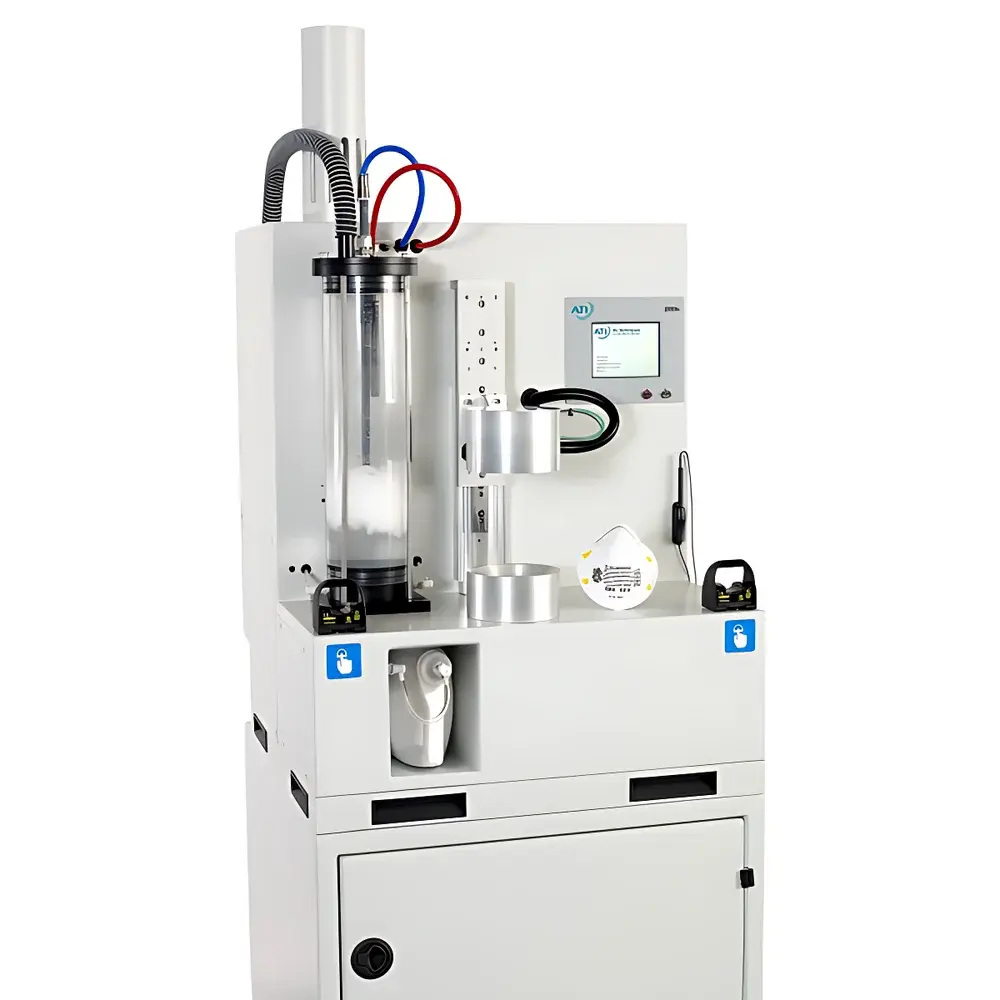
ATI 100X Automated Filter Tester
| Brand | ATI |
|---|---|
| Origin | USA |
| Manufacturer Type | Manufacturer |
| Origin Category | Imported |
| Model | 100X |
| Instrument Type | Aerosol Testing System |
| Compliance Standards | NIOSH 42 CFR Part 84, GB 2626, EN 13274-7:2019, ASTM F3502-21 |
Overview
The ATI 100X Automated Filter Tester is a high-precision, fully integrated aerosol testing platform engineered for quantitative evaluation of filtration efficiency and pressure drop across respirator filters, medical face masks, and industrial filter media. Operating on the principle of challenge-based aerosol penetration measurement, the system generates a stable, monodisperse or polydisperse test aerosol—typically sodium chloride (NaCl), dioctyl phthalate (DOP), or polyalphaolefin (PAO)—and delivers it at controlled flow rates to the test sample under standardized conditions. The instrument employs real-time photometric or particle-counting detection downstream to calculate fractional penetration and derive filtration efficiency with traceable uncertainty. Designed for regulatory-grade validation, the 100X supports both upstream/downstream dual-sensor configurations and full-volume sampling protocols required by international respiratory protection standards.
Key Features
- 100% full-volume aerosol sampling architecture ensures no bypass or dilution error, delivering metrologically sound efficiency data per ISO 17025-aligned practices.
- Three selectable volumetric flow rates up to 170 L/min, calibrated traceably to NIST standards, enabling compliance with diverse test protocols—including NIOSH TEB Method 0300 and EN 13274-7.
- High-accuracy differential pressure transducers (±0.1 Pa resolution) synchronized with flow control for precise ΔP characterization across filter media at specified face velocities.
- Filtration efficiency measurement range extends to 99.9995% (i.e., ≤5 × 10⁻⁶ penetration), supporting validation of P100, HEPA, and ULPA-grade materials.
- Patented aerosol replenishment system maintains continuous, stable challenge concentration without manual intervention or system shutdown during extended test sequences.
- Flexible operational modes: fully automated sequence execution, semi-automated hybrid workflows, and manual override for method development or troubleshooting.
- Low acoustic emission (<62 dBA at 1 m) enables seamless integration into shared QC and R&D laboratory environments without compromising ambient noise requirements.
Sample Compatibility & Compliance
The 100X accommodates flat-sheet filter media (up to 100 mm × 100 mm), pleated cartridges, molded respirator facepieces (N95, KN95, FFP2/FFP3), surgical and procedure masks (YY 0469, EN 14683), PAPR inlet filters, and anesthesia breathing circuit filters. It is validated for use in accordance with globally recognized regulatory frameworks including: NIOSH 42 CFR Part 84 (for particulate filtering facepiece respirators); GB 2626–2019 and GB 19083–2010 (China); EN 13274-7:2019 (paraffin oil challenge for filtering half masks); EN 12941/12942 (powered air-purifying respirators); ISO 23328–1:2021 (anesthesia and respiratory filter performance); ASTM F3502–21 (performance specification for barrier face coverings); and JIS T 8151 (Japan). All test methods are implemented with documented calibration intervals, audit trails, and electronic records compliant with FDA 21 CFR Part 11 and GLP/GMP data integrity requirements.
Software & Data Management
The embedded Windows-based control software provides intuitive workflow navigation, real-time graphical monitoring of aerosol concentration, pressure drop, and calculated efficiency, along with automated report generation in PDF and CSV formats. Each test run is time-stamped, user-authenticated, and stored with full metadata—including instrument ID, calibration status, environmental conditions (T/RH), operator credentials, and raw sensor outputs. Audit trail functionality logs all critical events (e.g., parameter changes, calibration actions, report exports) with immutable timestamps. Exported datasets retain SI-unit consistency and support third-party statistical analysis tools. Optional 21 CFR Part 11-compliant configuration includes role-based access control, electronic signatures, and encrypted database storage.
Applications
- Regulatory submission testing for FDA 510(k), CE marking, and NIOSH certification of respirators and medical masks.
- In-process quality control of electret-filter media, melt-blown nonwovens, and composite laminates used in PPE manufacturing.
- Comparative evaluation of aging, humidity conditioning, and mechanical stress effects on filter performance.
- Development and optimization of novel filtration architectures, including nanofiber-enhanced and antimicrobial-coated media.
- Validation of cleaning/reuse protocols for reusable elastomeric respirators and PAPR systems.
- Third-party verification testing for ISO/IEC 17025-accredited laboratories serving healthcare, pharmaceutical, and defense sectors.
FAQ
What aerosol agents are supported by the 100X system?
Sodium chloride (NaCl), dioctyl phthalate (DOP), polyalphaolefin (PAO), and paraffin oil—selected based on applicable standard requirements.
Does the 100X meet ISO/IEC 17025 traceability requirements?
Yes; all critical sensors (flow, pressure, photometer) are calibrated using NIST-traceable reference standards with documented uncertainty budgets.
Can the system be integrated into an existing LIMS or MES environment?
Yes; via configurable OPC UA or RESTful API interfaces for automated data ingestion and electronic batch record linkage.
Is training and application support included with purchase?
ATI provides on-site installation qualification (IQ), operational qualification (OQ), and comprehensive operator training aligned with GxP expectations.
What maintenance schedule is recommended for long-term accuracy?
Quarterly performance verification and annual full calibration are advised, with optional preventive maintenance contracts available.
Related Products







