
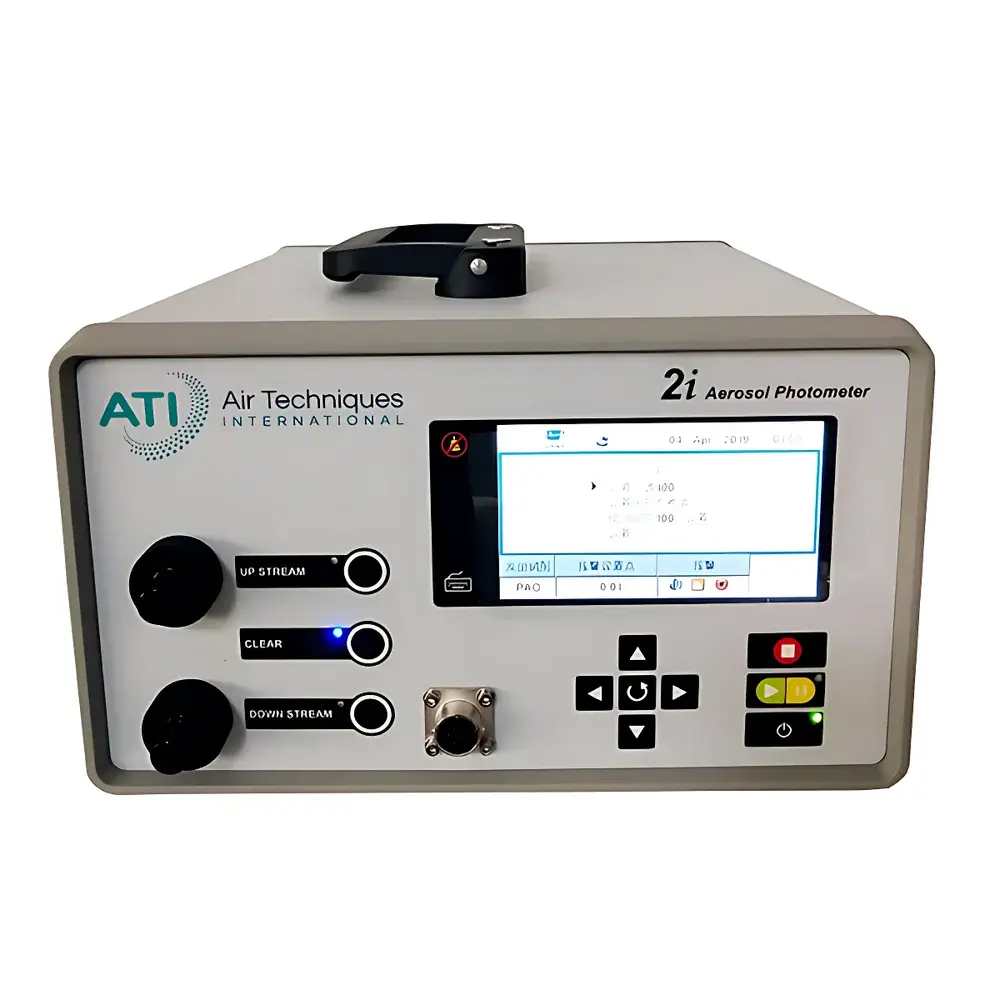
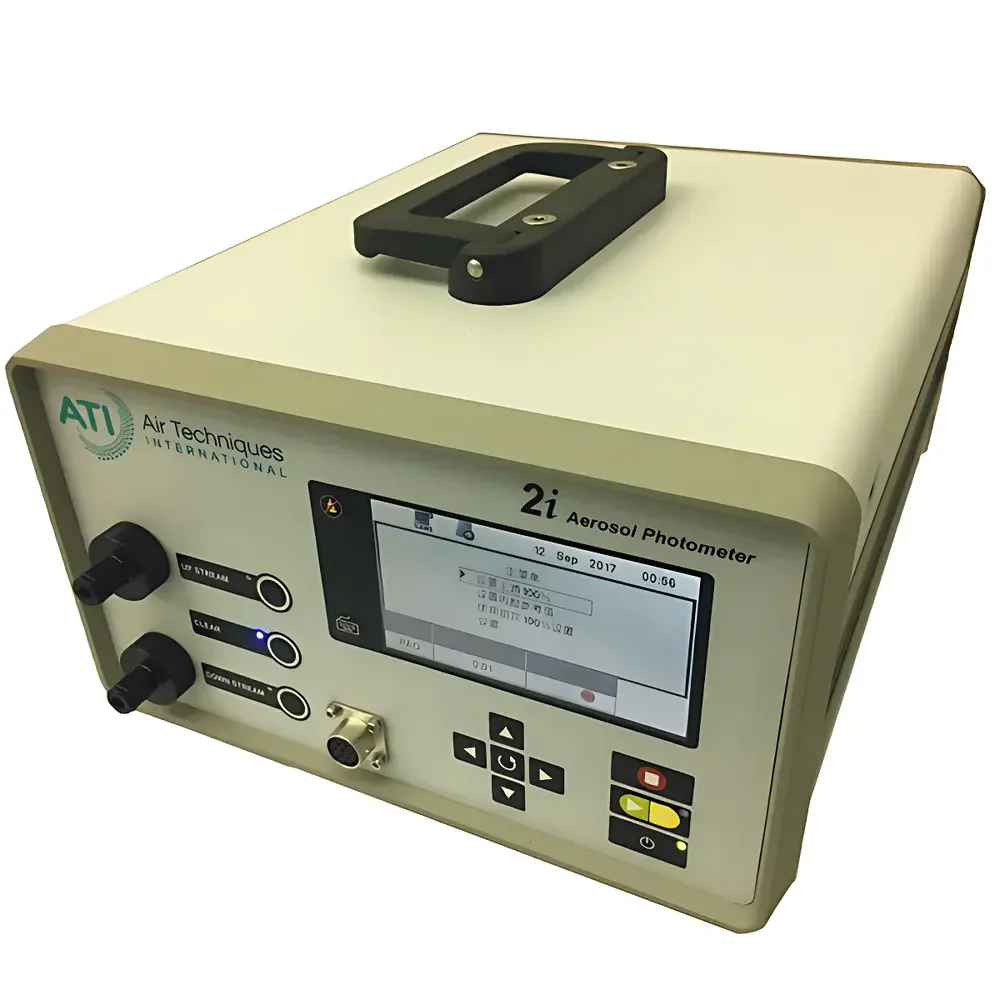
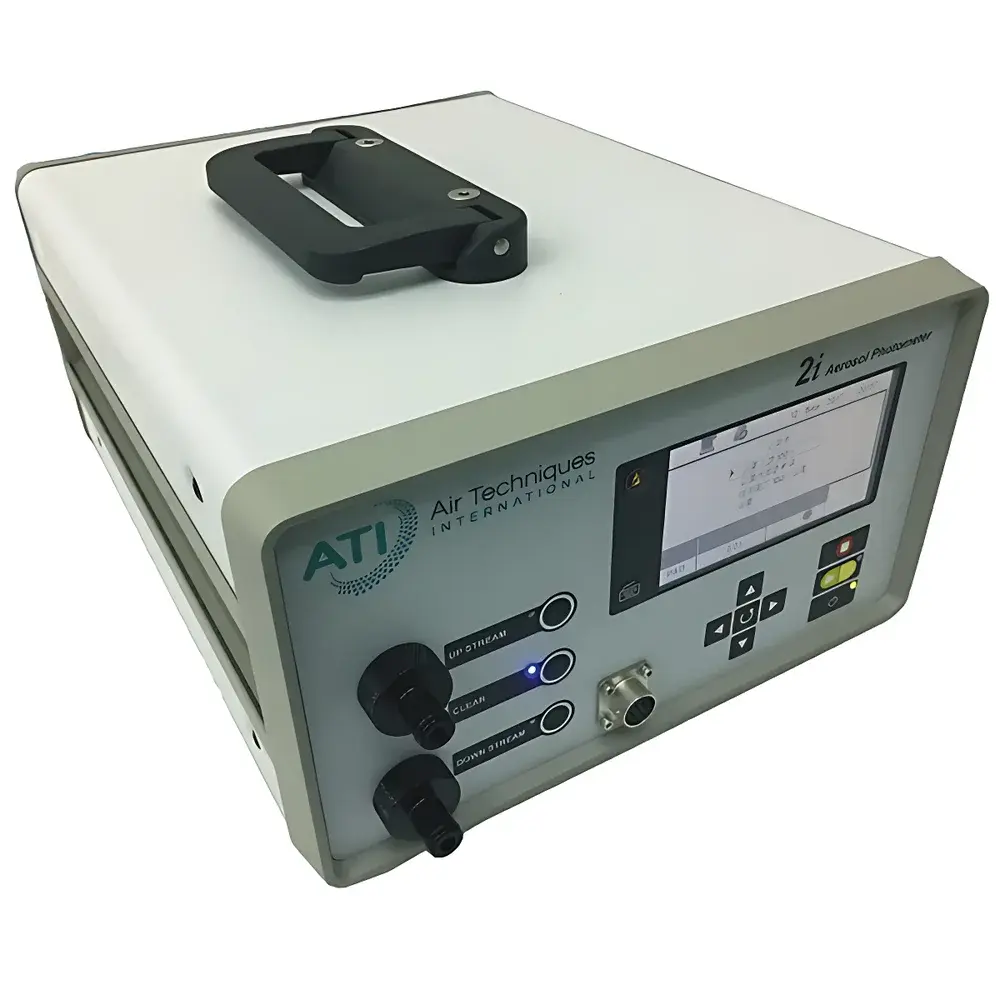
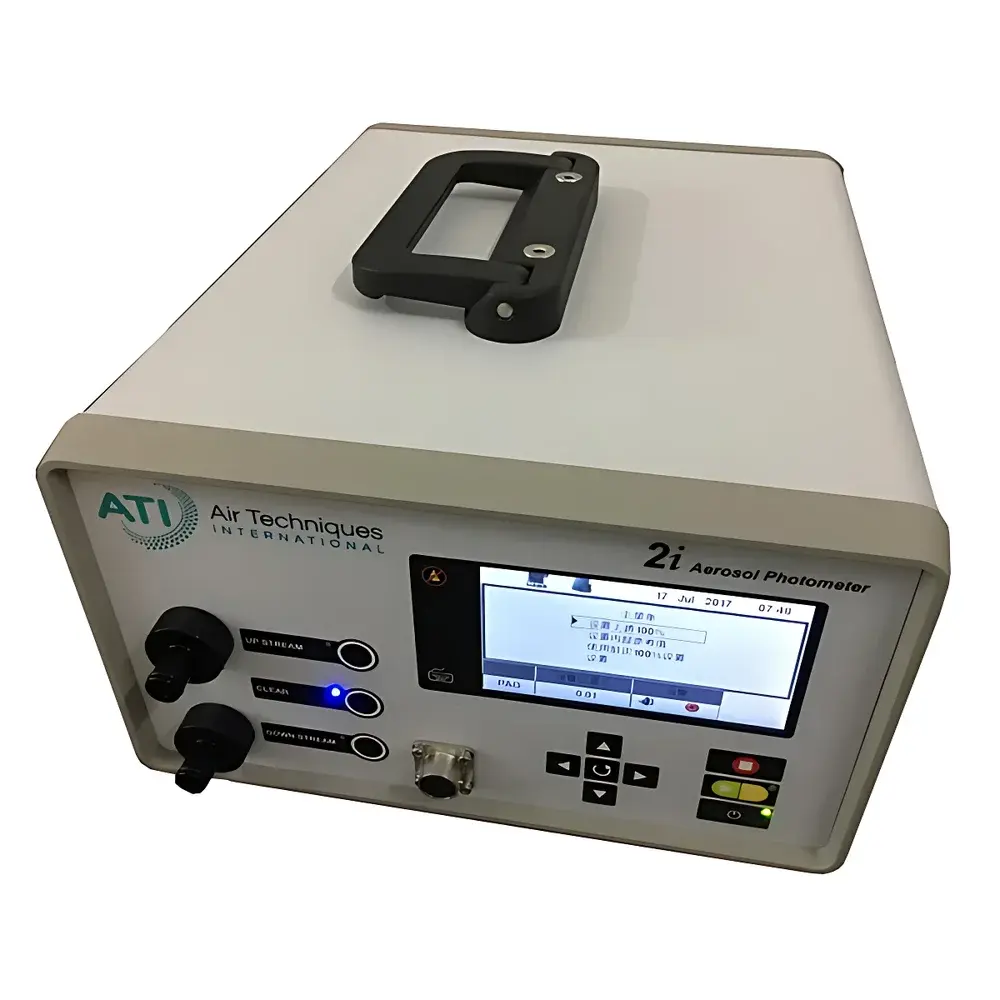
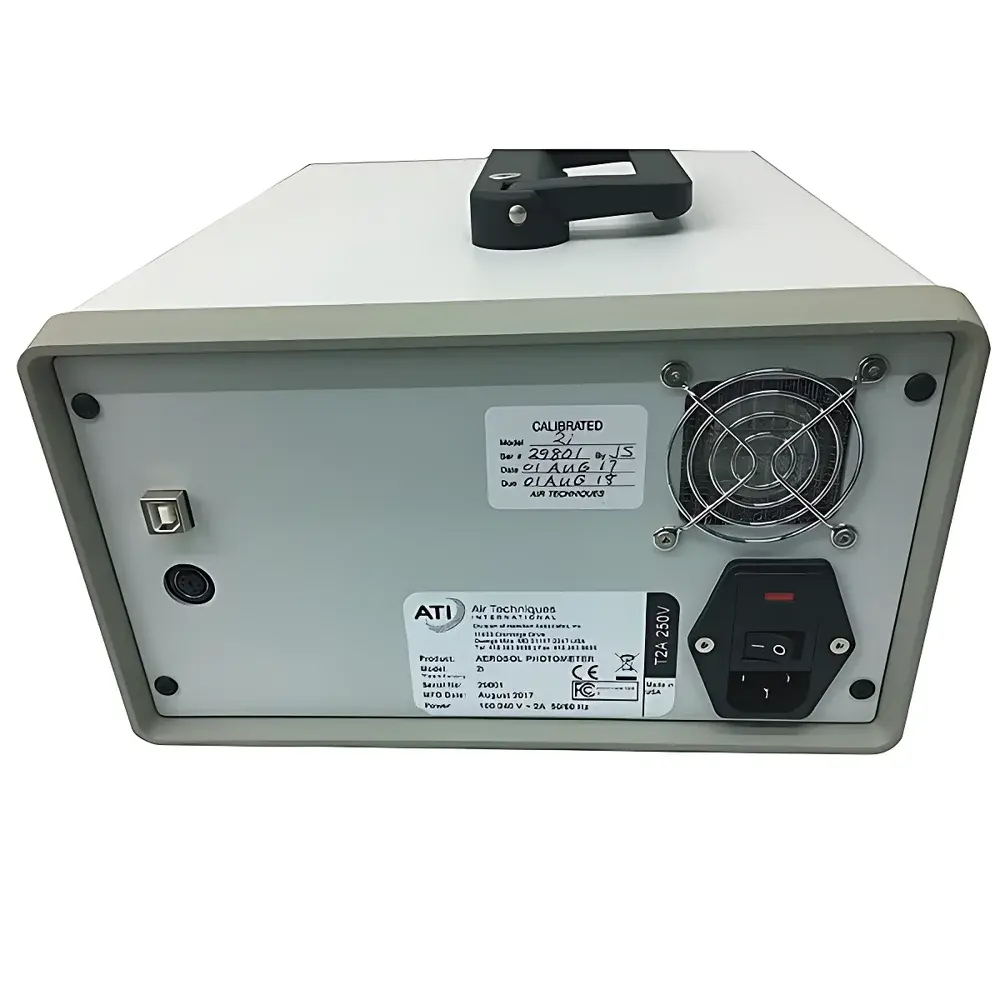
ATI TDA-2i Aerosol Photometer for Filter Integrity Testing
| Brand | ATI |
|---|---|
| Origin | USA |
| Model | TDA-2i |
| Dimensions | 25.7 cm × 33 cm × 15.2 cm |
| Weight | 8.6 kg (host 7.5 kg + probe & accessories 1.1 kg) |
| Power Supply | 100–250 V AC, 50/60 Hz |
| Flow Rate | 28.3 L/min ±10% |
| Detection Range | 0.0001% – 100.0% (aerosol penetration) |
| Sensitivity | ±1% of reading (≥0.01% to 100%) |
| Repeatability | ±0.5% of reading (≥0.01% to 100%) |
| Light Source | Solid-state, low-power, low-heat scattering cavity LED (50,000–100,000 hr lifetime) |
| Aerosol Compatibility | PAO-4, DOP, Ondina, PEG, Krydol, Corn Oil, Mineral Oil, Paraffin |
| Alarm | Audible + visual flashing on host and iProbe display |
| Data Output | USB interface (standard), thermal printer (optional) |
| Reporting Modes | Continuous, Summary, Monitoring |
| Compliance | NSF/ANSI 49, IEST-RP-CC001, ISO 14644-3, EN 61010-1:2010, EN 61326-1:2006, CE, FCC |
Overview
The ATI TDA-2i Aerosol Photometer is an engineered solution for quantitative filter integrity testing in cleanroom, pharmaceutical, and biomedical environments. It operates on the principle of light scattering photometry: aerosol particles—introduced upstream of a HEPA or ULPA filter—are illuminated by a stable, solid-state LED source within a precision optical cavity. Scattered light intensity is measured downstream and converted into real-time aerosol concentration (expressed as percent penetration relative to upstream challenge). This enables highly reproducible detection of filter leaks at sensitivities down to 0.0001% penetration, supporting validation per ISO 14644-3, IEST-RP-CC001, and NSF/ANSI 49 requirements. Unlike qualitative smoke tests, the TDA-2i delivers traceable, quantitative data essential for FDA-regulated facilities operating under cGMP and EU Annex 1 frameworks.
Key Features
- Integrated dual-display architecture: Both the main unit and the iProbe scanning head feature full-color LCDs with identical menu navigation—enabling remote configuration without returning to the host.
- Intelligent zeroing protocol: Automatic zero establishment during “Clear” mode using internal ultra-pure filtration; optional downstream zeroing prior to scan initiation ensures baseline stability across variable ambient conditions.
- Pulse-width modulated (PWM) flow control maintains consistent 28.3 L/min sampling regardless of probe orientation, hose length, or filter resistance—critical for compliance with ISO 14644-3 sampling velocity specifications.
- Rugged die-cast aluminum chassis with ergonomic tilt-adjustable handle facilitates field deployment, panel visibility, and service accessibility—internal components are modular for calibration traceability and NIST-traceable recalibration.
- Multi-aerosol compatibility: Validated for PAO-4, DOP, Ondina, PEG, Krydol, corn oil, mineral oil, and paraffin—supporting both legacy and modern non-hazardous challenge agents aligned with IEST and USP guidance.
Sample Compatibility & Compliance
The TDA-2i is designed for use in controlled environments where regulatory-grade documentation and audit readiness are mandatory. Its measurement methodology satisfies the physical detection criteria defined in ISO 14644-3 Annex B for filter leak testing and aligns with the performance verification protocols of NSF/ANSI 49 for biosafety cabinets. All firmware operations—including zeroing, alarm triggering, and report generation—log timestamps and operator IDs, enabling GLP/GMP-compliant recordkeeping. The device meets electrical safety standards EN 61010-1:2010 and electromagnetic compatibility standard EN 61326-1:2006, and carries CE and FCC markings for global deployment. Calibration certificates provided with each unit are traceable to NIST standards, and optional IQ/OQ documentation packages support qualification under 21 CFR Part 211 and EU GMP Annex 15.
Software & Data Management
Data acquisition and reporting are managed through three native operational modes: Continuous (real-time streaming), Summary (filter-position-specific aggregation), and Monitoring (time-interval logging). Raw concentration values, timestamps, alarm events, and user inputs are stored internally and exportable via USB to standard CSV or Excel-compatible formats—no proprietary software required. Optional thermal printing provides immediate hard-copy reports compliant with internal SOPs or external audit requests. All output includes instrument ID, calibration date, operator name, test location, and aerosol type—ensuring full data lineage for FDA 21 CFR Part 11–aligned environments when paired with validated electronic signature workflows.
Applications
- HEPA/ULPA filter leak testing in cleanrooms (ISO Class 5–8), isolators, and laminar flow hoods.
- Performance verification of biosafety cabinets (Class II A2/B2) per NSF/ANSI 49.
- Qualification and routine monitoring of HVAC terminal filters in pharmaceutical manufacturing suites.
- Validation of containment systems in API synthesis and cytotoxic drug handling areas.
- Commissioning and requalification of environmental control systems following ISO 14644-1 and EU GMP Annex 1.
FAQ
What aerosol agents are certified for use with the TDA-2i?
PAO-4, DOP, Ondina, PEG, Krydol, corn oil, mineral oil, and paraffin—all validated per IEST-RP-CC001 and compatible with non-hazardous agent requirements under USP and EU GMP Annex 1.
Does the TDA-2i meet FDA 21 CFR Part 11 requirements?
The instrument supports Part 11 compliance when integrated into a validated electronic record system—its timestamped, operator-identified data logs and USB-exportable audit trails satisfy data integrity requirements for electronic signatures and record retention.
Is field calibration possible without returning the unit to ATI?
Yes—modular design allows authorized service technicians to perform NIST-traceable calibration using certified reference aerosols and documented procedures outlined in the included calibration manual.
Can the iProbe operate independently of the main unit?
No—the iProbe functions exclusively as a remote interface extension; all photometric processing, flow control, and data storage occur in the host unit.
What is the expected lifetime of the optical light source?
The solid-state LED cavity has a rated operational life of 50,000–100,000 hours, with minimal drift and no warm-up time—ensuring long-term measurement stability without lamp replacement.
Related Products







