
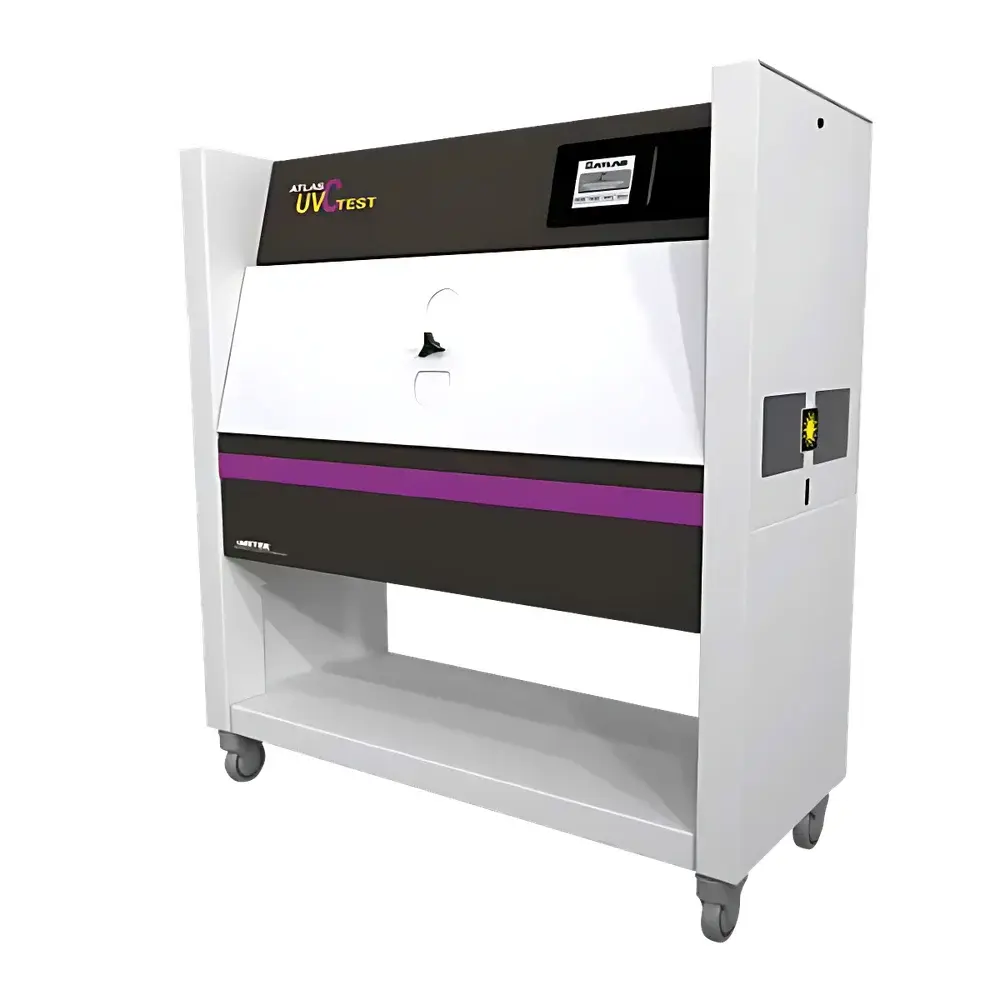
Atlas UVCTest UV-C Degradation Testing Chamber
| Brand | ATLAS |
|---|---|
| Origin | USA |
| Model | UVCTest |
| Chamber Type | UV-C Environmental Aging Test System |
| Light Source | UVC Germicidal Lamps (254 nm) |
| Temperature Range | Ambient to 80 °C |
| Humidity Control | Optional Integrated RH Module (10–95% RH, ±3% RH) |
| Sample Capacity | Standard 300 mm × 300 mm × 150 mm Exposure Zone |
| Compliance | ASTM G154, ISO 4892-3, IEC 60068-2-5 (UVC-modified), ATLAS Internal UV-C Irradiance Calibration Protocol |
Overview
The Atlas UVCTest is a purpose-engineered UV-C degradation testing chamber designed to replicate the photobiological stress imposed by commercial 254 nm germicidal ultraviolet irradiation systems. Unlike conventional UV-A/UV-B weathering chambers compliant with ASTM G154 or ISO 4892-3, the UVCTest integrates traceable, spectrally stabilized UVC emission (peak at 254 nm ±1 nm) with precise irradiance control (0.1–5.0 W/m² adjustable at sample plane), thermal management, and optional humidity regulation. It addresses an emerging materials qualification gap: the absence of standardized accelerated aging protocols for UVC-induced photochemical degradation in polymers, coatings, textiles, adhesives, and electronic encapsulants. The system operates on the principle of controlled photon flux exposure—quantifying cumulative radiant exposure (J/m²) while monitoring real-time spectral output via integrated NIST-traceable UVC radiometers. This enables correlation between laboratory exposure and field-relevant UVC disinfection cycles used in healthcare facilities, transit infrastructure, and consumer electronics sanitation workflows.
Key Features
- UVC-specific optical architecture: Dual-lamp configuration with high-purity fused silica reflectors and quartz sleeves optimized for 254 nm transmission (>92% transmittance)
- Real-time irradiance monitoring: Built-in calibrated UVC radiometer (240–260 nm bandwidth) with automatic feedback loop to maintain setpoint stability within ±2% over 1,000-hour operation
- Thermal management system: Air-cooled black-panel temperature control (35–80 °C range, ±0.5 °C accuracy) with independent sensor positioning per test specimen
- Modular environmental control: Optional integrated humidity module (10–95% RH, ±3% RH) compliant with modified IEC 60068-2-5 Annex B for combined UVC + moisture stress evaluation
- Test chamber construction: Stainless steel 316L interior with UVC-resistant epoxy coating; interlocked safety shutter and ozone exhaust port (activated carbon filter included)
- Compliance-ready calibration: Factory-certified irradiance mapping report (per ASTM E275) and annual recalibration traceable to NIST SRM 2032
Sample Compatibility & Compliance
The UVCTest accommodates flat, rigid, or semi-flexible specimens up to 300 mm × 300 mm × 150 mm, including molded polymer parts, coated metal substrates, textile swatches (ASTM D4966), printed circuit board laminates (IPC-CC-830B), and medical-grade silicone elastomers. Fixture options include non-reflective aluminum sample holders, UV-transparent quartz sample stages, and multi-angle mounting brackets for directional exposure studies. Regulatory alignment includes support for internal qualification against FDA 21 CFR Part 11 (audit trail enabled in software), GLP-compliant test record generation, and compatibility with ISO 17025-accredited laboratories. While no international standard yet mandates UVC-specific aging, the UVCTest’s operational parameters are structured to satisfy preliminary validation requirements outlined in USP , IEC 62368-1 Annex H (optical radiation safety), and draft CIE Technical Note 253:2023 on UVC material durability assessment.
Software & Data Management
Control and data acquisition are managed via ATLAS WinTest v5.2—a Windows-based platform supporting multichannel real-time logging of irradiance (W/m²), black-panel temperature (°C), chamber humidity (%RH), elapsed exposure time (h), and cumulative fluence (J/m²). All data streams are timestamped with millisecond precision and stored in encrypted SQLite databases compliant with 21 CFR Part 11 (electronic signatures, audit trails, user role permissions). Export formats include CSV, PDF test reports (with embedded calibration certificates), and XML for LIMS integration. Remote monitoring is available via secure HTTPS interface with TLS 1.2 encryption; no cloud storage is performed—the system operates as an air-gapped local installation unless explicitly configured otherwise by the user.
Applications
- Accelerated lifetime prediction of polymeric components exposed to repeated UVC surface disinfection in hospital rooms, ambulances, and cleanrooms
- Evaluation of yellowing, embrittlement, and gloss loss in automotive interior trim (PP, TPO, PU leather) subjected to UVC-emitting HVAC duct systems
- Stability screening of conformal coatings on PCBs under cyclic UVC exposure simulating automated disinfection robots in electronics manufacturing
- Validation of UV-blocking additives in medical textiles and antimicrobial fabrics per AATCC TM183-2022 (UVC transmittance method)
- Correlation studies between laboratory UVC dose and field performance of signage, kiosks, and touchscreens in airports and mass-transit hubs
- Research into photooxidative mechanisms in silicone-based gaskets and EPDM seals used in UVC-sanitized HVAC enclosures
FAQ
Does the UVCTest comply with ASTM G154 or ISO 4892-3?
Yes—but only for UV-A/UV-B modes when equipped with optional fluorescent UV-B lamps. The standard UVCTest configuration is optimized for 254 nm UVC and references modified versions of these standards (e.g., ISO 4892-3:2016 Annex D for UVC adaptation).
Can ozone accumulation be mitigated during extended UVC operation?
Yes. The chamber includes a dedicated ozone exhaust port with activated carbon filtration and optional catalytic ozone destruct module (order code: OZ-DESTR-UVCTEST).
Is spectral irradiance uniformity validated across the exposure area?
Yes. Each unit ships with a full irradiance mapping report (per ASTM E275) documenting spatial uniformity ≥85% across the 300 mm × 300 mm exposure zone.
What is the recommended recalibration interval for the UVC radiometer?
Annual recalibration is recommended and traceable to NIST SRM 2032. Field verification using ATLAS UV-C Reference Standards (Cat. No. UVREF-254) is supported quarterly.
Are consumables such as UVC lamps covered under warranty?
UVC germicidal lamps are classified as wear items and excluded from the standard 24-month parts-and-labor warranty; lamp life is rated at 1,000 hours at nominal output.



