
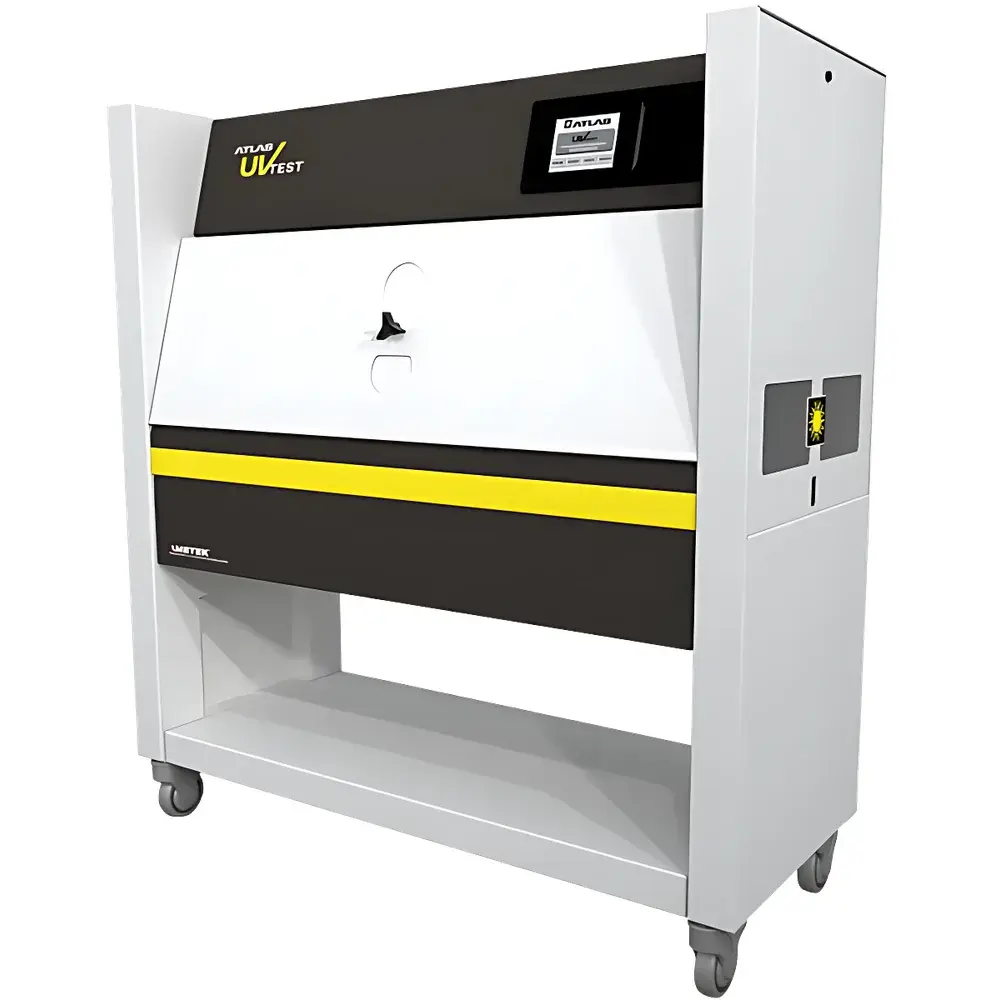
Atlas UVTest UV Aging Test Chamber
| Brand | ATLAS |
|---|---|
| Origin | USA |
| Model | UVTest |
| Test Duration | 1–9999 h |
| Irradiance Range | Typical 0.89 W/m² (UVA), 0.71 W/m² (UVB) |
| Lamp Power | 40 W per tube |
| Humidity Control | High-humidity mode |
| Illuminated Chamber Temperature Range | 35–80 °C |
| Black Panel Temperature (BPT) Range | UV Phase 35–80 °C |
| Spectral Peak Wavelengths | 351 nm, 340 nm, 313 nm (irradiance-controlled) |
Overview
The Atlas UVTest UV Aging Test Chamber is an engineered solution for accelerated weathering and photochemical degradation testing of polymeric, coating, automotive, aerospace, and architectural materials. Based on the fluorescent ultraviolet (QUV) principle—employing UVA-340, UVB-313, or UVA-351 lamp spectra—the UVTest replicates critical short-wave UV radiation found in terrestrial sunlight while integrating controlled condensation cycles to simulate dew formation. Unlike broad-spectrum xenon arc or carbon arc systems, this chamber delivers highly repeatable, spectrally defined UV exposure with precise black panel temperature (BPT) regulation, enabling compliance with internationally recognized accelerated aging protocols including ASTM G154, ISO 4892-3, EN 1062-7, SAE J2020, and GB/T 14522. Its modular architecture supports dual-stack configuration, optimizing laboratory floor space without compromising test integrity or thermal uniformity across specimens.
Key Features
- Eight 40 W fluorescent UV lamps (UVA-340, UVB-313, or UVA-351)—user-selectable per test standard requirements
- Patented irradiance access port enabling in-chamber sensor calibration without lamp removal or system shutdown
- Black panel temperature (BPT) control with independent monitoring in both UV irradiation and condensation phases
- Multi-language capacitive touchscreen interface (English, German, French, Spanish, Chinese, Japanese) supporting intuitive programming, real-time data visualization, and event logging
- Dual-stack capability: two UVTest units can be vertically integrated using certified mechanical support frames, doubling throughput within identical footprint
- Optional recirculating spray system reduces deionized water consumption by up to 70% versus conventional continuous spray configurations
- Integrated safety architecture: door interlock, overtemperature cutoff, lamp fault detection, and CE-compliant construction validated under UL 61010-1 and CSA C22.2 No. 61010-1
- Compliance-ready design: preconfigured test profiles align with ASTM D4329, ISO 11507, AATCC TM186, and MIL-STD-810H Method 506.6
Sample Compatibility & Compliance
The UVTest accommodates standard specimen sizes (e.g., 75 × 150 mm, 100 × 150 mm) on adjustable sample racks with non-reactive aluminum fixtures. Specimens are mounted at 45° or vertical orientation depending on test method requirements. The chamber meets GLP-relevant operational traceability criteria through built-in audit trail functionality (when paired with optional Atlas WinX software). All irradiance measurements conform to NIST-traceable calibration hierarchies, and BPT sensors are compliant with ASTM E1980 Annex A2 for spectral responsivity correction. Regulatory alignment includes FDA 21 CFR Part 11 readiness via electronic signature and data integrity modules (available with WinX v5.2+), as well as full adherence to ISO/IEC 17025 documentation practices for accredited laboratories.
Software & Data Management
Control and data acquisition are managed via Atlas WinX—a Windows-based platform offering protocol-driven test sequencing, automated irradiance ramping, and time-stamped parameter logging (temperature, humidity, irradiance, cycle phase). WinX supports CSV export, PDF report generation with embedded metadata, and configurable alarm thresholds with email/SNMP notification. When deployed in networked environments, WinX integrates with LIMS via ODBC and supports OPC UA connectivity for enterprise-level MES integration. All raw datasets include cryptographic hash verification to ensure immutability during regulatory audits. Firmware updates are delivered through secure HTTPS channels with SHA-256 signature validation.
Applications
- Automotive exterior trim and headlamp lens durability validation per SAE J2412 and J2527
- Architectural coating performance assessment against chalking, gloss loss, and color shift (ASTM D4587)
- Polymer photostability screening for medical device housings and packaging films
- Aerospace composite material qualification under UV/humidity cycling per Boeing BMS 10-60 and Airbus ABD0031
- Textile UV resistance evaluation per AATCC TM186 and ISO 105-B02
- RoHS-compliant electronics enclosure testing for long-term UV-induced embrittlement
FAQ
What lamp types are supported, and how are they selected for specific standards?
The UVTest accepts UVA-340 (closest match to solar UV below 365 nm), UVB-313 (enhanced degradation for aggressive screening), and UVA-351 (simulates透过 window glass) lamps. Selection is governed by test method requirements—e.g., ASTM G154 Cycle 1 mandates UVA-340, while Cycle 4 specifies UVB-313.
Is black panel temperature (BPT) measured and controlled separately in UV and condensation phases?
Yes. Dual BPT sensors operate independently: one actively regulates temperature during irradiation (35–80 °C), while a second maintains condensation-phase limits (35–60 °C) without cross-interference.
How does the patented irradiance port improve measurement reliability?
It allows insertion of a calibrated reference sensor directly into the irradiation field while lamps remain energized, eliminating downtime and positional error associated with external calibration jigs.
Can the UVTest be validated for IQ/OQ/PQ in regulated environments?
Yes. Atlas provides vendor-qualified validation protocols, factory-assembled IQ/OQ documentation packages, and PQ support tools compatible with FDA, EMA, and PMDA expectations.
What water quality specifications apply to the recirculating spray option?
Deionized water with resistivity ≥1 MΩ·cm and silica <10 ppb is required; the recirculation module includes inline conductivity monitoring and automatic drain-flush logic to prevent mineral buildup.



