
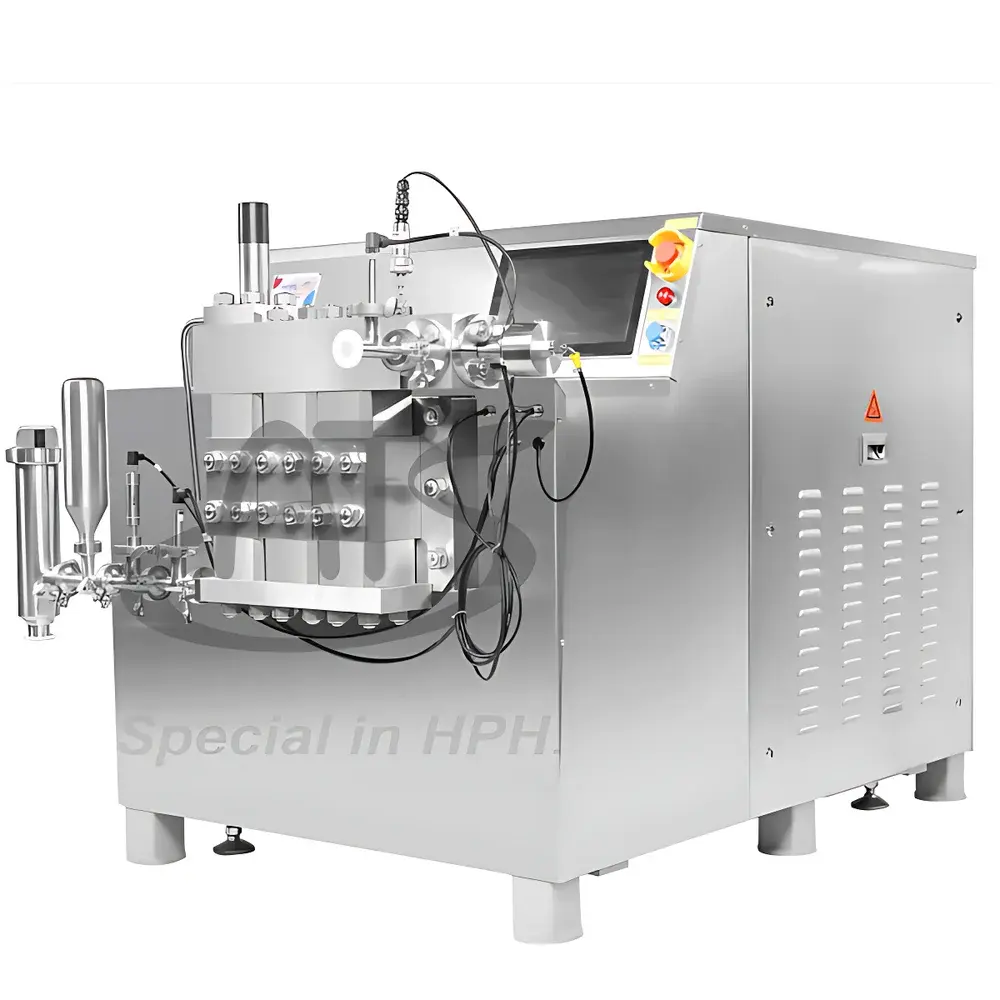
ATS AH22-100 Production-Scale High-Pressure Homogenizer
| Brand | ATS |
|---|---|
| Origin | Jiangsu, China |
| Manufacturer Type | Direct Manufacturer |
| Product Category | Domestic |
| Model | AH22-100 |
| Instrument Type | High-Pressure Homogenizer |
| Dimensions (W×D×H) | 800 × 530 × 740 mm |
| Processing Capacity | 10–500 L per batch |
| Maximum Operating Pressure | 1000 bar |
| Flow Rate | Up to 500 L/h (variable via frequency converter) |
| Cooling | Integrated in-line cooler + external chiller |
| Material of Construction | 316L stainless steel housing |
| Max Continuous Operating Temperature | 90°C |
| Compliance | ISO 9001 certified |
| Cleaning/Sterilization | CIP (Clean-in-Place) and SIP (Sterilize-in-Place) capable |
Overview
The ATS AH22-100 is a production-scale high-pressure homogenizer engineered for consistent, scalable, and GMP-compliant cell disruption, nanoemulsion formation, liposome extrusion, and particle size reduction in biopharmaceutical, nutraceutical, and functional food manufacturing. It operates on the principle of controlled high-pressure fluid dynamics: process fluid is pressurized by precision reciprocating plunger pumps and forced through an adjustable, geometrically defined micro-orifice (the homogenizing valve). Upon sudden pressure release across this narrow clearance zone, the fluid accelerates to supersonic velocities (>1000 m/s), generating intense hydrodynamic cavitation, turbulent impact against a hardened impact ring, and extreme shear gradients. This tri-modal mechanical energy transfer enables reproducible sub-100 nm particle size distributions and >99% microbial or cellular lysis efficiency—critical for monoclonal antibody purification, mRNA-LNP formulation, and stable nano-dispersions.
Key Features
- Robust dual-cooling architecture: integrated in-line heat exchanger at the homogenization point + external recirculating chiller—ensures thermal stability during extended batch processing (e.g., multi-pass homogenization of temperature-sensitive biologics).
- Variable flow control via industrial-grade frequency converter (VFD), enabling precise adjustment from 50 to 500 L/h without compromising pressure integrity or valve wear life.
- GMP-optimized construction: all wetted surfaces fabricated from corrosion- and wear-resistant materials—including tungsten carbide seat inserts, silicon nitride valve cores, and zirconia impact rings—to maintain dimensional stability and metrological repeatability over >10,000 operating hours.
- Full CIP/SIP capability: hygienic 316L stainless steel frame with orbital-welded piping, zero-dead-leg design, and validated steam-compatible seals meeting ASME BPE-2023 surface finish (Ra ≤ 0.4 µm) and leak-tightness standards.
- Modular pressure control system: digital pressure transducer feedback loop with real-time PID regulation ensures ±0.5% pressure stability across full 50–1000 bar range—even under variable viscosity or particulate load conditions.
Sample Compatibility & Compliance
The AH22-100 accommodates viscous suspensions (up to 15,000 cP), fibrous biomass slurries, lipid-based pre-emulsions, and sterile-filtered protein solutions. Its design conforms to ISO 22000 (food safety), ISO 13485 (medical devices), and ICH Q5A/Q5D (biotechnological product characterization). For pharmaceutical applications, the system supports 21 CFR Part 11-compliant electronic records—including audit trails for pressure setpoints, temperature logs, flow rate profiles, and CIP cycle parameters—with role-based user authentication and encrypted data export. All validation documentation (IQ/OQ/PQ protocols, FAT/SAT reports) is provided per client specification.
Software & Data Management
Equipped with ATS Homogenization Suite v3.2—a Windows-based SCADA interface with OPC UA connectivity—the system delivers real-time visualization of homogenization parameters, automated pass-count tracking, and deviation alerts (e.g., pressure drift >±2 bar for >5 s). Data is stored in SQL Server with automatic daily backup and configurable retention policies. Export formats include CSV, PDF e-signature-ready reports, and XML for LIMS integration. Optional MES/ERP linkage enables batch traceability from raw material intake to final fill-finish.
Applications
- Biopharmaceuticals: E. coli and yeast cell lysis for recombinant protein recovery; homogenization of viral vector suspensions (AAV, lentivirus); preparation of lipid nanoparticles for mRNA delivery.
- Food & Nutraceuticals: Nano-sizing of curcumin, resveratrol, and omega-3 emulsions; stabilization of dairy protein micelles; reduction of polyphenol particle size for enhanced bioavailability.
- Cosmeceuticals: Formation of non-ionic surfactant-free nanoemulsions; uniform dispersion of UV filters (e.g., zinc oxide) without aggregation.
- Fine Chemicals: Catalyst nanoparticle dispersion for heterogeneous reactions; pigment deagglomeration in inkjet inks and coatings.
FAQ
What is the maximum allowable solids content for continuous operation?
Up to 25% w/w suspended solids is supported with optional high-wear valve kits; above 15%, flow rate must be reduced to maintain <1000 bar stability.
Can the AH22-100 be validated for sterile processing?
Yes—SIP validation per HTM 01-05 or EN 285 is achievable using 121°C saturated steam for ≥15 min; all elastomers are EPDM/FKM-certified for repeated sterilization cycles.
Is remote monitoring and predictive maintenance supported?
Standard Ethernet/IP and Modbus TCP interfaces enable connection to cloud-based condition monitoring platforms; vibration, temperature, and pressure trend analytics support failure mode prediction with ≥72 h lead time.
Does ATS provide installation qualification (IQ) documentation?
Yes—custom IQ packages include as-built P&IDs, material certifications (EN 10204 3.1), surface roughness verification reports, and calibration certificates for all critical sensors.
What maintenance intervals are recommended for GMP environments?
Plunger seals: every 500 operational hours; homogenizing valves: every 1,200 hours or after 20,000 L processed—whichever occurs first; full CIP line inspection: quarterly per cGMP Annex 11.



