
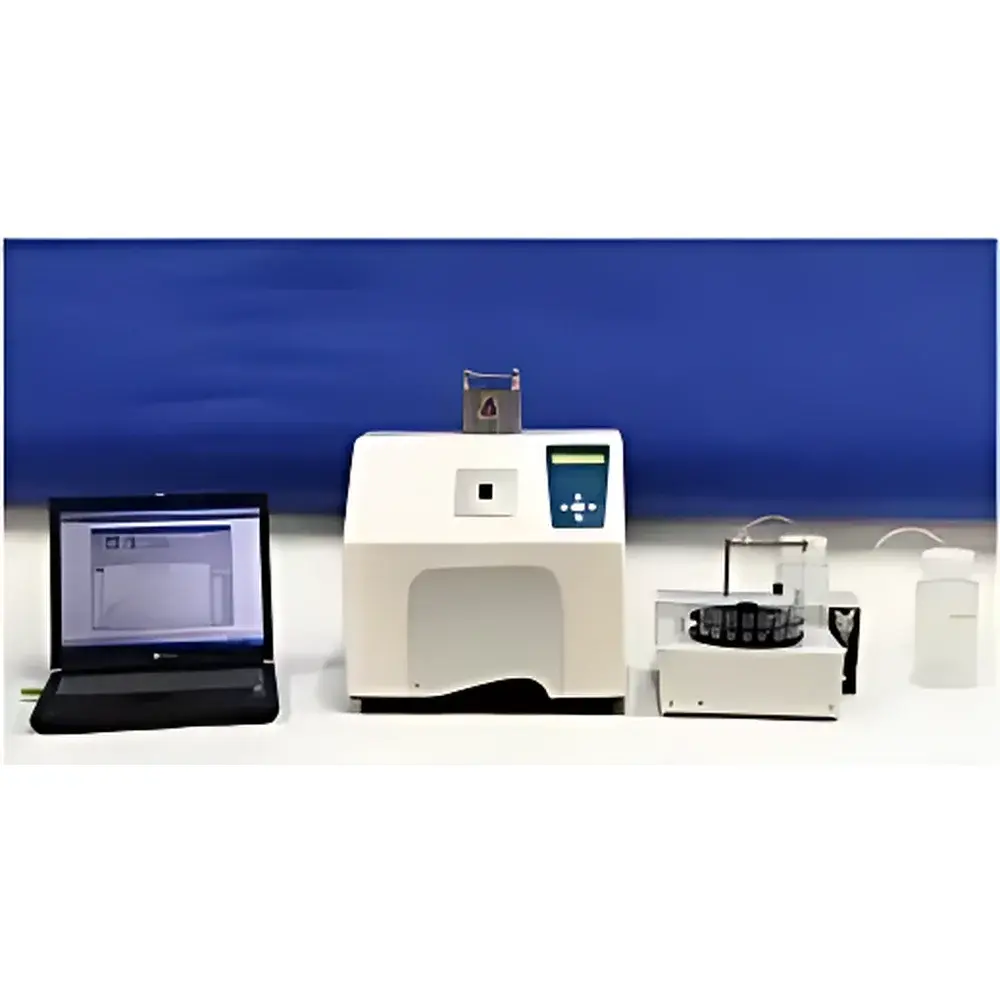
ATS ATS 200S/40998 Flame Photometer
| Brand | ATS |
|---|---|
| Origin | Switzerland |
| Model | ATS 200S/40998 |
| Measurement Principle | Atomic Emission Spectrometry (Flame Photometry) |
| Elements Measured (Standard) | Na, K, Ca, Mg |
| Optional Channels | Ba or custom single-element channel |
| Measurement Units | ppm, mmol/L, mEq/L |
| Linear Range | Na/K/Ca 0–200 ppm |
| Detection Limit | 0.2 ppm (Na, K) |
| Sensitivity | 0.4 ppm (Na, K) |
| Precision | ≤1% CV (n=10) |
| Drift | ≤1% over 30 min |
| Fuel Gases | Butane, Propane, LPG |
| Air Supply | Oil-free, water-free, particle-free compressed air with buffer tank |
| Optical Design | Fixed interference filters (non-movable) |
| Calibration | Automatic zeroing + single-point memory calibration |
| Software | ATS MiniSoftWin™ (GLP-compliant reporting, multi-point calibration curve generation, method/data archiving, ISO/IEC 17025 report templates) |
Overview
The ATS ATS 200S/40998 Flame Photometer is a precision benchtop atomic emission spectrometer engineered for routine quantitative analysis of alkali and alkaline earth metals—primarily sodium (Na), potassium (K), calcium (Ca), and magnesium (Mg)—in liquid samples across environmental, agricultural, food, pharmaceutical, and industrial quality control laboratories. Based on flame photometric principles, the instrument atomizes and thermally excites sample aerosols in a controlled hydrocarbon-air flame; emitted characteristic wavelengths are isolated via fixed-bandpass interference filters and quantified by a photomultiplier detector. Its microprocessor-controlled architecture integrates mobile-grade signal processing electronics to enable simultaneous four-channel measurement within a single aspiration cycle—eliminating sequential scanning delays and enhancing throughput without compromising photometric stability. Designed and assembled in Switzerland, the system emphasizes mechanical robustness, optical integrity, and regulatory readiness for GLP and ISO/IEC 17025 environments.
Key Features
- Four-channel simultaneous detection (Na, K, Ca, Mg) with optional fifth channel (e.g., Ba) configurable at factory or field level
- Fixed-optics design: Non-movable interference filters ensure long-term wavelength fidelity and eliminate alignment drift
- Integrated LabAssistant™ ATS/20101 module with piston-driven micro-volume dilutor (precision ±0.5% v/v) for automated 1:2 to 1:100 dilutions
- Full-sealed sample path from aspiration through nebulization to waste—minimizing contamination risk and operator exposure
- Onboard LCD interface displaying real-time signal intensity, calibration status, alarm flags (e.g., low flame, pressure fault), and method ID
- Automatic zero correction prior to each measurement cycle and persistent single-point calibration memory for rapid recalibration
- Stable thermal management system maintaining consistent flame geometry and burner head temperature across ambient fluctuations
Sample Compatibility & Compliance
The ATS 200S/40998 accepts aqueous solutions, digests (e.g., HNO₃/HCl-treated plant tissue, soil extracts), and clarified biological fluids (serum, urine, milk supernatants) without matrix-specific hardware modification. Sample introduction uses a concentric pneumatic nebulizer coupled with a Scott-type double-pass spray chamber for high transport efficiency (>8%) and low memory effect. The system complies with ASTM D1292 (water hardness), AOAC 976.22 (potassium in fertilizers), and USP (electrolytes in parenterals). Its firmware and MiniSoftWin™ software support full audit trail functionality—including user logins, method versioning, raw signal timestamps, and electronic signature capture—meeting FDA 21 CFR Part 11 requirements when deployed with validated IT infrastructure. All calibration and validation records adhere to ISO/IEC 17025 clause 7.7 (ensuring technical validity of results).
Software & Data Management
ATS MiniSoftWin™ is a Windows-based application enabling method development, data acquisition, statistical evaluation, and regulated reporting. Users define multi-parameter methods—including dilution factors, unit conversions (ppm ↔ mmol/L ↔ mEq/L), internal standard ratios, and outlier rejection criteria. The software generates NIST-traceable multi-point calibration curves (linear or quadratic) with residual error mapping and forced-zero intercept options. Stored datasets retain full metadata: instrument serial number, lamp hours, gas pressures, ambient temperature/humidity logs, and operator ID. Reports export as PDF or XLSX in customizable GLP format (including header/footer with lab accreditation details) or ISO/IEC 17025–aligned templates (with uncertainty estimation fields per ISO/IEC 17025:2017 Annex A.3). Data archives are encrypted and time-stamped, supporting periodic backup to network drives or LIMS integration via ODBC.
Applications
- Environmental testing: Quantification of Na⁺/K⁺ in surface water, wastewater effluents, and leachates per EPA Method 200.7
- Agricultural analysis: Rapid determination of Ca²⁺ and Mg²⁺ in irrigation water, plant tissue digests, and fertilizer formulations
- Food & beverage QC: Monitoring electrolyte balance in dairy products, soft drinks, and infant formula against Codex Alimentarius standards
- Pharmaceutical manufacturing: In-process control of cationic excipients in oral rehydration salts and injectables per Ph. Eur. 2.2.24
- Industrial process support: Monitoring boiler feedwater hardness (Ca/Mg) and coolant bath composition in metalworking facilities
FAQ
What flame gases are compatible with the ATS 200S/40998?
Butane, propane, and liquefied petroleum gas (LPG) are certified fuel options. Air must be supplied via an oil-free, desiccated, and filtered compressor with ≥10 L/min capacity and integrated buffer tank to ensure stable combustion.
Does the instrument support multi-point calibration?
Yes—ATS MiniSoftWin™ enables creation and storage of up to 12-point calibration curves with automatic goodness-of-fit assessment (R², % deviation). Curves may be applied globally or per-element basis.
Is method transfer between instruments possible?
Fully supported: MiniSoftWin™ exports/import methods (.msw files) including all parameters, calibration data, and report templates—ensuring consistency across multi-site labs.
How is system performance verified daily?
Built-in verification protocols include blank drift monitoring, sensitivity check using 10 ppm Na/K standards, and linearity verification across 0–200 ppm range per ISO 8466-1.
Can the ATS 200S/40998 connect to a LIMS?
Yes—via ODBC-compliant database export or ASCII file dump with user-defined delimiters and column headers, compatible with major LIMS platforms including Thermo Fisher SampleManager and LabVantage.






