
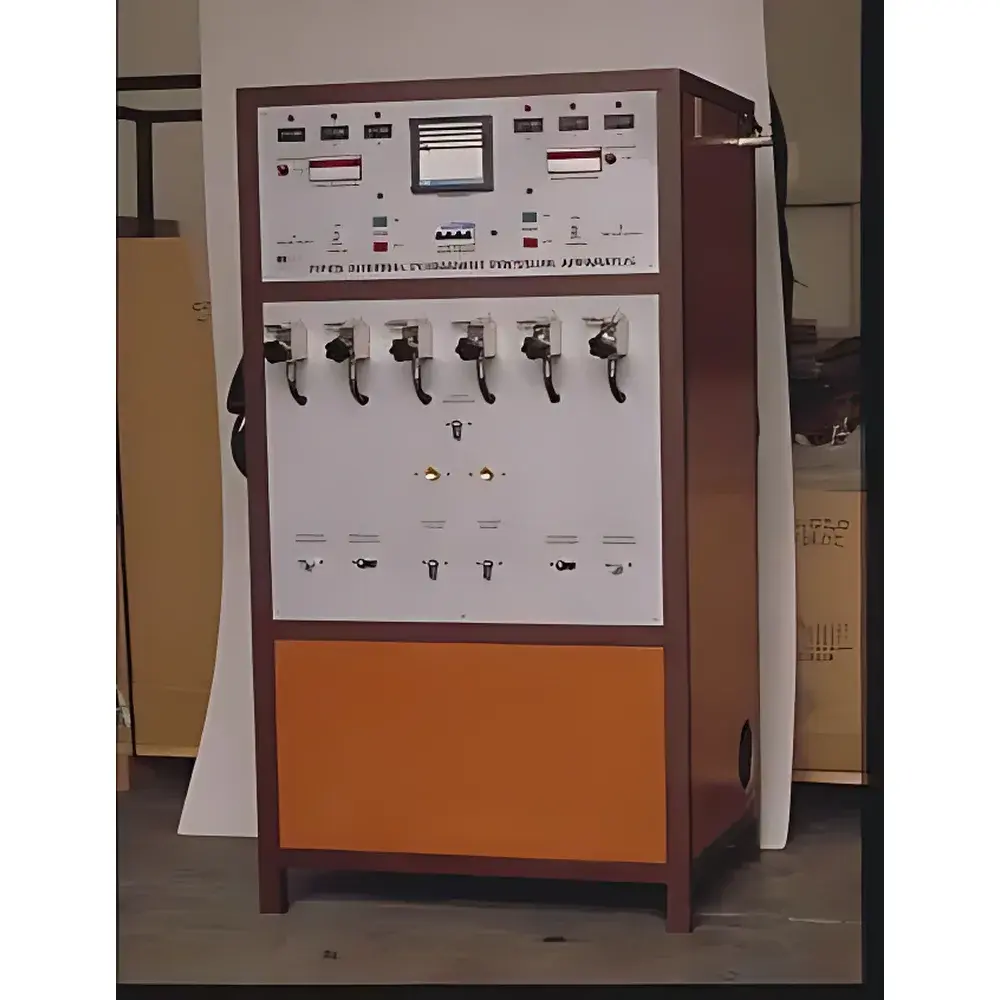
ATSFAAR 100 Series Automated Long-Term Hydrostatic Pressure Tester for Plastic Pipes
| Brand | ATSFAAR |
|---|---|
| Origin | Italy |
| Manufacturer Type | Authorized Distributor |
| Origin Category | Imported |
| Model | 100 |
| Price | Upon Request |
| Standards | ASTM D1598, DIN 8062, ISO 1167, ISO 4427, EN 1447, EN 1452-2 |
| Test Stations | 6 independent stations |
| Pressure Systems | 2 independent hydraulic circulation systems |
| Pumps per System | 3 |
| Max Pressure | 100 bar |
| Pressure Sensors | 2 electronic transducers |
| Display Range | 0–99.9 bar |
| Pressure Resolution | 0.1 bar |
| Buffer Valves | 2 |
| Auto-Compensation Valves | 6 (one per station) |
| Timing Control | Digital timer triggered at test initiation |
| Accessories | Temperature-controlled bath (custom-sized for pipe specimens), end-caps with hydraulic coupling |
| Optional | Calibrated reference pressure gauge, 3-channel data logger |
Overview
The ATSFAAR 100 Series Automated Long-Term Hydrostatic Pressure Tester is an engineered solution for accelerated life evaluation of thermoplastic piping systems under sustained internal hydrostatic pressure. Designed in strict compliance with internationally recognized standards—including ASTM D1598 (Time-to-Failure of Plastic Pipe Under Constant Internal Pressure), ISO 1167 (Determination of Resistance to Internal Pressure), and EN 1452-2 (Unplasticized Polyvinyl Chloride (PVC-U) Pipes for Water Supply)—this system enables laboratories to conduct standardized stress rupture testing over durations ranging from hours to thousands of hours. Its core operational principle relies on controlled pressurization of sealed pipe specimens immersed in a thermostatically regulated bath, simulating real-world service conditions while maintaining traceable, repeatable mechanical loading. The dual independent hydraulic circuits ensure statistical independence between parallel test groups, minimizing cross-system interference and supporting robust Weibull analysis of failure data.
Key Features
- Two fully isolated hydraulic pressure circulation systems, each equipped with three high-stability positive-displacement pumps capable of delivering up to 100 bar nominal working pressure.
- Six independent test stations, each fitted with a fail-safe electro-pneumatic isolation valve integrated with a digital timer—automatically initiating timing upon pressurization and triggering immediate shutdown upon pressure deviation exceeding ±0.5 bar or specimen rupture.
- Real-time pressure monitoring via two precision electronic pressure transducers (full-scale 99.9 bar, resolution 0.1 bar), each feeding a dedicated digital display amplifier with analog output capability for external logging.
- Active pressure compensation mechanism at each station: proprietary servo-controlled valves dynamically offset minor thermal drift or micro-leakage-induced pressure decay without manual intervention, preserving test integrity throughout extended durations.
- Dual buffer valves dampen hydraulic pulsation across both circuits, ensuring smooth pressure ramping and stable hold phases critical for low-noise data acquisition.
- Modular interface architecture supports optional integration of NIST-traceable calibration pressure gauges and 3-channel strip-chart or digital data loggers compliant with GLP audit requirements.
Sample Compatibility & Compliance
The system accommodates standard pipe specimens per ISO 1167-1:2014, including but not limited to PE, PP-R, PVC-U, PB, and multilayer composite pipes with outer diameters ranging from 16 mm to 160 mm. Specimens are sealed using standardized end-caps designed to prevent extrusion and leakage at elevated pressures and temperatures (operational bath range: 20 °C to 95 °C). All mechanical and control subsystems conform to CE marking directives (2014/30/EU EMC, 2014/35/EU LVD) and support full documentation packages required for ISO/IEC 17025-accredited laboratory audits. Test reports generated meet the evidentiary requirements of ISO 17025 Clause 7.8 and FDA 21 CFR Part 11 when paired with validated software and electronic signature modules.
Software & Data Management
While the base configuration operates via embedded firmware with local digital displays and hardwired timers, optional PC-based control software provides comprehensive test orchestration: scheduled start/stop, multi-parameter trending (pressure vs. time, temperature vs. time), automated pass/fail classification per ASTM D1598 Annex A1, and export to CSV or PDF formats compatible with LIMS integration. Audit trails record operator ID, parameter changes, system alarms, and timestamped event logs—all retained for minimum 10 years as defined under GLP Annex 4. Data encryption, user role management (admin/operator/viewer), and electronic signature workflows align with 21 CFR Part 11 Subpart B requirements for regulated environments.
Applications
- Hydrostatic design basis determination for PE100 and PE100-RC pipe materials in potable water and gas distribution networks.
- Validation of long-term strength coefficients (LTS) and minimum required strength (MRS) per ISO 9080 extrapolation protocols.
- Comparative assessment of pipe joint integrity (fusion, electrofusion, mechanical) under constant pressure at elevated temperatures.
- Accelerated aging studies evaluating the impact of UV pre-exposure, chemical immersion, or cyclic thermal loading on pressure resistance.
- Quality assurance testing in manufacturing facilities operating under ISO 9001:2015 and EN 1555-2 certification schemes.
FAQ
What standards does the ATSFAAR 100 Series explicitly support?
ASTM D1598, ISO 1167 Parts 1 & 2, ISO 4427, DIN 8062, EN 1447, and EN 1452-2—covering test methodology, specimen preparation, pressure application profiles, and failure criteria.
Can the system operate unattended for 1000+ hours?
Yes. With redundant pressure regulation, continuous thermal bath stability, and automatic failure detection, the system is engineered for uninterrupted operation over multi-week test campaigns typical in ISO 9080 extrapolation studies.
Is third-party calibration documentation available?
All pressure transducers ship with factory calibration certificates traceable to national metrology institutes (e.g., INRIM, PTB); on-site recalibration services and ISO/IEC 17025-compliant calibration reports are available upon request.
How is temperature uniformity maintained across six test stations?
The integrated thermostatic bath features PID-controlled heating/cooling, high-flow recirculation, and calibrated RTD sensors at multiple depth points—ensuring ΔT ≤ ±0.3 °C across the full specimen volume during steady-state operation.
Does the system support custom pressure–time profiles beyond standard step-hold sequences?
Via optional software upgrade, users may define non-linear pressure ramps, multi-step hold sequences, and conditional logic triggers (e.g., “increase pressure by 5% if no failure occurs after 500 h”).





