
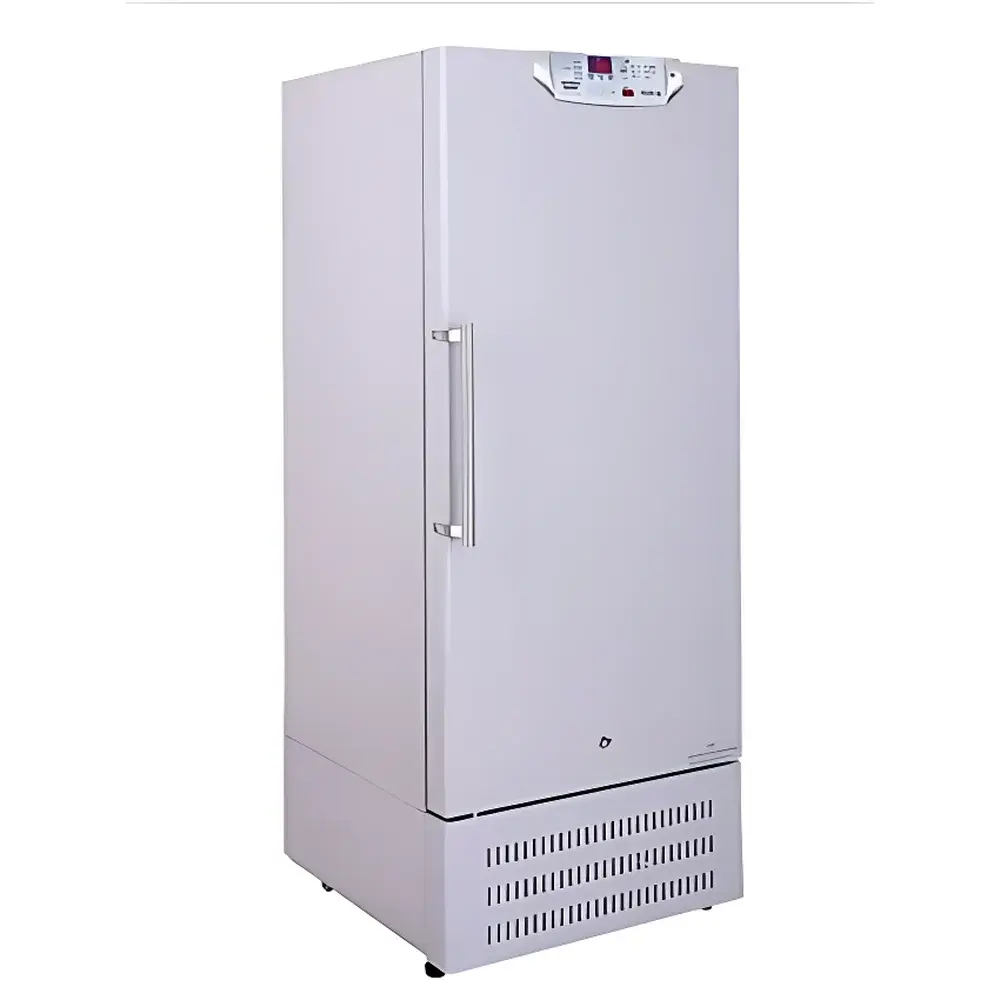
AUCMA DW-40L276 Upright Ultra-Low Temperature Storage Cabinet
| Brand | AUCMA |
|---|---|
| Model | DW-40L276 |
| Temperature Range | –20 °C to –40 °C |
| Effective Volume | 276 L |
| Internal Dimensions (W×D×H) | 506 mm × 505 mm × 1205 mm |
| External Dimensions (W×D×H) | 717 mm × 710 mm × 1745 mm |
| Net/Gross Weight | 106 kg / 125 kg |
| Power Supply | 220 V / 50 Hz |
| Compressor | Imported High-Efficiency Compressor |
| Fan Motor | EBM Premium AC Fan Motor |
| Insulation | High-Density Polyurethane Foam with Microcellular Foaming Technology |
| Refrigerant | Eco-Friendly R404A or Equivalent Non-Ozone-Depleting Refrigerant |
| Door Seal | Dual-Gasket Sealed Structure |
| Control System | Microprocessor-Based Digital Temperature Controller with Adjustable Setpoint (–10 °C to –40 °C) |
| Alarm Functions | High/Low Temperature, Door Open, Sensor Fault, Power Failure, Low Battery (for Backup Memory), Audible & Visual Alerts |
Overview
The AUCMA DW-40L276 Upright Ultra-Low Temperature Storage Cabinet is engineered for reliable, long-term preservation of temperature-sensitive biological specimens—including human plasma, cryopreserved cell lines, viral vectors, vaccines, and primary tissue samples—within a stable operating range of –20 °C to –40 °C. Designed in accordance with core principles of thermal stability and energy-efficient cold chain integrity, the unit employs a cascade-free single-stage refrigeration architecture optimized for consistent cabinet-wide temperature uniformity and minimal thermal fluctuation (< ±3 °C at setpoint). Its structural design prioritizes laboratory-grade operational resilience: reinforced steel frame construction, dual-gasket door sealing, and high-density polyurethane insulation (≥120 mm thick walls/ceiling, ≥100 mm floor) minimize heat ingress and reduce compressor cycling frequency. The system operates without ozone-depleting substances—utilizing R404A or equivalent low-GWP refrigerants—and complies with international environmental directives including EU F-Gas Regulation (EU No 517/2014) and China’s HCFC Phase-Out Management Plan.
Key Features
- Microprocessor-based digital temperature controller with real-time LED display and user-adjustable setpoint (–10 °C to –40 °C) for precise thermal management
- Multi-level alarm system with simultaneous audible (buzzer) and visual (LED flash) alerts for critical events: high/low temperature deviation, door-open duration >30 s, sensor failure, power interruption, and backup battery under-voltage
- Remote alarm interface supporting dry-contact output for integration into centralized lab monitoring systems (e.g., BMS or LIMS)
- Imported high-efficiency hermetic compressor paired with EBM premium AC condenser fan motor for rapid cooldown and stable load response
- Optimized evaporator-coil geometry and refrigerant charge calibration to support rapid recovery after door opening (≤15 min to return within ±2 °C of setpoint following 60-s door exposure at 25 °C ambient)
- Six-tier pull-out drawer configuration with reinforced polymer rails and ergonomic handles—enabling organized sample access while minimizing cold air loss
- Mechanical door lock + keypad lockout to prevent unauthorized temperature adjustment or access—aligned with GLP-compliant sample integrity protocols
- Wide-input voltage tolerance (220 V ±10%, 50 Hz) ensures stable operation in variable utility environments common in regional research facilities and field laboratories
Sample Compatibility & Compliance
The DW-40L276 supports storage of standard cryovial racks (e.g., 9×9, 10×10 formats), blood bag cassettes, and specimen transport containers conforming to ISO 11137 and AABB standards. Its validated temperature stability profile meets requirements for long-term storage of WHO-prequalified vaccines (per WHO Technical Report Series No. 999, Annex 8) and aligns with USP guidelines on storage conditions for biologics. The cabinet’s temperature mapping protocol follows ISO/IEC 17025-accredited methodology, enabling traceable validation documentation for GxP-regulated workflows. All electrical components comply with IEC 61010-1:2010 safety standards for laboratory equipment; EMC performance conforms to IEC 61326-1:2021.
Software & Data Management
While the DW-40L276 operates as a standalone hardware platform without embedded network connectivity, its analog/digital alarm outputs and optional RS485 interface (available via accessory module) support integration with third-party data loggers compliant with FDA 21 CFR Part 11 requirements—including electronic audit trails, user authentication, and immutable record retention. Temperature logging intervals (1–60 min), alarm history (≥500 event entries), and runtime statistics are locally retained in non-volatile memory—even during power outage—ensuring continuity of cold chain documentation for regulatory review.
Applications
- Long-term archival storage of peripheral blood mononuclear cells (PBMCs), induced pluripotent stem cells (iPSCs), and primary hepatocytes at –30 °C to –40 °C
- Vaccine stabilization prior to lyophilization or formulation transfer in contract development and manufacturing organizations (CDMOs)
- Controlled low-temperature testing of semiconductor components, optical coatings, and polymer-based medical devices per ASTM F1980 and ISO 11607
- Backup cold storage for ultra-low temperature freezers during maintenance cycles or emergency defrost events
- Field-deployable biospecimen staging in mobile biobanking units operating in temperate-to-cold climates
FAQ
What is the recommended ambient operating environment for this unit?
The cabinet is rated for continuous operation in ambient temperatures from +10 °C to +32 °C and relative humidity ≤80% non-condensing. Performance validation assumes installation in well-ventilated, non-sunlit spaces with ≥100 mm clearance on all sides.
Does the unit support temperature mapping for IQ/OQ validation?
Yes—its uniform internal geometry and documented thermal recovery behavior enable standardized mapping per ISO 14644-3 using calibrated thermistors or wireless data loggers. AURORA™ or similar validated platforms may be deployed for automated reporting.
Can the door lock be integrated with facility access control systems?
The mechanical lock accepts standard padlocks; however, electronic integration requires external relay-based actuation via the remote alarm port—custom wiring must comply with local electrical codes.
Is routine calibration required for the internal temperature sensor?
The NTC thermistor is factory-calibrated and drift-stabilized. Users should perform annual verification against an NIST-traceable reference probe per ISO/IEC 17025 procedures.
What maintenance intervals are specified for the refrigeration system?
Compressor oil and refrigerant integrity require inspection every 24 months by certified HVAC-R technicians. Condenser coil cleaning is recommended quarterly in dusty environments.



