
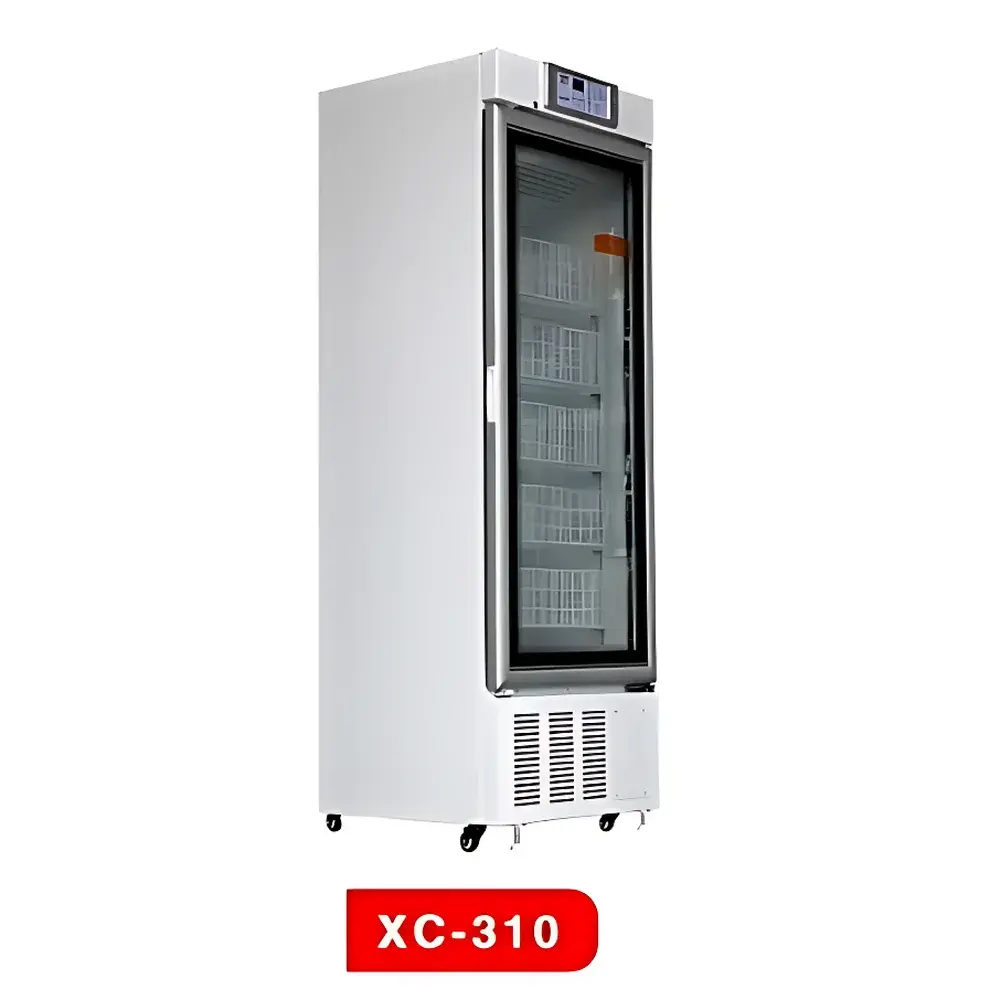
AUCMA XC-310 Blood Refrigerator
| Brand | AUCMA |
|---|---|
| Model | XC-310 |
| Temperature Range | 4 ± 1 °C |
| Effective Volume | 310 L |
| Internal Dimensions (W×D×H) | 565 × 454 × 1198 mm |
| External Dimensions (W×D×H) | 660 × 644 × 1960 mm |
| Power Supply | 220 V AC, 50 Hz |
| Sensor Configuration | 6 high-precision NTC sensors (including dual simulated-blood core temperature probes) |
| Alarm Types | Audible buzzer, visual LED flash, remote alarm output |
| Optional | Integrated temperature data logger with print capability |
Overview
The AUCMA XC-310 Blood Refrigerator is a purpose-built, medical-grade low-temperature storage system engineered for the safe, stable, and compliant refrigerated preservation of whole blood, packed red blood cells (RBCs), platelet concentrates (when stored at controlled 20–24 °C per AABB standards—note: this unit is not intended for platelet storage), and other temperature-sensitive biological specimens requiring strict thermal maintenance at 4 ± 1 °C. Designed in accordance with ISO 13485:2016 quality management requirements for medical devices and aligned with WHO Technical Report Series No. 961 (2011) Annex 9 on blood bank equipment, the XC-310 employs forced-air circulation with dual evaporator zones and microprocessor-based PID temperature control to ensure uniformity (< 1.5 °C spatial variation across load) and stability (±0.5 °C short-term fluctuation) throughout its 310 L usable chamber. Its architecture prioritizes thermal integrity under variable ambient conditions (10–32 °C), door-open recovery time (< 15 min to re-stabilize after 60-s opening), and continuous monitoring traceability—critical for GLP, GCP, and blood bank accreditation frameworks including CAP, AABB, and China’s YY/T 0057-2021 standard for blood refrigerators.
Key Features
- 6-point precision temperature monitoring network: Includes two dedicated NTC sensors embedded in glycol-filled simulation bottles placed at geometric center and lower rear corners—mimicking thermal mass and response kinetics of blood units per CLSI GP44-A4 guidance.
- Dual-door thermal barrier design: Outer tempered low-emissivity double-glazed door with integrated anti-fog heating element; inner transparent polycarbonate door with silicone gasket seal—reducing condensation risk in high-humidity environments (≥85% RH).
- Medical-grade interior: 304 stainless steel cabinet walls, floor, and shelving; seamless welded corners; non-porous surfaces compliant with ISO 15223-1 labeling and USP analytical instrument qualification protocols.
- Configurable storage infrastructure: Five adjustable stainless-steel shelves with removable, autoclavable polypropylene blood baskets (15 total); optional barcode-labeled basket identification system for sample-level traceability.
- Comprehensive safety logic: Multi-layered alarm hierarchy with configurable thresholds—including door-open duration (>30 s), ambient voltage deviation (>±10%), sensor fault detection, and battery-backed real-time clock for uninterrupted event logging during power interruption.
- Regulatory-ready data handling: Optional integrated temperature data logger (compliant with FDA 21 CFR Part 11 Annex 11 requirements when paired with audit-trail-enabled software) provides time-stamped, tamper-evident records exportable via USB or RS-485 interface.
Sample Compatibility & Compliance
The XC-310 is validated for storage of CPD-, CPDA-1-, and additive solution–preserved red blood cell units in standard 300–500 mL PVC or polyolefin containers. It meets IEC 61000-6-3 (EMC emissions) and IEC 61000-6-2 (immunity) standards. Temperature mapping per ISO 14644-3 and EU GMP Annex 15 principles confirms compliance with EN 61000-6-4 (industrial emission limits) and supports validation documentation for hospital JCI accreditation, CNAS ISO/IEC 17025 laboratory recognition, and provincial blood center licensing under China’s Administrative Measures for Blood Stations (Order No. 62, NHC). The unit does not support cryopreserved plasma or frozen RBCs—those require dedicated -30 °C or -65 °C freezers meeting ISO 13057-1.
Software & Data Management
While the base controller operates via an embedded 32-bit ARM Cortex-M4 MCU with local LCD interface, optional connectivity modules enable integration into centralized lab infrastructure. The AUCMA TempLink™ Software Suite (v3.2+) supports automated calibration certificate generation, deviation investigation workflows (CAPA-ready), and synchronized timestamping across multi-unit deployments. All logged temperature events include metadata: sensor ID, UTC timestamp, user login (if network-authenticated), and environmental context (e.g., “door opened – operator ID: BLD-07”). Audit trails are immutable and retain ≥18 months of data—satisfying FDA 21 CFR Part 11 electronic record retention mandates and EU Annex 11 data integrity expectations.
Applications
- Hospital blood banks maintaining ABO/RhD-typed RBC inventories under AABB Standard 5.12.1 (storage duration ≤42 days at 1–6 °C)
- Regional blood centers performing pooled testing, component separation, and distribution logistics
- Disease prevention and control institutions storing serological reference samples and vaccine diluents requiring 2–8 °C stability
- Clinical trial biobanks archiving EDTA-plasma aliquots for longitudinal biomarker assays
- Research laboratories preserving primary human PBMCs or isolated granulocytes prior to functional assay
FAQ
Is the XC-310 certified for use in FDA-regulated clinical trials?
Yes—when equipped with the optional Part 11-compliant data logger and operated under documented SOPs, it satisfies 21 CFR Part 11 requirements for electronic records and signatures in investigational new drug (IND) applications.
Can this unit store platelet concentrates?
No. Platelets require storage at 20–24 °C with continuous agitation. The XC-310 is designed exclusively for 4 ± 1 °C applications and lacks agitation or elevated temperature control.
What validation documentation is provided with shipment?
Each unit ships with a Factory Acceptance Test (FAT) report, IQ/OQ protocol templates aligned with ISO/IEC 17025, and a Certificate of Conformance referencing YY/T 0057-2021 and IEC 61010-1 safety standards.
Does the system support remote monitoring via Ethernet or Wi-Fi?
Ethernet (TCP/IP) is supported via optional module; Wi-Fi is not available due to electromagnetic interference concerns in critical care environments.
How often must temperature sensors be recalibrated?
Per ISO/IEC 17025:2017 Clause 7.7.1, annual calibration against NIST-traceable reference thermometers is recommended; internal verification using the dual simulated-bottle probes should occur daily as part of blood bank shift handover procedures.




