
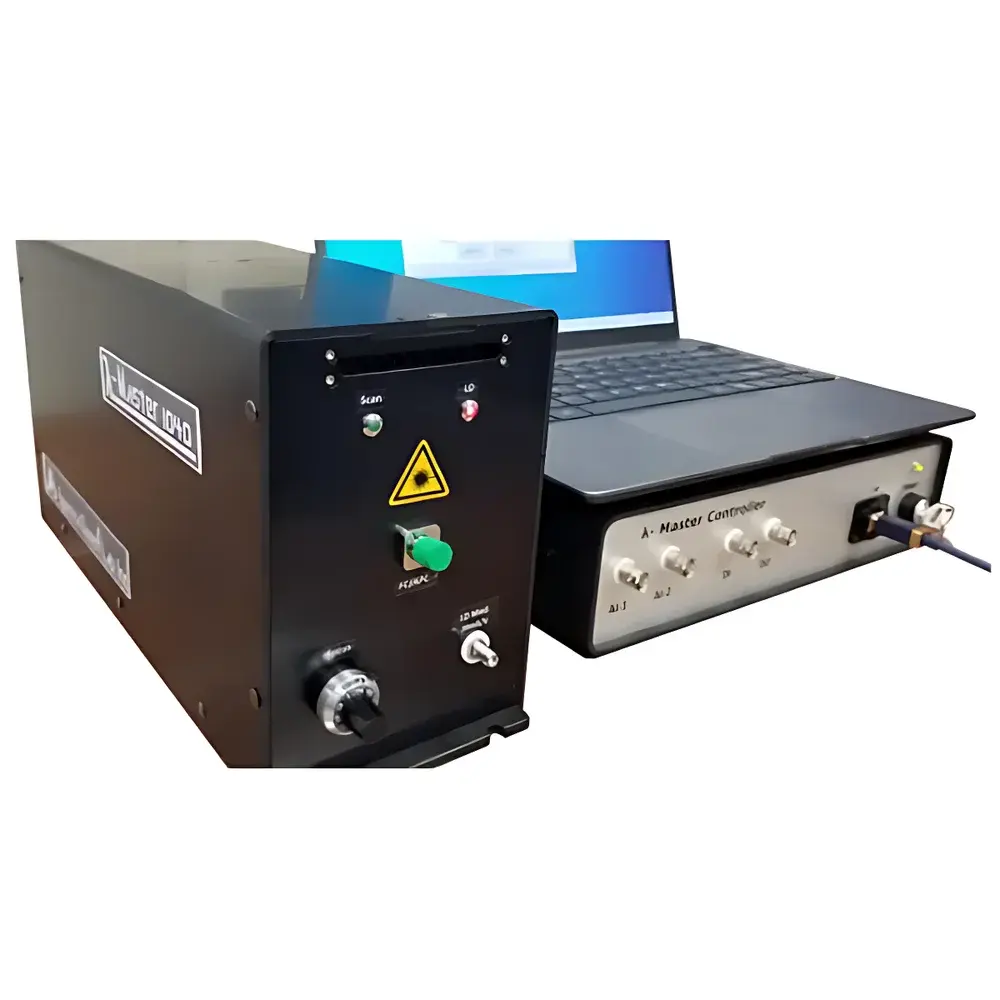
Auniontech λ-Master 950/1040 High-Performance Tunable Diode Laser System (920–1010 nm / 980–1090 nm)
| Brand | Auniontech |
|---|---|
| Origin | Shanghai, China |
| Product Type | External-Cavity Tunable Semiconductor Laser |
| Tuning Range | 920–1010 nm (λ-Master 950) / 980–1090 nm (λ-Master 1040) |
| Output Power | >100 mW (free-space), >60 mW (PM850 fiber-coupled, FC/APC) |
| SMSR | >80 dB @ 0.01 nm resolution |
| Linewidth | <100 kHz (100 µs integration) |
| Tuning Resolution | 0.1 pm (30 MHz) |
| Mode-Hop-Free Tuning | Full range |
| PZT Scan Range | ~10 GHz @ 150 V |
| Data Acquisition | 2-channel, 16-bit ADC synchronized with wavelength scan |
| Interface | USB 2.0, LabVIEW & EXE control software (λ-Master Control Suite) |
Overview
The Auniontech λ-Master 950 and λ-Master 1040 are high-precision external-cavity tunable diode laser (ECDL) systems engineered for demanding spectroscopic applications in research laboratories and industrial metrology environments. Operating in the near-infrared (NIR) spectral region—specifically 920–1010 nm (λ-Master 950) and 980–1090 nm (λ-Master 1040)—these lasers employ a proprietary transposed Littman-Metcalf cavity architecture. This configuration physically separates amplified spontaneous emission (ASE) from the main lasing axis via angular dispersion and retroreflection geometry, eliminating ASE contamination without attenuating output power. The optical design incorporates intentional beam path deformation to compensate for chromatic dispersion inherent in both the laser diode chip and cavity optics, enabling continuous, mode-hop-free tuning across the entire bandwidth—a critical requirement for high-fidelity absorption spectroscopy, cavity ring-down measurements, and frequency-comb-referenced calibration.
Key Features
- Ultra-High Spectral Purity: Suppressed ASE yields a side-mode suppression ratio (SMSR) exceeding 80 dB at 0.01 nm resolution—verified by high-resolution optical spectrum analyzers compliant with IEC 61280-2-9.
- Stable High-Power Output: Delivers >100 mW free-space output centered at 990 nm; fiber-coupled variants provide >60 mW into polarization-maintaining PM850 fiber with FC/APC termination, optimized for low back-reflection coupling into interferometers or nonlinear crystals.
- Continuous Wideband Tuning: Achieves seamless, hysteresis-free scanning over full ranges (920–1010 nm or 980–1090 nm) using a stepper-motor-driven precision translation stage with sub-nanometer positional repeatability and zero mechanical backlash.
- Narrow Intrinsic Linewidth: Typical linewidth <100 kHz (measured over 100 µs under acoustic isolation), suitable for Doppler-free saturation spectroscopy and coherent heterodyne detection.
- Multi-Modal Wavelength Control: Supports high-speed digital stepping (up to 30 nm/s), analog PZT-based fine scanning (~10 GHz range per 150 V), and hybrid coarse/fine actuation for hierarchical spectral interrogation.
- Synchronized Data Acquisition: Integrated dual-channel 16-bit analog-to-digital converter acquires detector signals time-locked to wavelength position, supporting lock-in, derivative absorption, and real-time baseline correction protocols.
Sample Compatibility & Compliance
The λ-Master platform is compatible with standard NIR optical components including InGaAs photodetectors, silicon and extended-InGaAs spectrometers, gas cells (e.g., H2O, CO, CH4, NH3), and atomic vapor cells (e.g., Rb D1/D2 lines). Its spectral stability and low intensity noise (<–140 dBc/Hz at 1 MHz offset) meet requirements for trace-gas sensing per ISO 14077 and environmental monitoring standards such as EPA Method TO-14A. The system’s firmware implements non-volatile wavelength calibration using a built-in 10 GHz free-spectral-range (FSR) etalon, traceable to NIST-traceable reference lines. All electronic subsystems comply with CE EN 61326-1 (EMC) and EN 61010-1 (safety) directives. No FDA or IEC 60825-1 Class IV laser safety certification is required due to integrated interlock circuitry and shutter control limiting accessible emission to Class 3B levels.
Software & Data Management
Control and data acquisition are managed through the cross-platform λ-Master Control Suite, distributed as native Windows executables and fully documented LabVIEW VIs (2015 SP1 and later). The software supports automated wavelength calibration routines, user-defined scan profiles (linear, logarithmic, step-and-hold), real-time spectral plotting, and export to HDF5, CSV, and MATLAB .mat formats. Audit trails—including timestamped parameter changes, calibration events, and hardware status logs—are retained locally and may be exported for GLP/GMP documentation. While not natively 21 CFR Part 11 compliant, the system supports third-party electronic signature modules and configurable user access levels when deployed within validated laboratory information management systems (LIMS).
Applications
- Absorption spectroscopy of molecular gases (H2O, CO, NO, C2H2) in atmospheric science and combustion diagnostics
- Saturation spectroscopy and hyperfine structure analysis in atomic physics experiments
- Calibration source for FTIR and grating spectrometers requiring sub-pm accuracy
- Pump-probe studies in ultrafast optics using synchronizable pulse triggering
- Seed source for MOPA systems targeting eye-safe wavelengths in remote sensing
- Frequency stabilization to ultra-stable cavities in quantum optics testbeds
FAQ
What distinguishes the transposed Littman configuration from conventional Littman or Littrow designs?
The transposed geometry decouples ASE spatially from the lasing mode using a retroreflector-based return path, eliminating the need for intracavity filters that degrade power efficiency. It also enables first-order dispersion compensation across the full tuning band.
Can the λ-Master be integrated into a vacuum-compatible setup?
The laser head is sealed and rated for operation at ambient pressure only; however, the collimated free-space output beam may be coupled into vacuum chambers via standard NIR viewports without modification.
Is fiber coupling polarization-maintaining and how is alignment stabilized?
Yes—PM850 fiber with FC/APC connector is standard. Alignment is factory-optimized and secured with UV-curable epoxy; no user recalibration is required under normal thermal cycling (15–30 °C).
Does the system support external clock synchronization for pump-probe experiments?
Yes—TTL-compatible trigger inputs and outputs are provided on DB9 connectors for synchronization with arbitrary waveform generators, pulsed lasers, or data acquisition cards.
How often does the internal etalon require recalibration?
Under stable lab conditions (±1 °C/h), recalibration is recommended every 6 months or after mechanical shock; the software includes guided procedures using known absorption features (e.g., water vapor lines) as secondary references.




