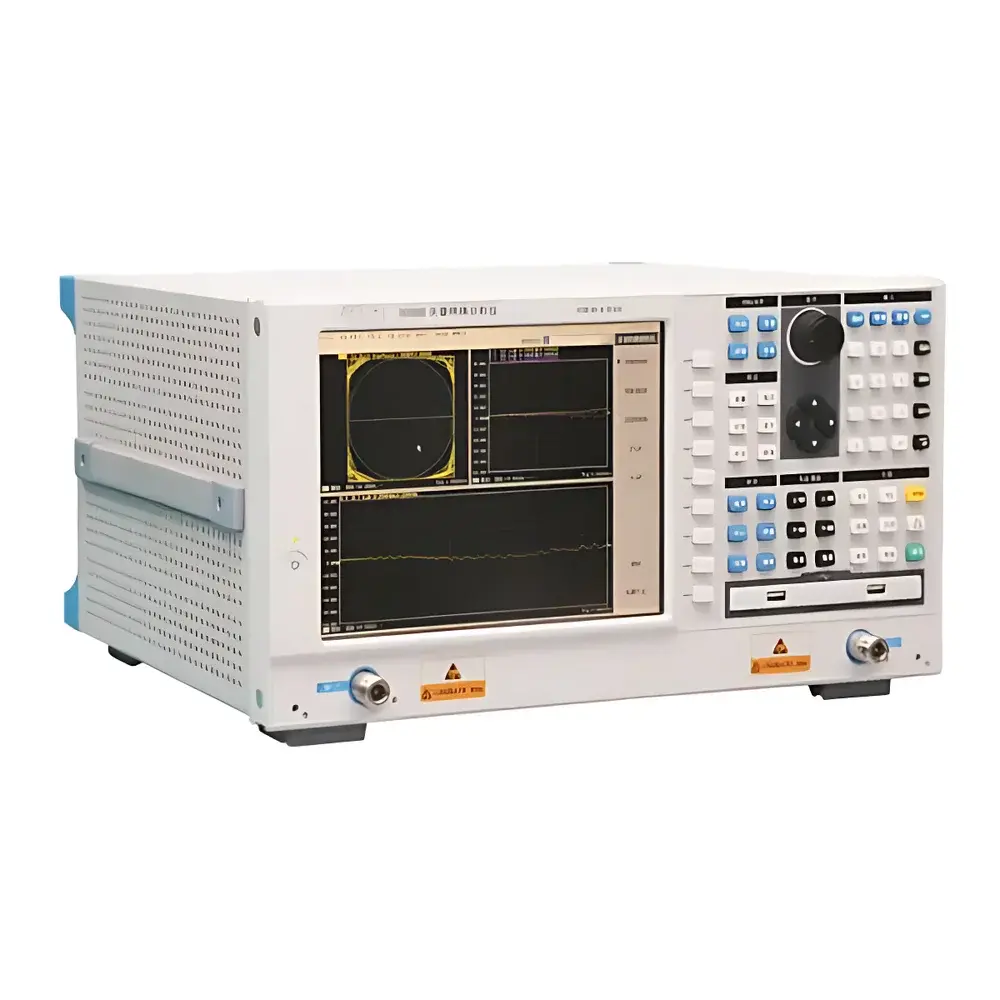
Auniontech 3656 Series Economical Vector Network Analyzer (VNA)
| Brand | Auniontech |
|---|---|
| Origin | Shanghai, China |
| Model | 3656A / 3656BA / 3656B / 3656D |
| Frequency Range | 100 kHz–3 GHz / 100 kHz–6.8 GHz / 100 kHz–8.5 GHz / 300 kHz–20 GHz |
| Dynamic Range (at 10 Hz IFBW) | up to 125 dB |
| Trace Noise | ≤ 0.001 dBrms |
| Measurement Ports | 2-port standard |
| IF Bandwidth | 1 Hz–5 MHz (1–2–3–5–7 decade steps) |
| Calibration Types | Response, One-Port, Response-Isolation, Enhanced Response, Full Two-Port SOLT, Electronic Calibration (E-Cal) |
| Display Formats | Log/Linear Magnitude, SWR, Phase, Group Delay, Smith Chart, Polar Plot |
| Operating System | Windows-based GUI |
| Interfaces | LAN (LXI-compliant), GPIB (IEEE-488.2), USB 2.0 ×4, VGA |
Overview
The Auniontech 3656 Series Economical Vector Network Analyzer (VNA) is a precision RF and microwave measurement platform engineered for high-reproducibility S-parameter characterization of passive and active components across telecommunications, aerospace, education, and automotive electronics sectors. Based on heterodyne superheterodyne receiver architecture with synthesized swept-frequency excitation, the instrument measures complex reflection (S11, S22) and transmission (S21, S12) coefficients with phase coherence and amplitude linearity traceable to NIST-traceable calibration standards. Its modular frequency coverage—spanning four configurations (3 GHz, 6.8 GHz, 8.5 GHz, and 20 GHz)—enables scalable deployment from R&D bench validation to high-throughput production test environments. The analyzer implements real-time digital signal processing for simultaneous acquisition of magnitude, phase, and group delay, supporting time-domain transformation via gated inverse Fourier analysis for fault location and discontinuity identification in cables and connectors.
Key Features
- Dynamic range up to 125 dB (at 10 Hz IF bandwidth), enabling accurate evaluation of high-rejection filters, low-loss antennas, and isolators with >100 dB suppression.
- Ultra-low trace noise of ≤0.001 dBrms ensures stable baseline resolution for small-signal device characterization and repeatability-critical manufacturing QA/QC.
- Up to 64 independent measurement channels support parallel execution of multi-parameter test plans—e.g., simultaneous pass/fail limit checking across multiple bands or polarizations.
- Integrated time-domain analysis (TDR/TDT) with gating and windowing functions allows impedance profiling, cable length verification, and connector fault isolation without external hardware.
- Fixture simulator module enables de-embedding of probe tips, PCB launch structures, and custom fixtures using user-defined lossy or lossless models—critical for on-wafer and package-level measurements.
- Four-port configuration (3656D model) supports full 16-term S-parameter acquisition in a single connection sequence, reducing test cycle time by >70% versus sequential two-port methods.
- Comprehensive calibration suite includes SOLT (Short-Open-Load-Thru), TRL (Thru-Reflect-Line), LRM (Line-Reflect-Match), and electronic calibration (E-Cal) with NIST-traceable modules for rapid setup and GLP-compliant documentation.
Sample Compatibility & Compliance
The 3656 Series accommodates a broad spectrum of RF components—including coaxial and waveguide-mounted filters, LNAs, power amplifiers, directional couplers, circulators, patch antennas, and flexible printed circuits—via standard 3.5 mm (up to 26.5 GHz) and SMA connectors. All models comply with IEC 61000-4 electromagnetic compatibility requirements and meet CE marking directives for industrial equipment. For regulated industries, the Windows-based firmware supports audit trail logging, user access control (with role-based permissions), and data export in CSV, Touchstone (.s2p), and MATLAB-compatible formats—facilitating alignment with FDA 21 CFR Part 11, ISO/IEC 17025, and IATF 16949 quality management systems. Calibration certificates include uncertainty budgets per ISO/IEC 17025 Annex A.
Software & Data Management
Operating under a real-time Windows 10 IoT Enterprise environment, the VNA’s embedded software provides intuitive graphical configuration, scriptable automation via SCPI over LAN/GPIB, and native Python API integration for custom test sequencing. Measurement data is stored with metadata tagging (operator ID, timestamp, calibration ID, environmental conditions). Export options include encrypted PDF reports with pass/fail annotations, raw binary files for post-processing, and direct database upload to SQL Server or Oracle via ODBC drivers. Remote monitoring and control are supported through web-based HTML5 interface (LXI Class C compliant), enabling secure access behind enterprise firewalls without proprietary client installation.
Applications
- Mobile communications manufacturing: High-speed S-parameter sweep for LTE/5G front-end modules (FEMs), BAW/SAW duplexers, and antenna tuning units—validated against 3GPP TS 36.141 and TS 38.141 conformance limits.
- Passive multi-port component testing: Full 16-S-parameter extraction for quad-band diplexers, MIMO antenna arrays, and RF switch modules using the 3656D’s four-port mode and balanced network analysis (mixed-mode S-parameters).
- Educational laboratories: Pedagogical platform for microwave theory instruction, including Smith chart interpretation, impedance matching design, and filter synthesis—supported by built-in tutorial guides and student lab templates.
- Automotive radar development: Characterization of 77–81 GHz bandpass filters and MMIC amplifiers via harmonic mixing extension (with external mixers), leveraging the 20 GHz baseband capability and low-phase-noise source architecture.
- Research-grade material characterization: Extraction of complex permittivity/permeability of dielectric substrates using free-space or waveguide fixture methods, aided by built-in material property calculation utilities.
FAQ
What calibration standards are supported?
The 3656 Series supports SOLT, TRL, LRM, and E-Cal with NIST-traceable kits. Full two-port calibration requires mechanical standards; TRL/LRM require custom line standards for non-coaxial environments.
Can the instrument perform time-domain analysis without additional hardware?
Yes—the integrated time-domain transform engine operates directly on acquired frequency-domain data, with selectable window types (Hamming, Kaiser, Rectangular), gate width, and position controls.
Is remote programming supported via industry-standard protocols?
Yes—SCPI commands over TCP/IP (port 5025) and GPIB (IEEE-488.2) are fully implemented. LXI Class C web interface provides zero-client remote operation.
Does the system meet regulatory requirements for medical or aerospace testing?
The platform supports GLP/GMP workflows via configurable audit trails, electronic signatures, and calibration traceability documentation aligned with ISO/IEC 17025 and DO-160 Section 20 compliance frameworks.
How many measurement points can be defined per sweep?
Up to 100,001 points per channel, adjustable from 1 to 100,001 in linear or logarithmic spacing, with user-defined frequency lists for segmented sweeps.