
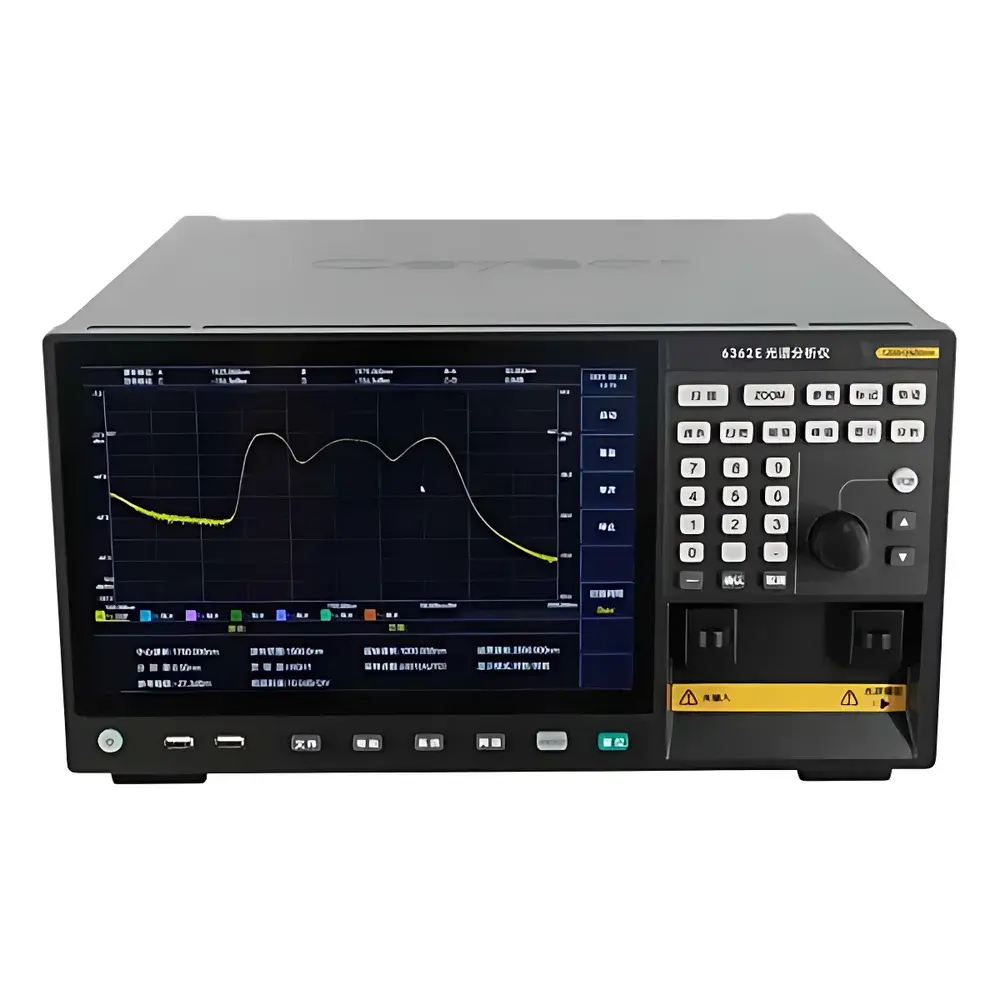
Auniontech 6362E High-Resolution Infrared Optical Spectrum Analyzer (1200–2400 nm, 50 pm Resolution)
| Brand | Auniontech |
|---|---|
| Origin | Shanghai, China |
| Model | 6362E |
| Spectral Range | 1200–2400 nm |
| Spectral Resolution | 50 pm |
| Dynamic Range | 55 dB |
| Sensitivity | −70 dBm (1800–2200 nm) |
| Wavelength Accuracy | ±0.05 nm (1520–1580 nm) |
| Input Interface | Free-space optical input |
| Detector Type | InGaAs linear array |
| Display | 12.1″ capacitive touchscreen |
| Compliance | CE, RoHS, ISO 9001 certified manufacturing |
Overview
The Auniontech 6362E is a high-performance, grating-based optical spectrum analyzer engineered for precision spectral characterization in the short-wave infrared (SWIR) region. Operating across a continuous wavelength range of 1200–2400 nm, it leverages optimized Czerny–Turner optical architecture with thermally stabilized diffraction gratings and a cooled InGaAs linear photodiode array to deliver sub-picometer resolution and high signal-to-noise ratio. Its design conforms to fundamental principles of dispersive spectroscopy—where incident light is spatially separated by wavelength via angular dispersion from a ruled or holographic grating, followed by pixel-resolved intensity detection. This enables quantitative analysis of spectral shape, peak position, linewidth, side-mode suppression ratio (SMSR), and optical power distribution—critical parameters in R&D, manufacturing test, and system-level validation of SWIR-emitting and transmitting components.
Key Features
- Continuous spectral coverage from 1200 nm to 2400 nm—spanning O-, E-, S-, C-, L-, and U-bands plus extended SWIR wavelengths used in gas sensing, tissue spectroscopy, and polymer analysis.
- Fixed spectral resolution of 50 pm (equivalent to ~0.006 nm at 1550 nm), achieved through hardware-optimized slit width, grating line density, and detector pixel pitch—ensuring reproducible linewidth measurement without software interpolation artifacts.
- 55 dB dynamic range measured at ±0.8 nm from peak (1523 nm, HIGH1–HIGH3 sensitivity modes), supporting accurate detection of weak side modes adjacent to strong laser emissions.
- Wavelength accuracy of ±0.05 nm (1520–1580 nm) and repeatability of ±0.015 nm over 1 minute—validated against NIST-traceable reference lasers and maintained via internal temperature stabilization (±0.05 °C control).
- Free-space optical input port compatible with collimated beams (Ø ≤ 12 mm, NA ≤ 0.15), eliminating coupling loss associated with fiber pigtailing and enabling direct integration with laser diodes, interferometers, or FTIR accessories.
- Built-in calibration source (1550 nm DFB laser) and optional integrated光源 modules—including tunable DFB/FP sources (1310–1625 nm), broadband SLEDs (1250–2100 nm), and custom-wavelength emitters—facilitating on-site wavelength and power calibration without external equipment.
- 12.1-inch industrial-grade capacitive touchscreen with embedded Linux OS, supporting standalone operation, real-time trace updates (>10 spectra/s full-range scan), and configurable display layouts for multi-parameter overlay (e.g., power vs. wavelength + derivative plot + pass/fail mask).
Sample Compatibility & Compliance
The 6362E accommodates both free-space and fiber-coupled inputs. For fiber measurements, it supports single-mode (SMF-28, 9/125 µm), multimode (50/125 µm and 62.5/125 µm GI), and large-core fibers (<200 µm core diameter) via optional FC/APC or SMA adapters. All optical paths are designed to minimize polarization-dependent loss (<±0.1 dB at 1550 nm), ensuring stable readings across arbitrary input SOP. The instrument meets CE marking requirements for electromagnetic compatibility (EN 61326-1) and safety (EN 61010-1). Manufacturing adheres to ISO 9001:2015 quality management standards. While not FDA-cleared as a medical device, its performance specifications align with ASTM E131 (Standard Terminology Relating to Molecular Spectroscopy) and IEC 61290-1 (Optical amplifiers—Test methods), making it suitable for GLP-compliant laboratory environments where audit-ready documentation and traceable calibration are required.
Software & Data Management
The embedded firmware includes a native GUI with intuitive workflow navigation and context-sensitive help. Raw spectral data (wavelength vector + intensity vector) is exportable in CSV, ASCII, and HDF5 formats—preserving metadata such as timestamp, integration time, sensitivity mode, and calibration ID. An optional PC-based SDK (C/C++, Python, LabVIEW APIs) provides low-level access to scan control, trigger synchronization (TTL input/output), and real-time streaming (UDP/TCP). All software modules support 21 CFR Part 11–compliant user authentication, electronic signatures, and audit trail logging when deployed in regulated environments. Firmware updates are delivered via secure HTTPS and verified using SHA-256 checksums.
Applications
- Characterization of SWIR semiconductor lasers (DFB, VCSEL, FP-LD) including threshold current, slope efficiency, SMSR, and wavelength drift under thermal or current sweep.
- Testing of passive components: FBGs, AWGs, thin-film filters, and photonic crystal waveguides—especially for telecom and sensing applications requiring precise center-wavelength verification.
- Optical amplifier evaluation (EDFA, SOA, Raman) across C+L bands, including gain flatness, noise figure estimation (via ASE method), and transient response analysis.
- Material science studies: absorption coefficient mapping of III–V semiconductors, polymer degradation monitoring, and moisture content quantification in pharmaceutical powders via overtone band analysis (e.g., 1900 nm OH stretch).
- Environmental and biomedical sensing: detection of CO, CH₄, NH₃, and H₂O vapor lines between 1650–2350 nm; non-invasive blood glucose or bilirubin screening using spectral fingerprinting.
FAQ
What is the minimum resolvable feature width at 1550 nm?
At 1550 nm, the 50 pm resolution corresponds to approximately 0.006 nm FWHM—enabling resolution of closely spaced DFB laser modes and narrowband filter passbands.
Can the 6362E measure absolute power per nanometer?
Yes. It provides calibrated spectral power density (dBm/nm) trace output, traceable to NIST-standard detectors via factory calibration certificates.
Is external triggering supported for synchronized acquisition?
Yes. TTL-compatible trigger input and output ports allow synchronization with laser drivers, pulse generators, or other test instruments.
Does the instrument support automated pass/fail testing?
Yes. Users can define up to 32 independent pass/fail masks per trace—including amplitude thresholds, wavelength windows, and peak-count criteria—with configurable reporting and CSV log generation.
How often does the internal calibration source require recalibration?
The built-in DFB reference laser is rated for >10,000 hours MTBF and requires no user recalibration; annual verification against an external reference is recommended for ISO/IEC 17025 compliance.




