
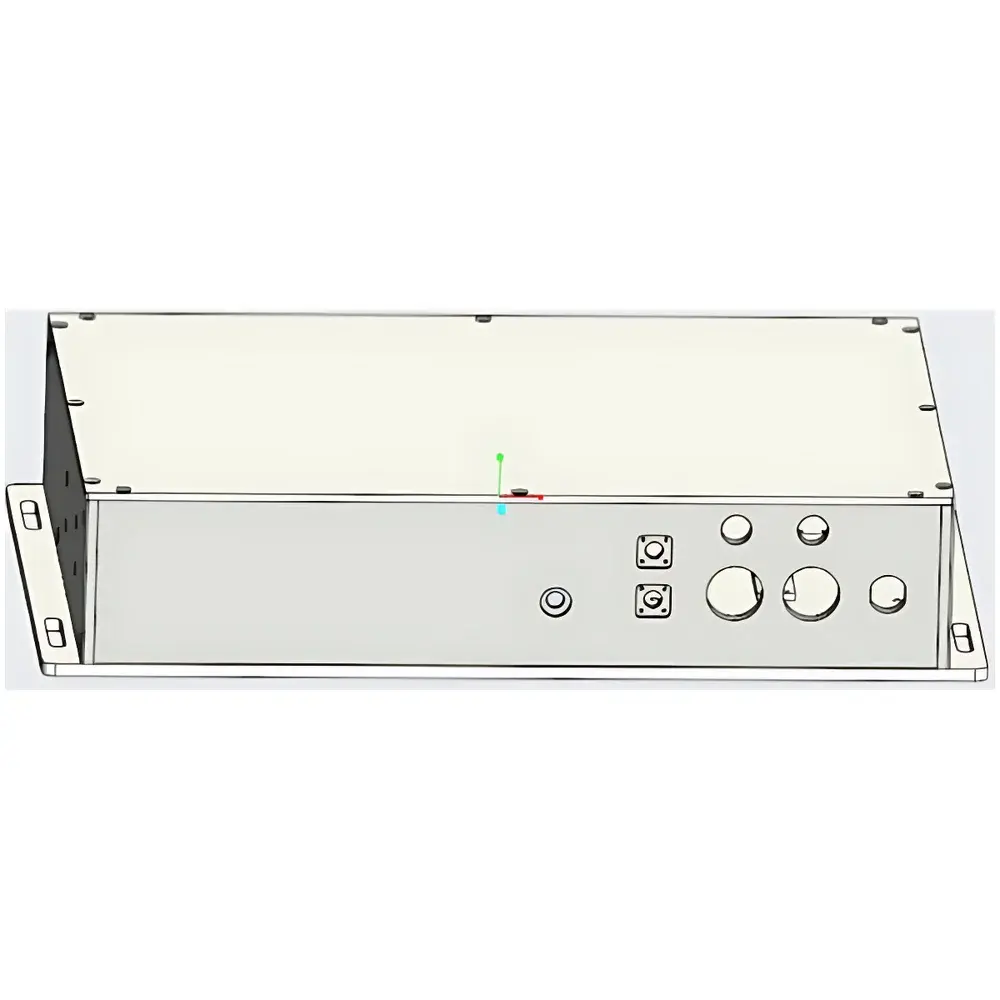
Auniontech 780 nm Single-Frequency Narrow-Linewidth Fiber Laser
| Brand | Auniontech |
|---|---|
| Origin | Shanghai, China |
| Model | Single-Longitudinal-Mode (SLM) |
| Output Power | >2 W |
| Optical Linewidth | <5 kHz |
| Frequency Drift (24 h) | <100 MHz |
| Polarization Extinction Ratio | >25 dB |
| Beam Quality (M²) | <1.1 |
| Cooling | Conductive/Thermoelectric |
| Compliance | RoHS, CE |
Overview
The Auniontech 780 nm Single-Frequency Narrow-Linewidth Fiber Laser is a high-stability, ultra-low-noise continuous-wave (CW) laser source engineered for quantum optics and precision atomic physics applications. Based on a master oscillator power amplifier (MOPA) architecture, it integrates a low-noise distributed feedback (DFB) fiber seed laser with polarization-maintaining (PM) fiber amplification and optimized second-harmonic-free fundamental emission at 780 nm. Unlike free-space diode lasers or external cavity diode lasers (ECDLs), this all-fiber design eliminates alignment sensitivity and provides intrinsic immunity to mechanical vibration and ambient temperature fluctuations—critical for long-term operation in mobile or field-deployable quantum sensors. The laser operates in strict single longitudinal mode (SLM) with side-mode suppression ratio (SMSR) exceeding 60 dB, ensuring diffraction-limited beam quality and minimal phase noise across extended integration times.
Key Features
- Single-frequency operation with linewidth <5 kHz (measured via delayed self-heterodyne interferometry)
- Output power >2 W at 780 nm with RMS power stability better than ±0.3% over 8 hours
- Frequency drift <100 MHz over 24 hours under passive thermal stabilization (no active cavity locking required)
- All-fiber monolithic construction using PM fiber components throughout the oscillator and amplifier stages
- Polarization-maintaining output with extinction ratio >25 dB and M² <1.1
- Integrated thermoelectric cooler (TEC) and precision current driver with analog modulation input (0–5 V)
- Front-panel and RS-232/USB interfaces for remote control, real-time monitoring of optical power, temperature, and drive current
Sample Compatibility & Compliance
This laser is optimized for interaction with 87Rb and 85Rb atomic vapors, matching the D2 transition line (780.241 nm) with sub-MHz detuning capability. Its spectral purity and amplitude stability meet requirements for Doppler-free saturation spectroscopy, magneto-optical trap (MOT) loading, and stimulated Raman adiabatic passage (STIRAP) protocols. The system complies with IEC 60825-1:2014 Class 3B laser safety standards and carries CE marking per EU Directive 2014/35/EU (Low Voltage Directive) and 2014/30/EU (EMC Directive). RoHS 2011/65/EU compliance ensures restricted substance control across all optical and electronic subassemblies. For GLP/GMP environments, optional firmware supports audit-trail logging of operational parameters in accordance with FDA 21 CFR Part 11 guidelines.
Software & Data Management
The laser is supplied with Auniontech’s LaserControl Suite—a Windows-based application enabling full parameter configuration, real-time oscilloscope-style waveform display, and automated data logging (CSV/TXT export). SDKs are provided for Python, LabVIEW, and MATLAB, supporting integration into larger experimental control stacks (e.g., NI PXI, Quantum Machines OPX). All firmware updates are delivered via signed binary packages with SHA-256 verification. Internal non-volatile memory stores calibration coefficients, serial-number-bound operating history, and last-known safe operating points—enabling traceable performance validation during facility audits or inter-laboratory comparisons.
Applications
- Atomic interferometry: Serving as the primary interrogation beam in gravity gradiometers, gyroscopes, and inertial navigation testbeds where coherence length >30 km (corresponding to <5 kHz linewidth) enables meter-scale interferometer baselines
- Quantum metrology: Enabling optical lattice clocks and compact vapor-cell atomic clocks through low-drift, high-SNR probing of hyperfine transitions
- Spin-exchange-relaxation-free (SERF) magnetometers: Providing stable, narrow-linewidth pump/probe beams for sub-fT/√Hz magnetic field resolution
- Entanglement generation: Pumping nonlinear waveguides (e.g., PPLN) for SPDC-based photon-pair sources requiring high spectral brightness and temporal coherence
- Ultracold atom experiments: Supporting MOT compression, optical molasses, and evaporative cooling stages with scalable power delivery and minimal intensity noise (<0.05% RMS, 10 Hz–10 MHz)
FAQ
Is active frequency stabilization required for atomic clock applications?
No—the inherent frequency stability (<100 MHz/24 h) and low technical noise floor allow direct use in medium-precision Rb vapor cell clocks without external locking. For primary-standard-grade operation, optional Pound-Drever-Hall (PDH) locking to a high-finesse cavity is supported via auxiliary modulation port.
Can the output be coupled into single-mode fiber without additional optics?
Yes—the laser features a factory-aligned, FC/APC-terminated PM980 pigtail with >90% coupling efficiency into standard PM fiber; no collimation or re-focusing is needed for most quantum setups.
What is the maximum allowable back-reflection level?
The system tolerates <−40 dB optical feedback without mode hopping or power instability, verified per IEC 61280-2-9 test methodology.
Does the laser support analog modulation for chirped Raman transitions?
Yes—0–5 V analog input modulates drive current with bandwidth up to 100 kHz, enabling linear frequency sweeps up to ±500 MHz at rates ≤10 kHz/s.
Is remote diagnostics available for multi-unit installations?
Yes—each unit broadcasts its MAC address and firmware version via DHCP; centralized health monitoring (temperature, current, power) is achievable via SNMPv3 or REST API endpoints.






