
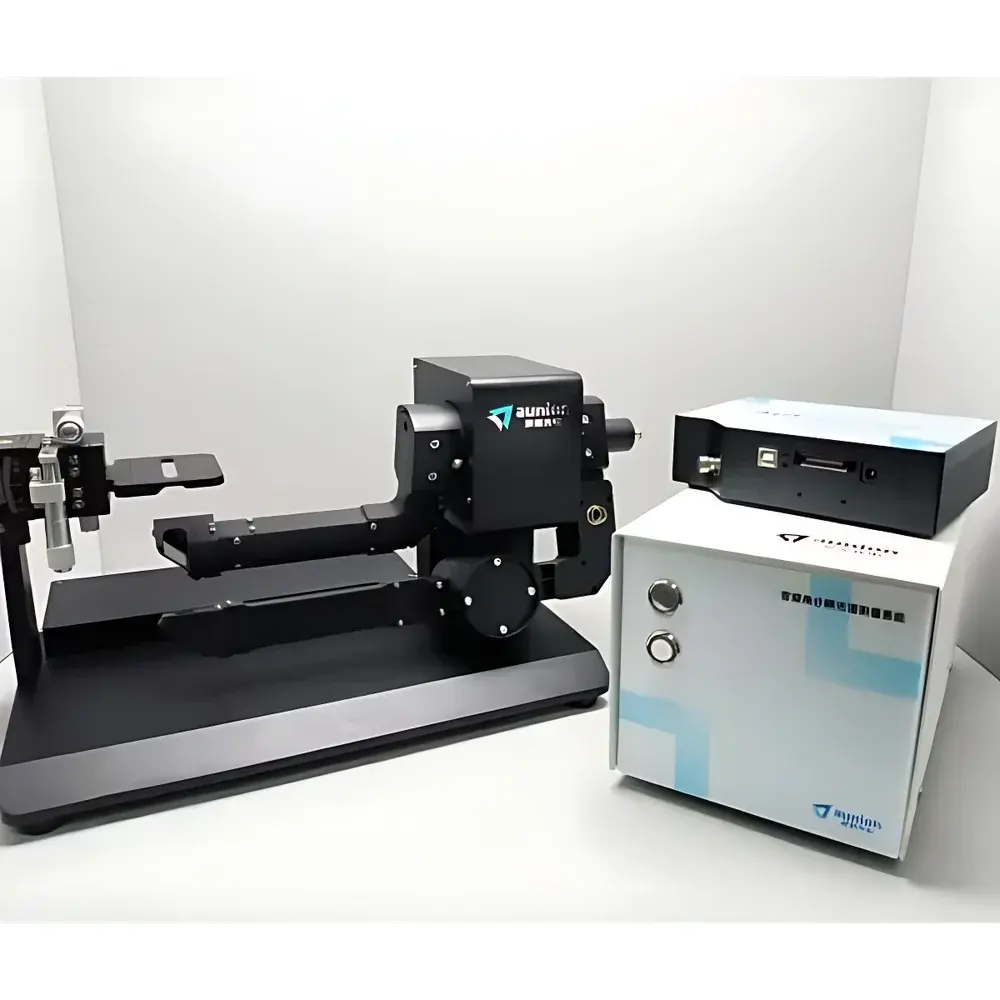
Auniontech ARS Macro-Angle-Resolved Spectroscopy System
| Brand | Auniontech |
|---|---|
| Origin | Shanghai, China |
| Model | ARS Macro-Angle-Resolved Spectroscopy System |
| Spectral Range | 190–2500 nm (expandable) |
| Angular Resolution | Adjustable incident & collection half-angles (0.5°, 1°, 1.5°, default 2°) |
| Sample Stage | 5-axis motorized adjustment |
| Illumination Sources | Integrated deuterium lamp (190–450 nm) and tungsten-halogen lamp (360–2500 nm) |
| Detection Modes | Reflectance, transmittance, absorbance, radiance, scattering, background-subtracted, raw |
| Compliance | Designed for GLP-aligned lab workflows |
Overview
The Auniontech ARS Macro-Angle-Resolved Spectroscopy System is a precision-engineered optical characterization platform designed to measure wavelength-dependent optical responses as a function of incident and/or collection angle in macro-scale samples. Unlike conventional spectrophotometers or integrating sphere-based systems, the ARS system implements a dual-goniometric architecture—separately controllable illumination and detection arms—enabling rigorous mapping of angular dispersion relations in photonic materials. It operates on the principle of collimated beam spectroscopy combined with high-fidelity angular positioning, delivering spatially resolved spectral data across real-space angular coordinates (θi, θr, φr) and spectral domains (190–2500 nm). This capability is essential for quantifying anisotropic optical properties such as photonic band structure, surface plasmon polariton (SPP) coupling angles, guided-mode resonances, and polarization-dependent diffraction efficiency in planar microstructured media.
Key Features
- Motorized dual-axis goniometer: Independent control of incident and collection angles with ±0.05° repeatability and 0–360° continuous rotation range
- Seven programmable measurement states: Top/bottom reflectance, transmittance, scattering, radiance, free-space, and user-defined scripting mode
- Expandable spectral coverage: Native 190–1100 nm detection with optional multi-spectrometer integration supporting simultaneous UV-VIS-NIR acquisition (190–2500 nm)
- Dual integrated broadband sources: Hamamatsu deuterium lamp (190–450 nm) and tungsten-halogen lamp (360–2500 nm), providing stable, calibrated illumination from deep UV to short-wave IR
- 5-degree-of-freedom sample stage: Precision XYZ translation plus tip/tilt adjustment for sub-milliradian alignment of macroscopic specimens (up to Ø50 mm)
- Modular optical interface: SMA905 and FC/PC fiber ports for external lasers, supercontinuum sources, or synchronized pump-probe configurations
- Configurable angular apertures: Interchangeable field stops offering incident and collection half-angles of 0.5°, 1°, or 1.5° (default 2°) to balance signal-to-noise ratio and angular resolution
Sample Compatibility & Compliance
The ARS system is optimized for planar, macroscopic samples exhibiting intrinsic or engineered optical anisotropy—including photonic crystals, metasurfaces, dielectric gratings, optical thin films, plasmonic nanostructures, and luminescent 2D materials. Its large working distance (>100 mm) and flexible stage design accommodate samples up to 10 mm thick without optical obstruction. All hardware and software components are engineered to support audit-ready laboratory practices: spectral calibrations are traceable to NIST-traceable standards (e.g., certified white reflectance tiles and aluminum mirrors); measurement metadata—including angle, integration time, lamp status, and aperture selection—is automatically embedded in exported data files. The system supports compliance with ISO 13655 (spectral measurement geometry), ASTM E275 (UV-VIS-NIR instrument qualification), and FDA 21 CFR Part 11 when deployed with validated software configuration and electronic signature modules.
Software & Data Management
The ARS Control Suite provides a deterministic, scriptable environment for experiment orchestration. Users define angular sequences (e.g., fixed θi sweeps, bidirectional θi/θr grids, or custom Lissajous trajectories), assign detector parameters per angle step, and trigger synchronized acquisitions across multiple spectrometers. Raw spectra are stored in HDF5 format with embedded metadata compliant with the Spectral Data Interchange Format (SDIF) conventions. Post-processing tools include Kubelka-Munk transformation, Fresnel-corrected reflectance modeling, dispersion contour extraction, and band-edge fitting using Levenberg-Marquardt optimization. Export options include CSV, MATLAB .mat, and vendor-neutral JCAMP-DX for third-party analysis pipelines. Audit trails record all parameter changes, user logins, and calibration events—enabling full reproducibility under GLP/GMP frameworks.
Applications
- Photonic band structure mapping of periodic dielectric structures via angle-resolved reflectance/transmittance
- Quantitative determination of SPP excitation angles on metallic gratings and prism couplers
- Characterization of angular selectivity in structural-color films and bio-inspired optical coatings
- Validation of dispersion engineering in metasurface lenses and holographic elements
- Angle-dependent quantum yield measurement of emissive 2D semiconductors (e.g., WS2, MoS2)
- Optical anisotropy profiling of aligned polymer films and liquid crystal layers
- Calibration of angular response functions for remote sensing instrumentation and satellite spectroradiometers
FAQ
What is the minimum resolvable angular step size?
The system achieves <0.05° mechanical repeatability; effective angular resolution depends on aperture selection and signal-to-noise constraints—typically 0.1°–0.5° in standard configurations.
Can the system perform polarization-resolved measurements?
Yes—optional motorized polarization mounts support rotation from 0° to 360° with ±0.1° accuracy; compatible with VIS/NIR broadband polarizers (S1.PMF.P-VIS and S1.PMF-NIR models).
Is the software compatible with LabVIEW or Python APIs?
Native Python bindings (via PyARS SDK) and LabVIEW VIs are provided for custom automation, integration into OEM platforms, or synchronization with cryostats/stages.
How is spectral calibration performed?
Factory calibration uses Hg-Ne and Hg-Ar emission lines; users may perform recalibration using supplied NIST-traceable holmium oxide and didymium filters.
Does the system support time-resolved angle-resolved spectroscopy?
Not natively—but with external pulsed laser triggering and gated detector synchronization (e.g., ICCD or SPAD arrays), time-domain angular dispersion studies are feasible via user-defined scripting.







