
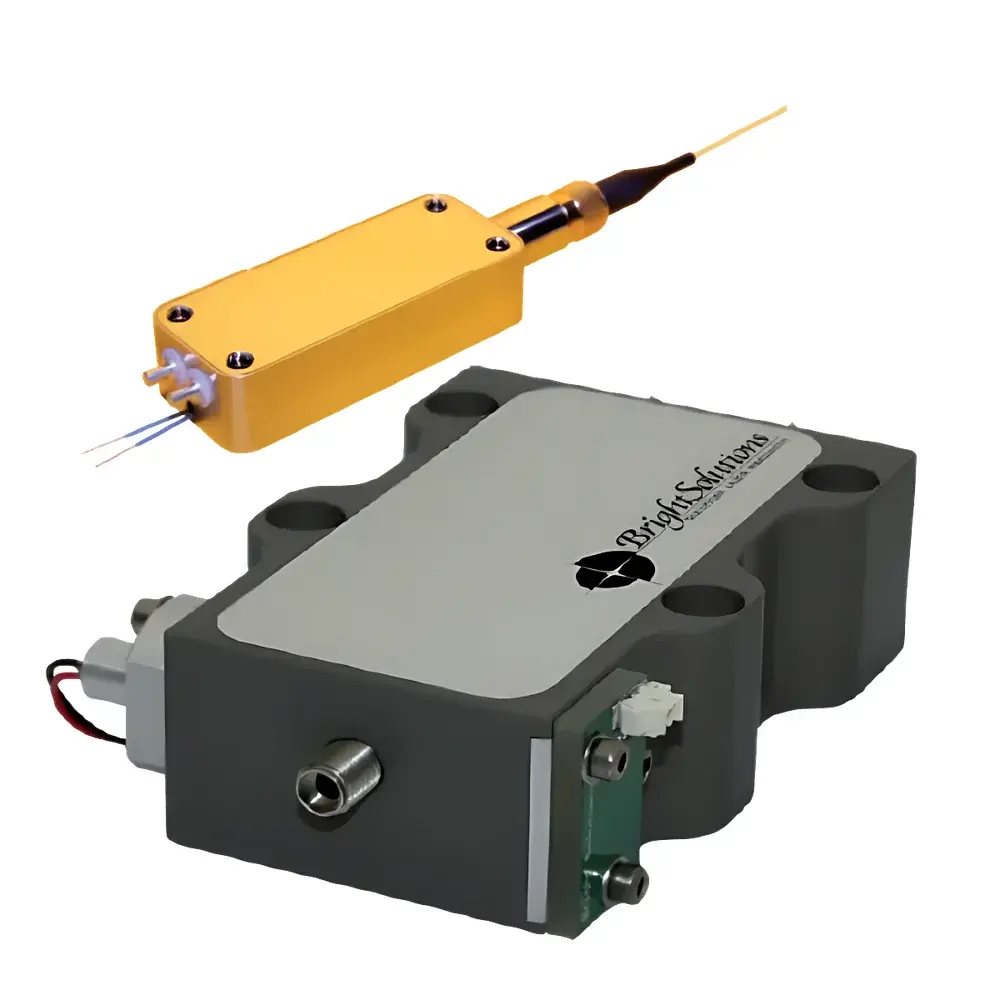
Auniontech BDL & BFP Fiber-Coupled Diode Laser Modules
| Brand | Auniontech |
|---|---|
| Origin | Shanghai, China |
| Manufacturer Type | Authorized Distributor |
| Product Origin | Domestic (China) |
| Model | High-Power Semiconductor Laser Modules |
| Wavelengths | 808 nm, 88X nm, 915 nm, 940 nm, 976 nm, 980 nm, 1064 nm |
| Output Power (BDL) | Up to 400 W QCW / Up to 200 W CW |
| Output Power (BFP) | Up to 50 W CW / Hundreds of W peak (pulsed) |
| Fiber Interface | SMA 905 (optional: FC, ST, custom patch cable or pigtail) |
| Core Diameter | 100–800 µm |
| NA | 0.15 or 0.22 |
| Spectral Bandwidth (FWHM) | 1–5 nm |
| Center Wavelength Tolerance | ±1–10 nm |
| Operating Temperature | 15–35 °C (extended range optional) |
| Storage Temperature | −20–60 °C |
| Cooling | Conductive (water-cooled option available) |
| Electro-Optical Efficiency | Up to 45% |
| Integrated NTC Thermistor | 10 kΩ @ 25 °C |
| Multi-Wavelength Option | Available (up to 4 wavelengths in one module) |
Overview
The Auniontech BDL and BFP fiber-coupled diode laser modules are engineered for high-reliability, high-brightness direct-diode applications requiring precise spectral control, stable power delivery, and compact thermal management. These modules operate on the principle of semiconductor electroluminescence, where electrically driven III–V compound semiconductor junctions (e.g., AlGaAs, InGaAs) emit coherent light at discrete near-infrared wavelengths. The BDL series employs a monolithic single-emitter or bar-based architecture optimized for high continuous-wave (CW) and quasi-continuous-wave (QCW) output—up to 400 W—with excellent beam quality and long-term stability under conductive cooling. The BFP series utilizes an integrated multi-single-emitter platform, enabling high brightness at low drive current density, extended lifetime (>10,000 h typical), and superior spatial coherence—making it especially suitable for end-pumping solid-state lasers and fiber laser pumping. Both families feature hermetically sealed TO-style or custom metal-ceramic packages with integrated thermistors and precision collimation optics pre-aligned to standard fiber connectors. Their design complies with industrial standards for optical safety (IEC 60825-1 Class 4), electromagnetic compatibility (EN 55032/55035), and mechanical robustness (MIL-STD-810G shock/vibration profiles upon request).
Key Features
- Wide wavelength selection across key NIR bands: 808 nm, 88X nm (e.g., 885 nm or 888 nm), 915 nm, 940 nm, 976 nm, 980 nm, and 1064 nm—optimized for Nd:YAG, Yb-doped fiber, Er:YAG, and Tm-doped gain media absorption peaks
- Flexible output configurations: Standard SMA 905 fiber coupling; optional FC/ST connectors; customizable fiber pigtails (length, coating, connector type); free-space collimated or line-generator optics available
- Conductive cooling architecture enables operation without forced-air or liquid systems—ideal for embedded OEM integration and space-constrained platforms
- Multi-wavelength module (MDL) option supports up to four independently controlled wavelengths in a single housing—designed for multi-modal medical therapeutics (e.g., vascular, dermatological, and lithotripsy protocols)
- High electro-optical efficiency (up to 45%) reduces thermal load and power supply requirements, enhancing system-level energy economy
- Integrated 10 kΩ NTC thermistor enables real-time temperature monitoring and closed-loop thermal regulation in host systems
- Compliance-ready design supports customization to MIL-STD-461E (EMI), DO-160G (aerospace environmental), and ISO 13485 (medical device manufacturing) requirements
Sample Compatibility & Compliance
These modules are compatible with silica-based multimode fibers (core diameters from 100 µm to 800 µm; NA 0.15 or 0.22), including low-OH and radiation-hardened variants. They meet IEC 60825-1:2014 for Class 4 laser product classification and include built-in interlock circuitry for safe integration into larger optical systems. For regulated environments—including clinical laser systems and GMP-compliant manufacturing lines—the modules can be supplied with full traceability documentation (material certifications, burn-in reports, lot-level test data) and support FDA 21 CFR Part 11–compliant software interfaces when paired with optional controllers. RoHS 3 and REACH compliance is standard; halogen-free packaging and lead-free soldering are available per customer specification.
Software & Data Management
While the base modules operate as analog-controlled devices (TTL/analogue modulation input), optional integrated drivers provide USB/RS-485 communication, enabling remote parameter configuration (current setpoint, temperature limit, pulse width/frequency), real-time telemetry (output power, case temperature, diode voltage), and event logging. Firmware supports configurable safety interlocks, ramp-up/down profiles, and error-code reporting aligned with IEC 62304 software lifecycle standards. Audit trails and user-access controls are implemented in higher-tier controller units, satisfying GLP/GMP validation requirements for laboratory and production use.
Applications
- Solid-state laser pumping: End-pumping of Nd:YVO₄, Nd:YAG, Yb:YAG, and Tm:YLF crystals in scientific and industrial Q-switched or mode-locked oscillators
- Fiber laser pumping: Cladding- or core-pumping of Yb-doped double-clad fibers in kW-class MOPA and CW amplifier architectures
- Medical laser systems: OEM integration into dermatology, urology, ophthalmology, and aesthetic platforms—particularly where multi-wavelength flexibility and compact footprint are critical
- Materials processing: Direct diode applications in brazing, soldering, polymer welding, and selective heating—leveraging high absorption at 976 nm and 1064 nm in metals and plastics
- Sensing & instrumentation: Use in LIDAR transmitters, gas spectroscopy sources (e.g., water vapor detection at 940 nm), and fluorescence excitation systems
- Aerospace & defense: Ruggedized variants deployed in directed-energy demonstrators, target illuminators, and free-space optical communication terminals
FAQ
What is the typical lifetime expectancy under rated CW operation?
Mean time to failure (MTTF) exceeds 10,000 hours at 25 °C heatsink temperature and rated drive current, based on accelerated life testing per Telcordia GR-468-CORE. Lifetime scales inversely with junction temperature—thermal interface quality is critical.
Can these modules be operated in pulsed mode with arbitrary waveforms?
Yes—both BDL and BFP modules support TTL-triggered pulsing up to 500 kHz (depending on driver). Analog modulation bandwidth exceeds 100 kHz for current control. Custom pulse shaping requires external driver integration.
Are calibration certificates and spectral measurement reports available?
Factory spectral characterization (wavelength, FWHM, power stability, pointing stability) is included with each shipment. NIST-traceable power calibration and spectral irradiance reports are available as optional add-ons.
Do you support custom fiber termination or mechanical housing modifications?
Yes—custom fiber pigtails (e.g., armored, angled PC, PM fiber), hermetic feedthroughs, and MIL-DTL-38999-compatible housings are routinely offered for defense and aerospace integrations.
Is there a version qualified for use in Class II medical devices?
Auniontech provides design history files (DHF), risk analysis (ISO 14971), and biocompatibility documentation (ISO 10993-1) for modules configured per IEC 60601-2-22 requirements—subject to joint development agreement.





