
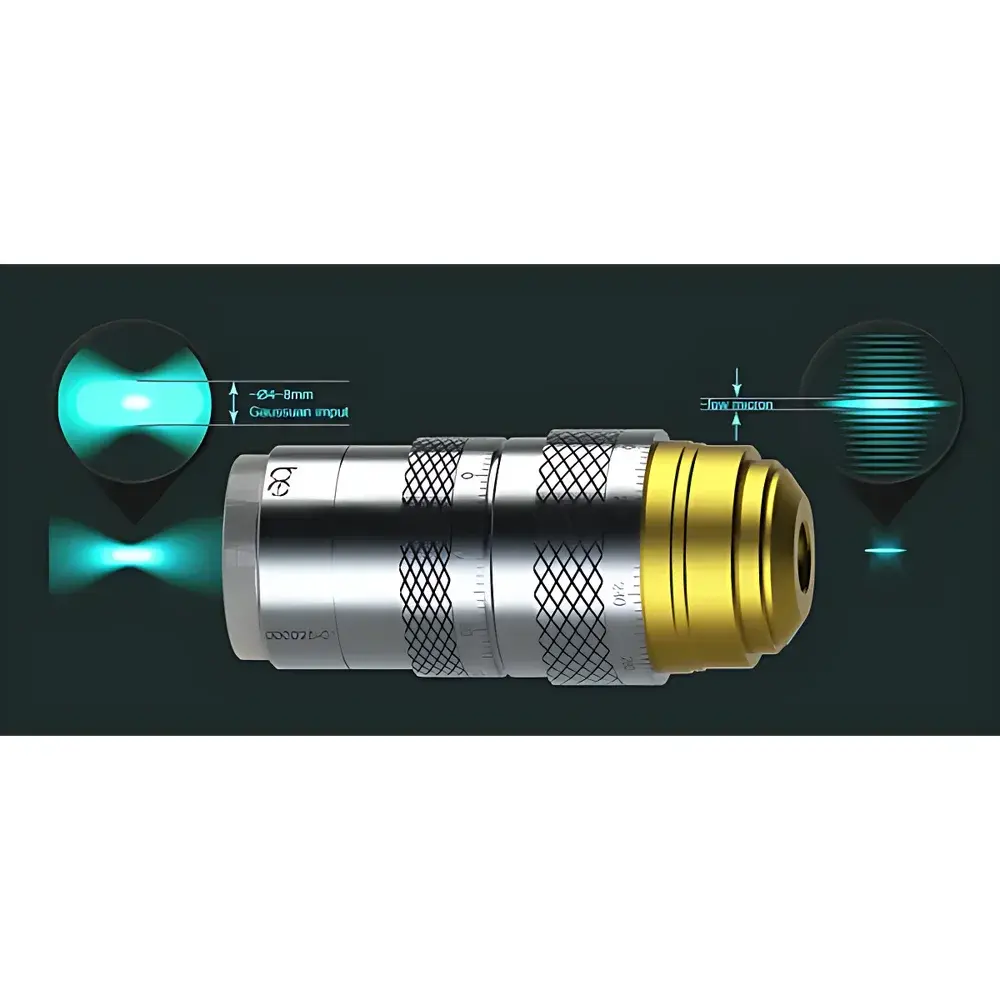
Auniontech Bessel Beam Shaper (Model: Custom Bessel Optical Element)
| Brand | Auniontech |
|---|---|
| Origin | Shanghai, China |
| Component Type | Optical Element |
| Wavelength Options | 343 nm, 515 nm, 1030 nm, 1064 nm |
| Input Polarization Requirement | Circular |
| Conversion Efficiency | ~95% |
| Bessel Zone Length | Up to 450 µm |
| LIDT | >25 J/cm² @ 1064 nm, 10 ns, 100 Hz |
| LIDT | >3.6 J/cm² @ 1064 nm, 10 ps, 100 Hz |
| Output Configurations | Negative Bessel–Gaussian, Positive Bessel–Gaussian, or Dual Bessel–Gaussian |
| Mounting | Compatible with Standard Optical Cage Systems |
| Beam Input | Gaussian |
| Beam Output | Bessel–Gaussian (Non-diffracting, Focus-Free) |
Overview
The Auniontech Bessel Beam Shaper is a precision-engineered diffractive optical element (DOE) designed to transform an incident Gaussian laser beam into a high-fidelity Bessel–Gaussian beam—a quasi-non-diffracting, focus-free intensity distribution with extended depth of field and self-healing properties. Unlike conventional focusing optics, this shaper operates on the principle of axicon-based conical wavefront generation combined with tailored phase modulation, enabling propagation-invariant intensity profiles over millimeter-scale axial distances. It is optimized for pulsed and CW solid-state lasers operating at key industrial and scientific wavelengths: 343 nm (3rd harmonic of Nd:YAG), 515 nm (2nd harmonic of Yb fiber), 1030 nm (fundamental of Yb-doped systems), and 1064 nm (Nd:YAG fundamental). The device produces a central lobe with near-ideal Bessel characteristics—minimal side-lobe suppression, uniform axial intensity, and no internal focal point—making it suitable for applications demanding spatially stable irradiance over extended working distances.
Key Features
- High laser-induced damage threshold (LIDT): >25 J/cm² at 1064 nm, 10 ns pulse width, 100 Hz repetition rate; >3.6 J/cm² at 1064 nm, 10 ps pulse width, 100 Hz—limited only by dielectric coating performance
- Configurable output topology: selectable negative, positive, or dual Bessel–Gaussian zones to match specific beam propagation requirements
- Optimized conversion efficiency: ~95% optical power transfer from input Gaussian to output Bessel–Gaussian profile
- Input requirement: circularly polarized illumination ensures consistent phase response and minimizes polarization-dependent loss
- Mechanical integration: designed with standard kinematic mounting interfaces (e.g., SM1/SM2 threading, cage system compatibility) for rapid alignment and modular integration into OEM or lab-scale optical trains
- No internal focusing: eliminates thermal lensing risk and enables uniform energy deposition along the Bessel zone—critical for transparent material processing
Sample Compatibility & Compliance
This Bessel beam shaper is compatible with nanosecond- to picosecond-pulsed laser sources and continuous-wave systems emitting at 343 nm, 515 nm, 1030 nm, and 1064 nm. Its fused silica substrate and high-performance multilayer dielectric coatings meet ISO 10110 surface quality standards (scratch-dig 10–5), ensuring low wavefront distortion (<λ/8 RMS over clear aperture). While not certified to a specific regulatory framework as a standalone component, the shaper supports compliance in end-user systems adhering to IEC 60825-1 (laser safety), ISO 13694 (laser beam parameter measurement), and ASTM F2792 (standard terminology for additive manufacturing). When integrated into GMP or GLP environments, its traceable manufacturing origin (Shanghai, China) and documented LIDT testing facilitate qualification under FDA 21 CFR Part 11–aligned documentation protocols.
Software & Data Management
As a passive optical component, the Auniontech Bessel Beam Shaper requires no embedded firmware, drivers, or software control. Performance characterization data—including measured M², axial intensity profiles, side-lobe ratios, and far-field divergence—are provided in standardized .csv and .txt formats upon request. These datasets are compatible with common optical simulation platforms (Zemax OpticStudio, COMSOL Multiphysics, MATLAB) for system-level modeling. For customers integrating the shaper into automated laser workstations, Auniontech supplies mechanical drawings (STEP, IGES), coating spectral reflectance/transmittance curves, and calibrated LIDT test reports—enabling full metrological traceability within QA/QC workflows.
Applications
- Ultrafast laser micromachining of transparent dielectrics (fused silica, sapphire, BK7) for micro-drilling, waveguide inscription, and Bragg grating fabrication
- Nonlinear frequency conversion enhancement via extended interaction length in periodically poled crystals
- Optical trapping and manipulation of low-refractive-index particles in microfluidic channels
- Confocal microscopy illumination with extended depth-of-field for volumetric imaging of thick biological specimens
- Plasma channel generation in air or gases for remote spectroscopy and THz emission
- Industrial laser scribing of photovoltaic wafers where uniform line width and minimal heat-affected zone are critical
FAQ
Is the Bessel beam shaper compatible with femtosecond lasers?
Yes—provided pulse energy and peak intensity remain below the specified LIDT thresholds. For sub-100-fs pulses, consult Auniontech for custom coating options optimized for broader bandwidth and reduced group delay dispersion.
What input beam diameter is required to achieve the maximum 450 µm Bessel zone length?
The Bessel zone length scales linearly with input beam radius. To realize the nominal 450 µm axial range, a collimated input beam diameter of approximately 8–10 mm (1/e²) is recommended, assuming diffraction-limited input quality.
Does the shaper introduce chromatic aberration across its supported wavelength set?
No—it is a wavelength-specific design. Each unit is manufactured and coated for a single nominal wavelength (e.g., 1064 nm); multi-wavelength operation requires separate elements or custom achromatic designs.
Can the output be focused using downstream optics without disrupting the Bessel character?
Focusing collapses the non-diffracting property. However, relay optics can image the Bessel zone onto a target plane while preserving axial uniformity—this configuration is commonly used in laser glass cutting systems.
Is technical support available for optical alignment and system integration?
Yes—Auniontech provides application engineering support, including alignment protocols, beam profiling recommendations, and integration schematics for common laser platforms (Coherent, Trumpf, IPG, Light Conversion).





