
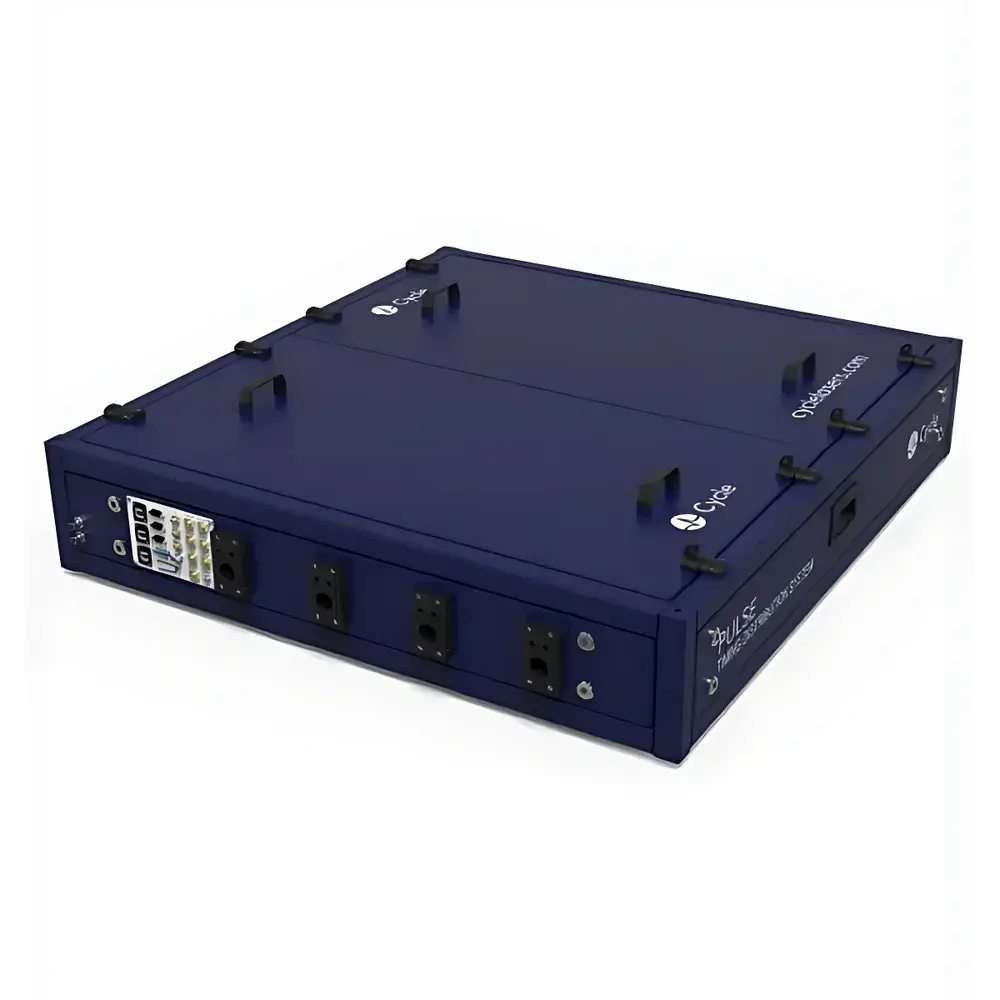
Auniontech BOMPD Balanced Optical-Microwave Phase Detector
| Brand | Auniontech |
|---|---|
| Model | BOMPD Series |
| Type | Balanced Optical-Microwave Phase Detector |
| Wavelength Options | 800 ± 30 nm, 1030 ± 30 nm, 1550 ± 40 nm |
| RF Input Power | >15 dBm (up to 10 GHz) |
| Optical Input Power | >20 mW |
| Detector Sensitivity | >0.2 mV/fs (at detector output, unamplified) |
| Integrated Noise Floor (10 kHz BW) | <0.5 fs RMS |
| Residual Timing Jitter (std dev) | <20 fs |
| RF Output Power (RFG option) | >10 dBm, 50 Ω |
| RF Power Stability | <0.1% |
| Dimensions (H×W×L) | 420 × 300 × 171 mm (controller optional for SD/RFG configurations) |
| Weight | 10–20 kg |
| Compliance | Compatible with EPICS & TANGO control frameworks |
| Configurations | MD (Measurement-Only), SD (Synchronization-Driven), RFG (RF Generation) |
Overview
The Auniontech BOMPD Balanced Optical-Microwave Phase Detector is a precision metrology instrument engineered for ultra-low-jitter timing synchronization between optical pulse trains and microwave reference signals. It operates on the principle of balanced heterodyne detection, where the phase difference between an optical pulse train and a microwave carrier is converted into a baseband voltage signal linearly proportional to the time delay between their zero-crossings. This enables sub-femtosecond-level residual jitter characterization and closed-loop stabilization in photonic–electronic hybrid systems. Unlike conventional photodetector-based phase monitors, the BOMPD employs a dual-channel balanced photoreceiver architecture that inherently rejects common-mode amplitude fluctuations—effectively eliminating AM-to-PM conversion noise and enhancing long-term measurement stability. Its design targets applications requiring traceable, high-reproducibility time-domain alignment, including optical frequency comb stabilization, ultrafast laser timing distribution, and photonic-assisted RF synthesis.
Key Features
- Sub-20 fs residual timing jitter (RMS), validated under controlled environmental conditions and low-noise reference sources
- Three configurable operational modes: MD (measurement-only), SD (synchronization-driven with integrated feedback controller), and RFG (RF generation with optically referenced low-noise VCO)
- Multi-wavelength support: factory-calibrated operation at 800 nm, 1030 nm, and 1550 nm—with ±30–40 nm tolerance bands optimized for Ti:Sapphire, Yb-fiber, and Er-fiber laser systems
- High dynamic range RF input (>15 dBm up to 10 GHz) with 50 Ω impedance matching; optical input via polarization-maintaining (PM) fiber with >20 mW power handling
- Integrated detector sensitivity exceeding 0.2 mV/fs (unamplified output), enabling direct interfacing with low-noise voltage-controlled actuators or digitizers
- EPICS and TANGO-compatible control interface for integration into large-scale scientific infrastructure (e.g., free-electron lasers, synchrotron timing systems)
- Rack-mountable 19″ chassis option available when SD or RFG configurations are selected, supporting GLP/GMP-aligned system documentation workflows
Sample Compatibility & Compliance
The BOMPD is designed for use with mode-locked lasers operating below 10 GHz repetition rates and microwave oscillators compliant with IEEE Std 1139 (Definitions of Physical Quantities for Fundamental Frequency and Time Metrology). It supports PM-fiber-coupled optical inputs by default; single-mode (SM) fiber variants are available upon request and subject to modal dispersion compensation verification. RF inputs must conform to IEC 61000-4-3 radiated immunity standards for laboratory instrumentation. While the device itself does not carry CE or FCC certification as a standalone subsystem, its mechanical and electrical interfaces comply with EN 61326-1:2013 (EMC requirements for measurement equipment) and ISO/IEC 17025:2017 traceability guidelines when operated within specified environmental parameters (20–25 °C, <50% RH, vibration-isolated benchtop).
Software & Data Management
The BOMPD includes embedded firmware supporting real-time PID parameter optimization for lock acquisition and hold-in performance. Control logic is accessible via TCP/IP and RS-232 interfaces, with native drivers provided for MATLAB, Python (PyVISA), and LabVIEW. All configuration states, calibration timestamps, and raw voltage outputs are logged with ISO 8601-compliant metadata. When deployed in regulated environments (e.g., pharmaceutical QC labs or defense R&D facilities), the system supports audit-trail-enabled operation per FDA 21 CFR Part 11 requirements—provided external data acquisition hardware implements electronic signature and user access controls. Export formats include CSV, HDF5, and TDMS, ensuring compatibility with LIMS and ELN platforms.
Applications
- Optical frequency comb stabilization against microwave references in primary frequency metrology laboratories
- Timing distribution networks for X-ray free-electron lasers (XFELs), where femtosecond-level synchronization between pump lasers and electron bunches is critical
- Photonic microwave generation using electro-optic modulation, requiring precise phase locking between optical carriers and synthesized RF tones
- Ultrafast pump–probe experiments demanding jitter-free triggering across multi-channel detection systems
- Development and validation of low-phase-noise microwave oscillators referenced to optical clocks
- Calibration of time-of-flight measurement systems used in quantum sensing and distributed fiber optic sensing
FAQ
What is the minimum measurable time delay resolution?
The BOMPD achieves an effective timing resolution better than 0.5 fs (integrated over 10 kHz bandwidth), limited primarily by thermal and shot noise contributions at the balanced photodiode stage.
Can the BOMPD be used with non-mode-locked lasers?
No—it requires periodic optical pulse trains with stable repetition rates below 10 GHz; continuous-wave or chaotic sources are incompatible with its zero-crossing detection architecture.
Is factory recalibration required annually?
Yes. To maintain traceability to NIST-traceable time standards, annual recalibration—including photodetector responsivity mapping and RF path delay characterization—is recommended and documented per ISO/IEC 17025 procedures.
Does the SD configuration support arbitrary waveform generators as actuators?
It interfaces exclusively with analog voltage-controlled inputs (e.g., laser cavity piezo drivers or VCO tuning ports); digital actuation requires external DAC integration.
Are custom wavelength options supported beyond 800/1030/1550 nm?
Yes—custom configurations for 780 nm, 920 nm, or 2 µm can be engineered, subject to photodiode quantum efficiency validation and thermal drift compensation modeling.




