Auniontech Chalcogenide Infrared Glass Fiber
| Brand | Auniontech |
|---|---|
| Type | Chalcogenide (ChG) Infrared Fiber |
| Transmission Range | 1.1–6.5 µm (S-based), 2–9 µm (Se-based), 3–11.5 µm (Te-based) |
| Core Diameter Options | 8–500 µm |
| Attenuation | 0.2–0.3 dB/m @ 2.5–4 µm & 4.5–5 µm |
| Numerical Aperture | ~0.25–0.30 (typ.) |
| Tensile Strength | >50 kpsi (coated fiber) |
| Bend Radius (min.) | <15 mm (repeated bending) |
| Resolution (imaging bundle) | ≥20 lp/mm |
| Fill Factor | ≥50% |
| Broken-fiber Rate | ≤1% |
| Crosstalk | ≤2% |
| Max. Pixel Count (bundle) | >1×10⁶ |
| Minimum Single-fiber Diameter | 10 µm |
| Software & Compliance | Compatible with ISO 17025-compliant calibration workflows |
Overview
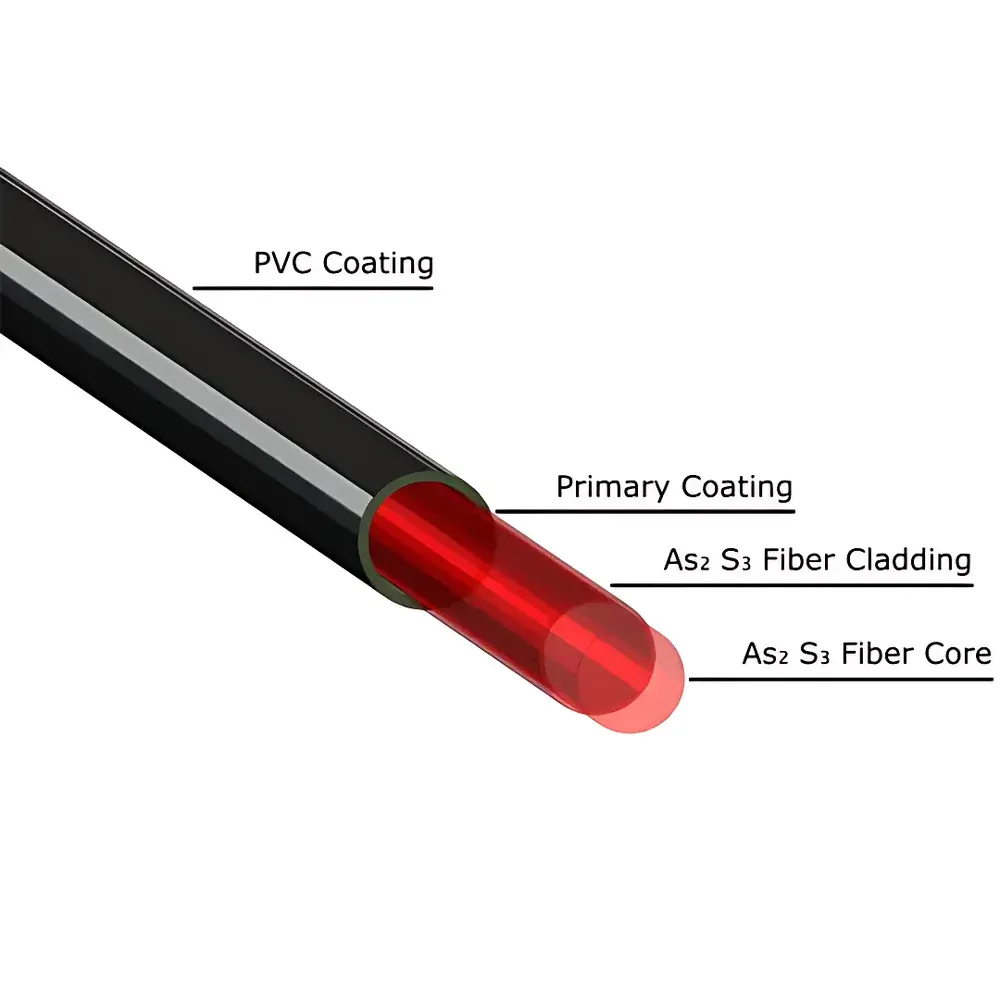
Auniontech Chalcogenide Infrared Glass Fibers are engineered for high-fidelity transmission and delivery of mid- to long-wave infrared (MWIR–LWIR) radiation across the spectral range of 1.1–11.5 µm, depending on glass composition (sulfide, selenide, or telluride-based). Fabricated via precision drawing at controlled temperatures near the softening point of bulk chalcogenide glass, these fibers leverage the intrinsic low phonon energy and wide IR transparency window of amorphous chalcogenides—enabling minimal multiphonon absorption beyond 5 µm. Unlike silica-based fibers, which become opaque beyond ~2.2 µm, chalcogenide fibers provide a robust waveguide platform for applications requiring optical access in the molecular fingerprint region (2.5–12 µm), where fundamental vibrational modes of gases, biomolecules, and polymers reside. Their core/clad architecture ensures guided-mode propagation with low modal dispersion, while dual-layer polymer coating (typically acrylate + polyimide) imparts mechanical resilience, bend tolerance, and environmental stability essential for laboratory, industrial, and field-deployable systems.
Key Features
- Ultra-broad spectral transmission: 1.1–6.5 µm (S-based), 2–9 µm (Se-based), and 3–11.5 µm (Te-based) formulations available
- Low propagation loss: 0.2–0.3 dB/m in key atmospheric windows (2.5–4 µm and 4.5–5 µm)
- Scalable core geometry: Standard core diameters from 8 µm to 500 µm, supporting single-mode to high-power multimode operation
- Dual-polymer coating system: Enhances tensile strength (>50 kpsi), flexibility (minimum bend radius <15 mm), and resistance to thermal cycling and humidity
- High numerical aperture (~0.25–0.30): Maximizes coupling efficiency with quantum cascade lasers (QCLs), interband cascade lasers (ICLs), and thermal sources
- Imaging-grade fiber bundles: Tight-packed, linear-to-area, and custom-geometry configurations with ≥20 lp/mm resolution, ≤1% broken-fiber rate, and ≤2% optical crosstalk
Sample Compatibility & Compliance
These fibers are compatible with standard IR optical interfaces—including SMA-905, FC/PC, and FC/APC connectors—and support custom jacketing (e.g., stainless steel, PTFE, or flexible armored sheaths) for harsh-environment deployment. All fibers are manufactured under controlled cleanroom conditions and undergo batch-level spectral attenuation profiling and mechanical screening per ISO 10110-3 and IEC 61753-1. For regulated applications, fiber-based sensing and imaging subsystems may be integrated into ISO/IEC 17025-accredited measurement chains; traceability to NIST-traceable IR radiometric standards is achievable through calibrated source/fiber/detector characterization protocols. While the fiber itself is not an active medical device, its use in FDA-cleared IR thermography or breath analysis platforms complies with relevant sections of 21 CFR Part 11 when paired with audit-trail-enabled data acquisition software.
Software & Data Management
Auniontech provides configuration files and spectral response templates for integration with common spectroscopic platforms (e.g., Bruker OPUS, Thermo OMNIC, LabVIEW-based DAQ systems). No proprietary firmware or closed drivers are required—fibers operate as passive optical components. However, for imaging bundle applications, we supply pixel-mapping matrices and fill-factor correction coefficients to enable quantitative radiometric reconstruction in MATLAB, Python (NumPy/SciPy), or ENVI environments. All calibration reports include uncertainty budgets aligned with GUM (JCGM 100:2008) guidelines, supporting GLP/GMP documentation requirements for QC/QA labs and instrument OEMs.
Applications
- Mid-infrared spectroscopy: Coupling QCLs and FTIR spectrometers to gas cells, flow-through cuvettes, or remote sampling probes for real-time detection of CO, NOx, CH4, NH3, and volatile organic compounds (VOCs)
- Infrared thermometry and thermal imaging: Flexible light pipes for non-contact temperature monitoring in confined, high-EMI, or hazardous zones (e.g., furnace interiors, battery module inspection, plasma chambers)
- Supercontinuum generation: Pumping with femtosecond Er:fiber or Cr:ZnSe lasers to produce octave-spanning MWIR spectra for hyperspectral imaging and dual-comb spectroscopy
- Fiber-delivered laser surgery and ablation: High-peak-power transmission of pulsed CO2 (10.6 µm) or QCL output for minimally invasive tissue interaction
- Spaceborne and airborne remote sensing: Lightweight, radiation-tolerant fiber bundles replacing rigid relay optics in line-scan or staring-array IR imagers for Earth observation
- Biochemical sensing: Evanescent-wave absorption in suspended-core or D-shaped chalcogenide fibers for label-free detection of proteins, lipids, and nucleic acids in aqueous media
FAQ
What is the maximum continuous power handling capability of these fibers?
Power handling depends on core size, wavelength, and pulse regime. For CW QCLs (4.5–4.9 µm), 100-µm-core fibers sustain >1 W without thermal lensing or coating degradation; for pulsed operation (ns–ps), peak powers up to 10 MW/cm² are supported with appropriate beam conditioning.
Can these fibers be spliced or connectorized in-house?
Yes—fusion splicing is feasible using chalcogenide-specific arc fusion units with inert atmosphere control; cleaving requires diamond scribes and low-stress polishing. We supply pre-connectorized assemblies and technical notes for OEM integration.
Do you offer custom numerical aperture or polarization-maintaining variants?
Standard fibers are low-birefringence; PM versions with elliptical stress rods or asymmetric core geometries are available under NRE development agreements.
Are there RoHS or REACH compliance documents available?
All sulfur- and selenium-based compositions meet RoHS Annex II heavy-metal limits; full REACH SVHC declarations and SDS are provided upon request.
How does humidity affect long-term transmission stability?
Uncoated chalcogenide surfaces exhibit slow oxidation in ambient air; the dual-polymer coating fully isolates the glass, enabling >10-year operational stability under 85% RH at 40°C per IEC 60068-2-30 testing.