
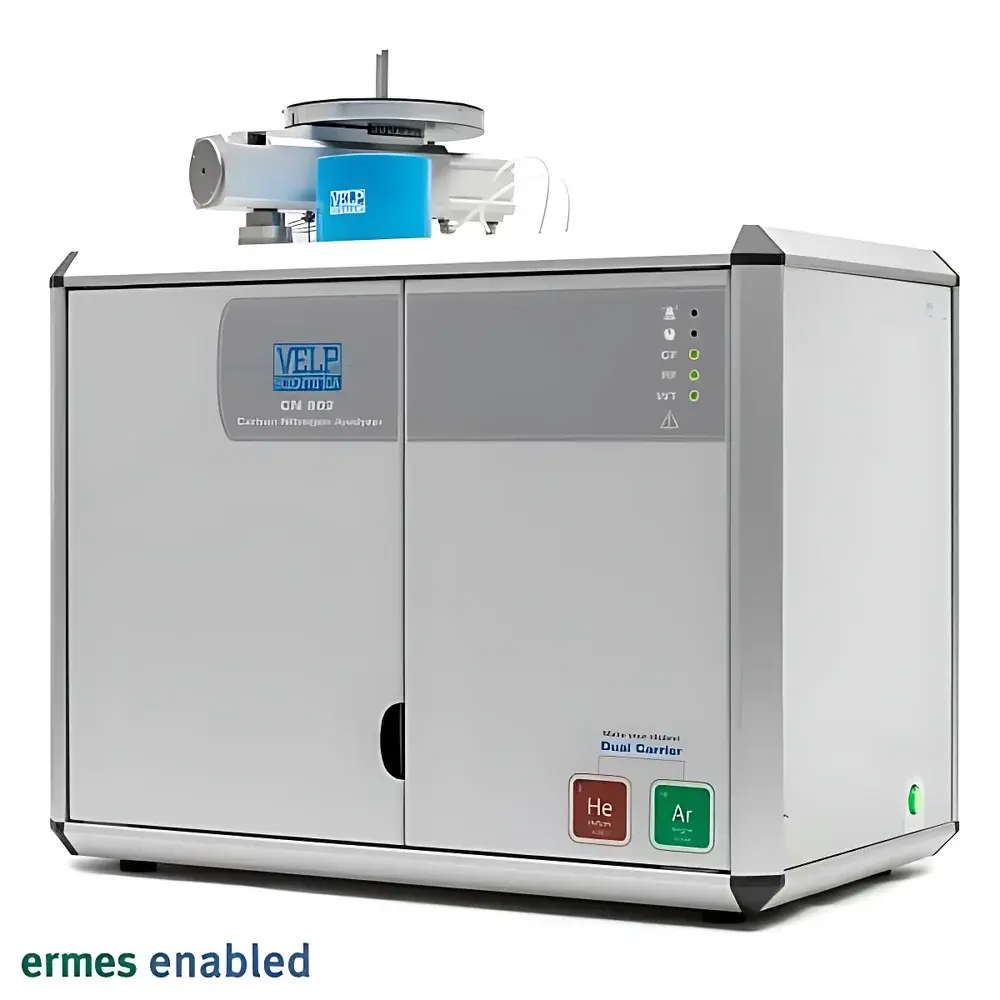


Auniontech CN802 Carbon-Nitrogen Elemental Analyzer
| Brand | Auniontech |
|---|---|
| Model | CN802 |
| Detection Principle | High-Temperature Combustion Coupled with NDIR and LoGas TCD Detection |
| Sample Types | Solids and Liquids (TC, TN, TOC*, TIC, C/N Ratio) |
| Analysis Time | 2–5 min per sample |
| Compliance | AOAC, AACC, ASBC, ISO, DIN, IFFO, OIV, ASTM, EPA |
| Combustion Temperature | 1030 °C |
| Water Removal | Dual-Stage (DriStep Physical Condenser + Chemical Trap) |
| Gas Switching | Seamless He/Ar Carrier Gas Switching Without Hardware Modification |
| Detector Configuration | Dual-Channel — NDIR for CO₂, LoGas TCD for N₂ |
| Automation | 30-Position Autosampler (expandable to 120 positions with optional trays) |
| Software Platform | VELP Ermes Cloud-Based Instrument Control & Data Management |
| Regulatory Support | Audit Trail, User Access Levels, Electronic Signatures (21 CFR Part 11 Ready) |
Overview
The Auniontech CN802 Carbon-Nitrogen Elemental Analyzer is a fully automated, high-precision combustion-based instrument engineered for quantitative determination of total carbon (TC), total nitrogen (TN), total organic carbon (TOC after acid pretreatment), total inorganic carbon (TIC), and the C/N ratio in solid and liquid matrices. It operates on the principle of high-temperature catalytic combustion (1030 °C) followed by selective gas-phase detection: carbon is converted quantitatively to CO₂ and measured via high-stability non-dispersive infrared (NDIR) spectroscopy, while nitrogen oxides are reduced to elemental N₂ in a dedicated reduction furnace and detected using LoGas thermal conductivity detection (TCD)—a reference-gas-free, maintenance-minimized architecture. The system integrates physical and chemical water removal stages (DriStep condenser + chemical trap), CO₂ scrubbing with auto-regenerating adsorbent, and oxygen scavenging to ensure baseline stability and analytical specificity. Designed for laboratories requiring regulatory-compliant elemental data across diverse sample classes, the CN802 delivers reproducible results traceable to international standard methods.
Key Features
- High-temperature combustion at 1030 °C ensures complete oxidation of refractory organic and inorganic carbon/nitrogen species.
- Dual-detector configuration: NDIR module optimized for CO₂ quantification (sub-ppm detection limit); LoGas TCD for N₂ measurement without reference gas or frequent calibration drift.
- Integrated dual-stage moisture management—DriStep cold trap removes >99% of H₂O physically; secondary chemical trap eliminates residual vapor prior to detection.
- Auto-regenerating CO₂ scrubber eliminates manual cartridge replacement and maintains consistent baseline integrity over extended run sequences.
- Seamless carrier gas switching between helium and argon—no mechanical valve changes or hardware reconfiguration required.
- 30-position autosampler with modular expansion capability (up to 120 positions via additional trays), supporting unattended overnight operation.
- Fast-cycle operation: analysis time per sample ranges from 2 to 5 minutes, enabled by rapid thermal stabilization and intelligent idle/sleep mode transitions.
Sample Compatibility & Compliance
The CN802 accommodates heterogeneous sample types—including powders, granules, slurries, filtrates, digests, and homogenized tissues—without requiring method-specific hardware swaps. Its combustion protocol meets or exceeds performance criteria defined in AOAC 993.13, ASTM D5373, ISO 13878, DIN 15932, EPA Method 440.1, and IFFO Standard 2017. All critical process parameters—including furnace temperature, gas flow rates, detector gain, and reaction timing—are logged with timestamps and user attribution. System validation documentation supports GLP and GMP environments; audit trail functionality, role-based access control, and electronic signature support align with FDA 21 CFR Part 11 requirements when deployed with compliant software configurations.
Software & Data Management
Instrument control, method development, real-time monitoring, and data reporting are managed through the VELP Ermes cloud platform—a secure, browser-accessible interface compatible with Windows, macOS, and Linux endpoints. Users define multi-step methods (e.g., TC/TN dual determination, TOC/TIC sequential analysis), assign calibration curves, configure QC checkpoints (blanks, duplicates, CRMs), and schedule batch runs remotely. Raw chromatograms, peak integration logs, and metadata (sample ID, operator, timestamp, instrument status) are stored in encrypted format with version-controlled backups. Export options include CSV, PDF reports (with customizable templates), and direct LIMS integration via ASTM E1384-compliant XML schema.
Applications
The CN802 serves as a core analytical tool across regulated and research-intensive sectors. In environmental labs, it quantifies carbon sequestration potential in soils and sediments, monitors nutrient loading in wastewater effluents, and assesses organic content in landfill leachates. Pharmaceutical QA/QC workflows employ it for residual solvent screening, excipient characterization, and elemental impurity profiling per ICH Q3D guidelines. Agricultural research utilizes C/N ratios to evaluate compost maturity and fertilizer efficiency. Petrochemical applications include carbon content verification in coals, coke, lubricants, and alternative fuels. Materials science labs apply it to quantify carbon doping in ceramics, nitrogen incorporation in catalysts, and stoichiometric deviations in advanced polymers and battery electrode materials.
FAQ
What sample preparation is required for solid samples?
Solid samples must be homogenized and weighed into tin or silver capsules (typically 0.1–100 mg, depending on expected C/N concentration). No acid digestion is needed for TC/TN; TOC analysis requires pre-acidification and sparging to remove inorganic carbon.
Can the CN802 analyze volatile or low-boiling liquids directly?
Yes—liquids are introduced via sealed vials or microcapsules; the autosampler accommodates both direct injection and cryo-trap interfaces for volatile organics.
Is method validation support available?
Auniontech provides IQ/OQ documentation templates, certified reference material (CRM) compatibility lists, and application notes aligned with ISO/IEC 17025 method validation parameters (linearity, LOD/LOQ, precision, recovery).
How is detector stability maintained over long-term operation?
The LoGas TCD employs temperature-compensated filament design and continuous baseline correction algorithms; the NDIR cell features sealed optical path and auto-zero referencing—both eliminate need for daily recalibration.
Does the system support 21 CFR Part 11 compliance out-of-the-box?
The Ermes cloud platform includes configurable audit trail, electronic signatures, and user permission hierarchies; full compliance requires site-specific validation under laboratory SOPs and IT infrastructure review.



