
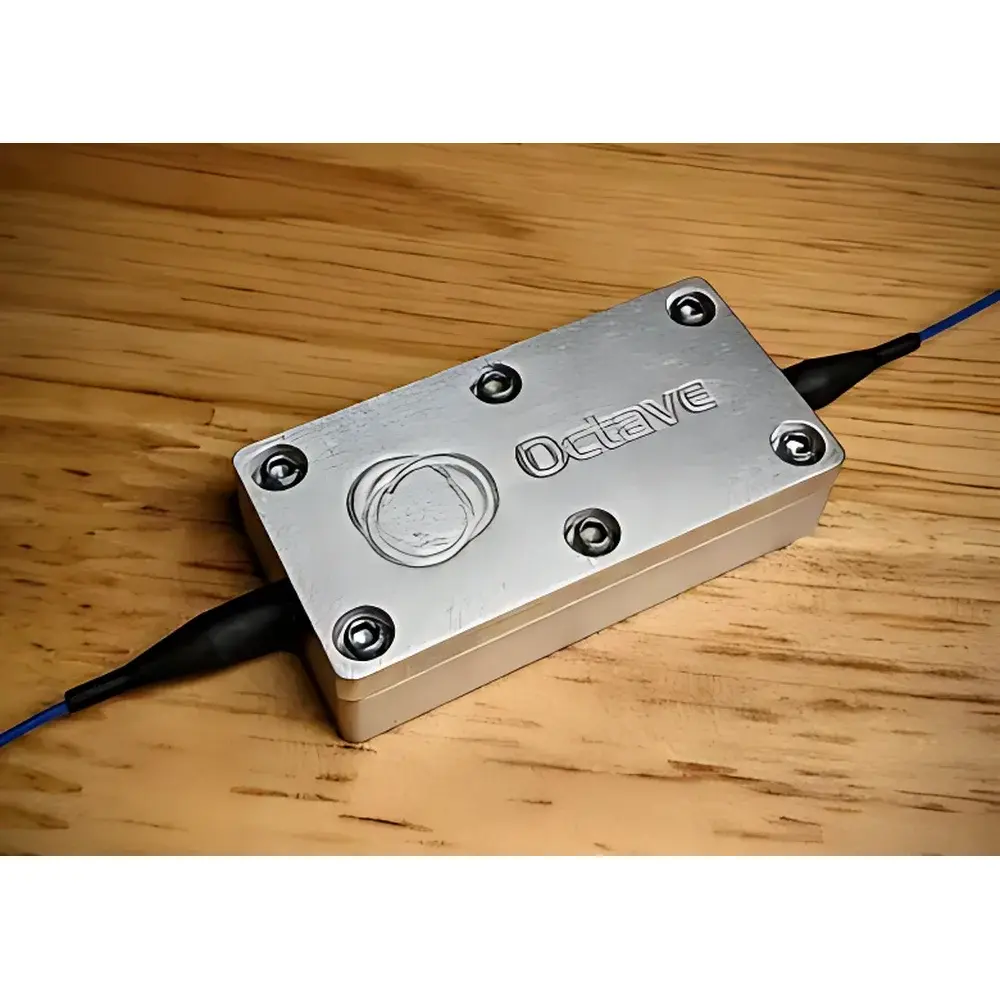
Auniontech COSMO f-2f Self-Referencing Carrier-Envelope Offset Locking Module
| Brand | Auniontech |
|---|---|
| Model | COSMO |
| Input Wavelength | ~1560 nm |
| Input Pulse Energy | >200 pJ |
| Input Fiber | PM1550 |
| Output Connector | SMA |
| Dimensions | ~40 × 25 × 15 mm |
| CEO Signal SNR | >35 dB |
| Application | Optical Frequency Comb Stabilization via f-2f Interferometry |
Overview
The Auniontech COSMO f-2f Self-Referencing Carrier-Envelope Offset (CEO) Locking Module is an integrated photonic solution engineered for robust, compact stabilization of optical frequency combs in the telecom C-band. Based on nonlinear waveguide-based supercontinuum generation and interferometric f-2f detection, the COSMO module implements the fundamental self-referencing technique required to measure and lock the carrier-envelope offset frequency (fCEO). It operates by spectrally broadening femtosecond pulses centered at ~1560 nm in a dispersion-engineered nonlinear waveguide, generating an octave-spanning spectrum that enables interference between the second harmonic of the low-frequency end (~780 nm) and the fundamental frequency of the high-frequency end (~1560 nm). This heterodyne beat yields the fCEO signal, which is extracted as a radio-frequency electrical output via an integrated photodetector and RF amplifier stage. Designed for integration into turnkey frequency comb systems, the COSMO eliminates the need for free-space alignment, bulk nonlinear crystals, or complex vacuum-pumped gas cells—replacing them with polarization-maintaining fiber-coupled architecture and monolithic waveguide processing.
Key Features
- Fiber-pigtailed, fully packaged design with PM1550 input and SMA RF output—enabling plug-and-play integration into existing Er:fiber laser comb platforms
- Low-threshold operation: functional with input pulse energies as low as 200 pJ, supporting high-repetition-rate (>250 MHz) or low-power oscillator architectures
- High CEO signal fidelity: >35 dB signal-to-noise ratio (SNR) measured at the output RF port under optimal dispersion compensation and pulse compression conditions
- Compact footprint: 40 × 25 × 15 mm sealed housing suitable for OEM integration, vacuum-compatible enclosures, or portable metrology-grade instrumentation
- Engineered for long-term phase stability: thermally stabilized waveguide platform minimizes drift in fCEO beat note position over multi-hour locking sessions
- No external pump lasers or auxiliary light sources required—fully self-contained f-2f detection path
Sample Compatibility & Compliance
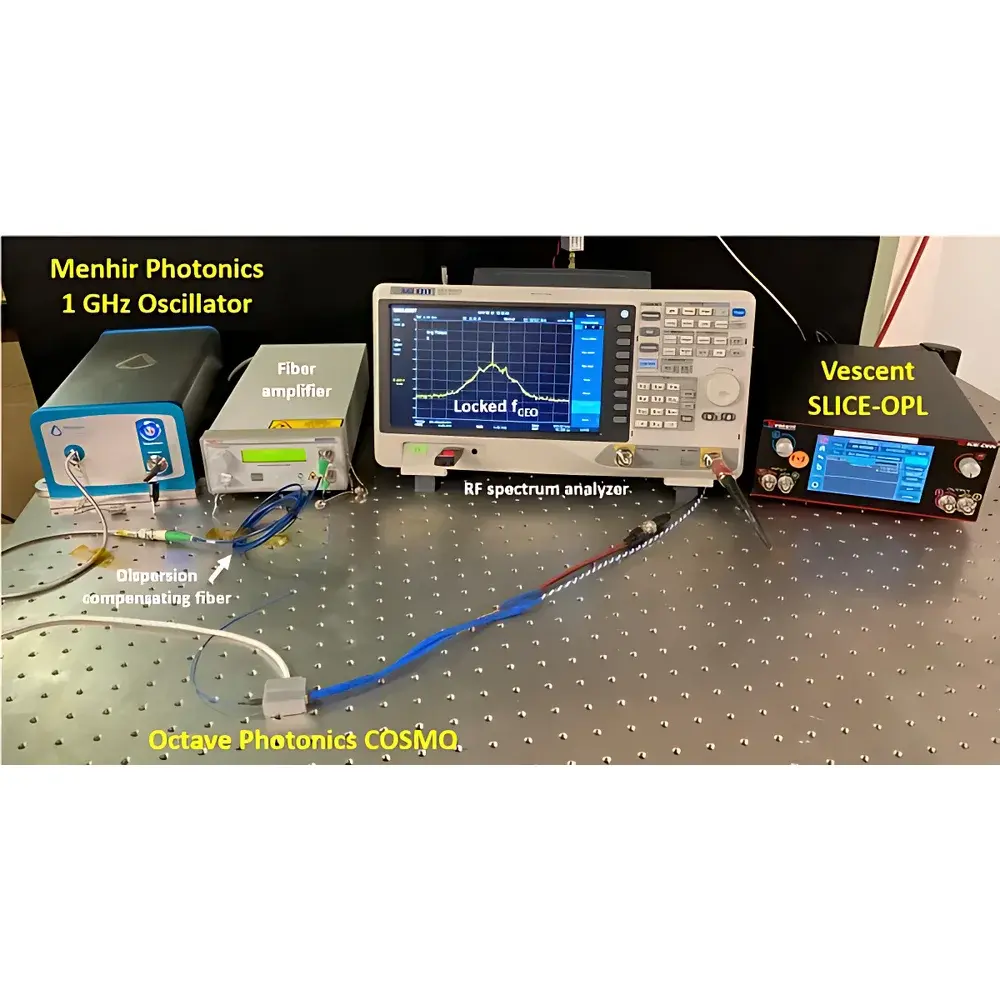
The COSMO module is optimized for use with mode-locked Er-doped fiber oscillators emitting transform-limited pulses near 1560 nm, with repetition rates ranging from 100 MHz to 1 GHz. Input pulses must be pre-compressed to sub-100-fs duration using either dispersion-compensating fiber (DCF) or chirped fiber Bragg gratings to ensure sufficient peak power for efficient supercontinuum generation in the waveguide. The module complies with IEC 61340-5-1 (ESD control), RoHS Directive 2011/65/EU, and meets CE marking requirements for electromagnetic compatibility (EMC) per EN 55032 and EN 55035. While not certified to ISO/IEC 17025, its performance characteristics align with traceable calibration practices used in national metrology institutes (NMIs) for optical frequency comb validation per ITU-T G.698.2 and IEEE Std 1139–2008 (Standard Definitions of Physical Quantities for Fundamental Frequency and Time Metrology).
Software & Data Management
The COSMO module itself is hardware-only and does not include embedded firmware or user interface software. Its RF output is intended for direct connection to commercial phase-locked loop (PLL) controllers (e.g., Toptica DLC pro, Vescent D2-125, or SRS SIM900 series modules) or custom FPGA-based lock electronics. When integrated into GLP/GMP-compliant environments—such as optical atomic clock development or primary frequency standard dissemination—the RF signal may be logged via time-stamped digitizers (e.g., Keysight U5303A) with audit-trail-capable acquisition software satisfying FDA 21 CFR Part 11 requirements. Auniontech provides detailed timing diagrams, impedance-matching guidelines (50 Ω termination), and spectral noise floor characterization reports upon request to support system-level validation.
Applications
- Stabilization of Er:fiber-based optical frequency combs for optical atomic clocks and timekeeping infrastructure
- Coherent optical communications: calibration of multi-carrier transceivers using absolute frequency references
- Spectroscopic metrology: dual-comb spectroscopy requiring synchronized fCEO and fREP control
- Attosecond science: seeding high-harmonic generation (HHG) sources with phase-stabilized combs
- Quantum optics experiments: entanglement distribution and quantum memory interfacing requiring ultra-low phase noise
- Industrial calibration: transfer standards for wavelength meters, wavemeters, and optical spectrum analyzers traceable to SI second
FAQ
What pulse duration is required at the COSMO input?
Input pulses must be compressed to ≤100 fs (FWHM) before entering the module; longer durations reduce supercontinuum bandwidth and degrade f-2f overlap.
Is dispersion compensation mandatory?
Yes—either DCF spools or inline chirped FBGs are required upstream to compensate for anomalous dispersion in standard SMF-28 fiber and achieve optimal pulse compression.
Can the COSMO operate with non-PM fiber inputs?
No—only polarization-maintaining PM1550 fiber is supported; non-PM input induces polarization-dependent fCEO amplitude fluctuations and SNR degradation.
Does the module include active temperature stabilization?
The waveguide chip is mounted on a thermally conductive submount but lacks integrated TEC control; ambient temperature stability ±0.5 °C is recommended for <100 mHz fCEO drift over 1 hour.
What is the maximum input average power the COSMO can handle?
While not specified in datasheet, sustained operation above 50 mW average power risks thermal lensing in the waveguide; typical use cases remain below 20 mW.



