
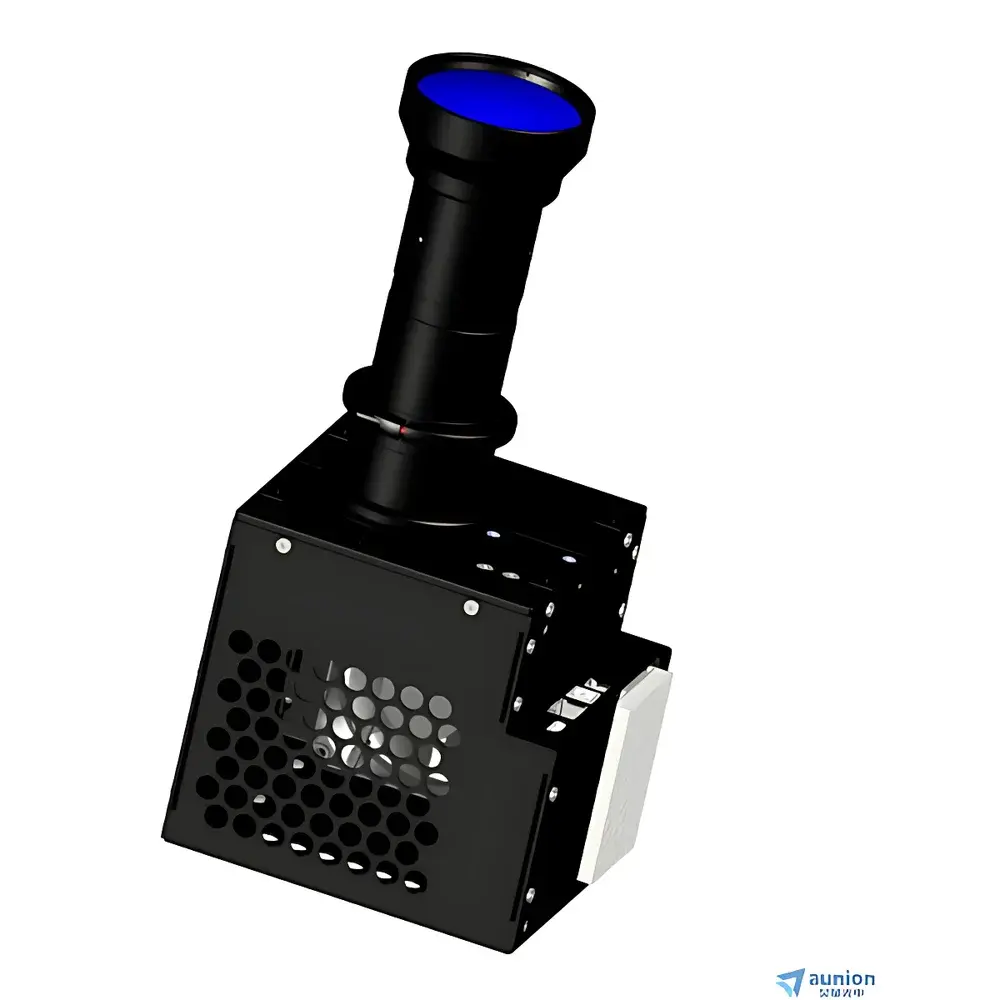
Auniontech DLP Optical Engine Series (Phoenix, Ikarus II, Firebird, TwoWave, Helios, Mercury)
| Brand | Auniontech |
|---|---|
| Origin | Imported |
| Manufacturer Type | Authorized Distributor |
| Chipset | Texas Instruments DLP670S / DLP6500 / DLP9000 |
| Wavelength Options | 365 nm, 385 nm, 405 nm, 460 nm |
| Resolution | Up to 3840×2160 (XPR), Native 2560×1600 (WQXGA), 1920×1080 (FHD), 1440×1080 (4:3) |
| Optical Output Power | Up to 12 W (image plane, wavelength-dependent) |
| Contrast Ratio | Up to 1:400 ANSI |
| Uniformity | ≥92–95% (per IEC 61947, lens-dependent) |
| Standard Lens Pixel Sizes | 2–162 µm |
| Cooling | Active air-cooled or integrated water-cooling (Helios series) |
| Compliance | IEC 61947, RoHS, CE |
Overview
The Auniontech DLP Optical Engine Series is a family of high-precision digital light projection modules engineered for demanding photonic applications in additive manufacturing, 3D metrology, maskless lithography, and structured-light machine vision. Built around Texas Instruments’ industry-standard DLP chipset architecture—including the DLP670S (4K XPR), DLP6500 (1080p), and DLP9000 (WQXGA/2K)—each engine integrates proprietary optical design, thermally optimized LED illumination, and robust mechanical packaging to deliver repeatable, stable, and spatially accurate light patterns. Unlike generic projector modules, these engines are purpose-built for industrial integration: they operate in video pattern mode (not video streaming), support programmable exposure timing down to microsecond resolution, and maintain pixel-level fidelity across extended operational lifetimes. The core measurement principle relies on digital micromirror device (DMD)-based spatial light modulation, where each mirror corresponds to a discrete pixel whose binary state (on/off) modulates incident LED light with nanosecond-scale switching speed. This enables precise control over dose, grayscale via pulse-width modulation (PWM), and multi-wavelength sequencing—critical for advanced photopolymerization, profilometry, and dynamic fringe projection.
Key Features
- Multi-platform chipset compatibility: DLP670S (4K XPR), DLP6500 (FHD), and DLP9000 (WQXGA) chipsets ensure scalability from R&D prototyping to production-grade throughput.
- UV-optimized illumination: Factory-calibrated LED sources at 365 nm, 385 nm, 405 nm, and 460 nm with integrated thermal management to sustain spectral stability and irradiance uniformity over >10,000 hours of operation.
- Modular optical interface: Interchangeable lens assemblies supporting pixel sizes from 2 µm to 162 µm; native magnification options include 76.5×, 50×, and 162× (depending on model); custom telecentric and wide-field lenses available upon request.
- Industrial-grade thermal architecture: Phoenix and Helios models feature active air cooling with zero-pixel-sticking design; Helios DUO/TRIO variants integrate sealed water-cooled optics for continuous-duty operation in ambient temperatures up to 40 °C.
- Dual- and triple-wavelength capability: TwoWave supports synchronized or sequential 365/460 nm exposure; Helios TRIO enables three independent UV channels (365/385/405 nm) within a single optical head—enabling multi-material printing and wavelength-selective curing protocols.
- Firmware-level LED aging compensation: Optional closed-loop photodiode feedback maintains constant radiant exitance across LED lifetime, meeting ISO 15775 stability requirements for calibrated photolithography systems.
Sample Compatibility & Compliance
These optical engines are designed for seamless integration into OEM equipment used in ASTM F2792-compliant DLP-based additive manufacturing systems, ISO/IEC 17025-accredited metrology workstations, and Class 1000 cleanroom-compatible maskless lithography platforms. All units comply with IEC 61947-2 for projection uniformity testing and meet CE/EMC Directive 2014/30/EU for electromagnetic compatibility. RoHS 2011/65/EU compliance ensures restricted substance control for global deployment. For regulated environments—including medical device manufacturing under FDA 21 CFR Part 820—the engines support traceable calibration reports and optional GLP/GMP audit trails when paired with Auniontech’s certified software SDK. Mechanical interfaces conform to standard M3/M4 mounting patterns and include SMA905 or FC/PC fiber-coupling options for hybrid optical architectures.
Software & Data Management
Auniontech provides a cross-platform C++/Python SDK compliant with Windows, Linux (x86_64 and ARM64), and real-time OS environments (VxWorks, QNX). The SDK supports low-latency pattern loading (<1 ms frame-to-frame), hardware-triggered exposure synchronization (TTL/RS-422), and full access to DMD bitplane sequencing—including 8-bit grayscale via time-multiplexed PWM. Pattern libraries include ANSI-standard test charts (ISO 12233), sinusoidal fringes, binary Gray codes, and user-defined bitmap sequences. All firmware versions log internal diagnostics (LED junction temperature, DMD die temperature, fan RPM, power rail voltages) with timestamped CSV export. Optional SDK extensions enable DICOM-compatible image metadata embedding, DICOM-SR structured reporting for metrology workflows, and 21 CFR Part 11-compliant electronic signatures for audit-ready operation in regulated labs.
Applications
- High-resolution DLP 3D printing: Phoenix (4K UV) and Helios (12 W UV) engines enable sub-25 µm voxel resolution in dental, jewelry, and microfluidic resin printing—supporting ISO/ASTM 52900 process qualification.
- Non-contact 3D surface metrology: Mercury engines deliver high-MTF, low-distortion fringe projection at 460 nm for industrial CT scanning, turbine blade inspection, and reverse engineering per VDI/VDE 2634 Part 2.
- Maskless micro-lithography: Firebird and TwoWave modules provide <100 ns exposure jitter and <0.1% intensity drift—meeting requirements for semiconductor prototyping and MEMS fabrication (JEDEC JESD22-A108).
- Dynamic structured-light vision: Ikarus II and Mercury support real-time phase-shifting algorithms for robotic bin-picking, autonomous navigation, and AR/VR spatial mapping under variable ambient lighting.
- Multi-spectral material characterization: Helios TRIO enables wavelength-resolved photoreaction kinetics studies—used in polymer science, photocatalysis research, and photobiomodulation development.
FAQ
What DLP chipsets are supported across the product line?
The series includes TI DLP670S (4K XPR), DLP6500 (1080p), and DLP9000 (WQXGA/2K) chipsets—each selected for optimal trade-offs between resolution, speed, and thermal envelope.
Can these engines be integrated into existing motion-control or PLC-based systems?
Yes. All models provide TTL-compatible trigger inputs/outputs, RS-422 serial control, and EtherCAT slave option (via external bridge) for deterministic synchronization with linear stages, galvanometers, or industrial robots.
Is radiometric calibration included with purchase?
Standard units ship with factory-measured irradiance maps (per IEC 61947) and spectral power distribution (SPD) reports. NIST-traceable calibration certificates are available as an add-on service.
Do you offer OEM mechanical or electrical customization?
Yes. Auniontech supports custom housing designs (IP54/IP65), connector configurations (M12, Hirose), voltage input ranges (12–48 VDC), and embedded FPGA co-processing for real-time pattern generation.
What is the expected lifetime of the LED sources under continuous operation?
Rated L70 lifetime exceeds 10,000 hours at nominal drive current and ≤35 °C ambient. Water-cooled Helios variants extend this to >15,000 hours under full-power 405 nm operation.



