
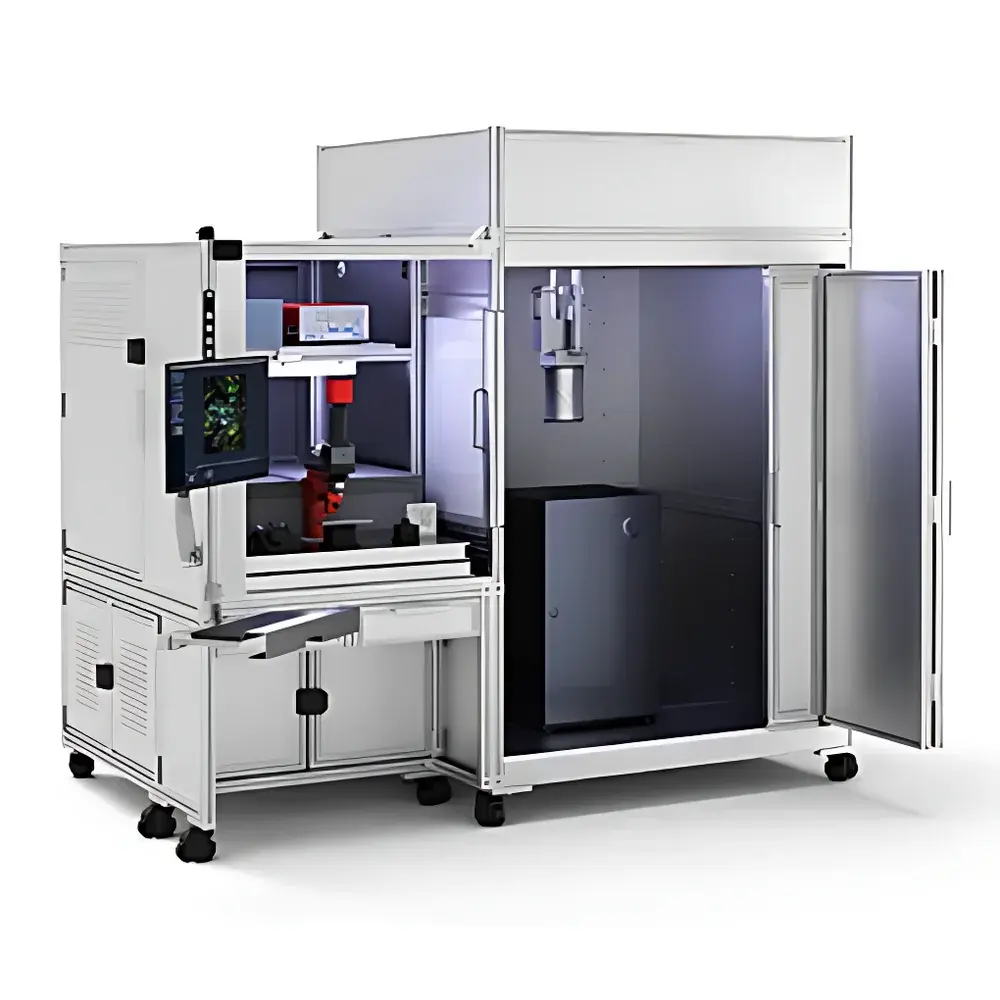
Auniontech FIRM-TPM Miniaturized Two-Photon Microscopy System
| Brand | Auniontech |
|---|---|
| Origin | Shanghai, China |
| Model | FIRM-TPM (Field-Expanded & High-Resolution Configurations) |
| Probe Weight | 2.2 g (HR) / 2.8 g (FE) |
| Probe Dimensions | 9.5×15.5×17 mm³ (HR) / 10×16×21 mm³ (FE) |
| Resolution | < 850 nm (HR) / < 1.3 µm (FE) |
| Field of View | > 180 × 180 µm² (HR) / > 400 × 400 µm² (FE) |
| Imaging Speed | 9 Hz @ 512×522, 18 Hz @ 256×256 |
| Axial Scan Range | 0–30 µm (HR) / 0–100 µm (FE) |
| Inter-plane Switching Speed | 4 Hz |
| Excitation Wavelength | 920 nm / 1030 nm (fs-pulsed) |
| Avg. Power | > 400 mW |
| Pulse Width | < 200 fs |
| Emission Collection Range | 300–720 nm |
| Bandpass Filters | 520/50 nm (Green), 605/50 nm (Red) |
| Working Distance | > 390 µm (HR) / ~1 mm (FE) |
| Data Acquisition | ≥ 120 MS/s, ≥ 16-bit resolution, ≥ 110 MHz bandwidth |
| Operating System | Windows 10 |
| Host PC | 32 GB RAM, 256 GB SSD + 2 TB HDD, 2 GB DDR5 professional GPU |
| Software | GINKGO-MTPM |
| System Footprint | 955 × 1380 × 825 mm³ (imaging unit) |
| Ambient Requirements | 24 ± 2 °C, RH < 60 % |
Overview
The Auniontech FIRM-TPM Miniaturized Two-Photon Microscopy System is a purpose-engineered platform for high-fidelity, motion-robust in vivo functional imaging of neural circuits in freely behaving rodents. Leveraging near-infrared femtosecond pulsed excitation (920 nm and 1030 nm), the system enables deep-tissue two-photon fluorescence excitation with minimal photodamage and scattering—critical for longitudinal studies of dendritic spines, synaptic dynamics, and calcium signaling in awake, untethered mice. Its head-mounted probe architecture eliminates motion artifacts associated with conventional benchtop microscopes while preserving optical performance through diffraction-limited resolution ( 400 × 400 µm² in field-expanded mode). The system operates on the principle of nonlinear excitation confined to the focal volume, ensuring intrinsic optical sectioning and superior signal-to-background ratio in scattering biological tissue.
Key Features
- Lightweight, modular head-mounted probe (2.2 g HR / 2.8 g FE) with plug-and-play optical interface—enabling rapid surgical mounting and minimizing animal stress during chronic experiments.
- Dual-configurable optical design: High-Resolution (HR) variant optimized for sub-micron spine morphology and structural plasticity; Field-Expanded (FE) variant supporting simultaneous monitoring of tens of neurons and thousands of synapses within a single FOV.
- Integrated axial scanning module with electro-optic or piezo-driven focus tuning (0–30 µm or 0–100 µm range), enabling volumetric acquisition at up to 4 Hz inter-plane switching—essential for mapping laminar activity or tracking dynamic dendritic Ca²⁺ transients across depth.
- Simultaneous dual-channel fluorescence detection (520/50 nm green, 605/50 nm red) compatible with genetically encoded indicators (e.g., GCaMP, jRGECO1a, mCherry) and synthetic dyes, supporting ratiometric or multi-color functional readouts.
- Femtosecond laser source delivering >400 mW average power with pulse width <200 fs—engineered for efficient two-photon excitation of common neurobiological fluorophores while maintaining thermal stability and beam pointing stability over multi-hour sessions.
- High-throughput data acquisition subsystem featuring ≥120 MS/s sampling rate, ≥16-bit analog input resolution, and ≥110 MHz analog bandwidth—ensuring faithful digitization of fast transient signals without aliasing or quantization error.
Sample Compatibility & Compliance
The FIRM-TPM system is validated for use with standard murine models (C57BL/6, Thy1-GCaMP, Ai94, etc.) under stereotaxic cranial window preparations (e.g., glass coverslip or GRIN lens implantation). Its mechanical and thermal design complies with ISO 13485-aligned manufacturing practices for research-grade instrumentation. While not certified as a medical device, the system supports GLP-compliant experimental workflows when integrated with time-stamped behavioral tracking (via synchronized TTL triggers), audit-trail-enabled software logging (GINKGO-MTPM), and metadata-rich HDF5-based data storage—facilitating traceability in preclinical neuroscience studies aligned with NIH BRAIN Initiative standards and FAIR data principles.
Software & Data Management
GINKGO-MTPM is a dedicated, Python-based acquisition and analysis suite developed for real-time two-photon microscopy in behavioral paradigms. It provides synchronized control of laser power, scan mirrors, axial position, and external stimuli (e.g., optogenetic pulses, auditory cues, or treadmill velocity). Raw data are saved in HDF5 format with embedded metadata including timestamp, laser power history, galvo voltage traces, and behavioral event markers. Built-in modules support motion correction (non-rigid registration), ROI segmentation (semi-automated dendritic spine detection), ΔF/F₀ quantification, spike inference (using OASIS or ML-based deconvolution), and export to NWB 2.0 for cross-platform interoperability with tools such as Suite2p, CaImAn, and Neurodata Without Borders ecosystem. All software logs—including user actions, parameter changes, and system errors—are retained with ISO 8601 timestamps to satisfy internal audit requirements.
Applications
- Longitudinal monitoring of dendritic spine turnover and structural plasticity during learning, memory consolidation, or disease progression (e.g., Alzheimer’s mouse models).
- Real-time mapping of functional connectivity within cortical microcircuits during sensory processing, decision-making, or social interaction tasks.
- Combined optogenetics and imaging (all-optical physiology): precise spatiotemporal perturbation of defined neuronal populations followed by immediate functional readout.
- Multi-modal integration with electrophysiology (e.g., silicon probe coupling), fMRI validation, or peripheral physiological monitoring (ECG, respiration).
- Translational applications beyond neuroscience: intravital skin imaging for immune cell trafficking, tumor angiogenesis assessment, and stem cell engraftment kinetics in orthotopic models.
FAQ
Is the FIRM-TPM system compatible with existing cranial window protocols?
Yes—the probe is designed for standard 3–5 mm diameter glass or GRIN lens implants. Working distance and optical alignment tolerances have been validated against common surgical preparations used in laboratories worldwide.
Can the system be upgraded from FE to HR configuration post-purchase?
Probe optics and scan lenses are configuration-specific and not field-upgradable; however, the core imaging engine, laser source, and software platform are shared across both variants—allowing flexible procurement strategies based on experimental priorities.
Does the system meet FDA 21 CFR Part 11 requirements for electronic records?
While GINKGO-MTPM implements full audit trail logging and user authentication, formal Part 11 compliance requires site-specific validation documentation and IT infrastructure controls (e.g., secure network architecture, backup policies)—services available upon request through Auniontech’s technical support team.
What maintenance is required for long-term reliability?
Annual calibration of laser power output and galvo mirror linearity is recommended. No consumables are required; all optical components are sealed and rated for >10,000 hours of operational lifetime under controlled environmental conditions (24 ± 2 °C, RH < 60%).



