
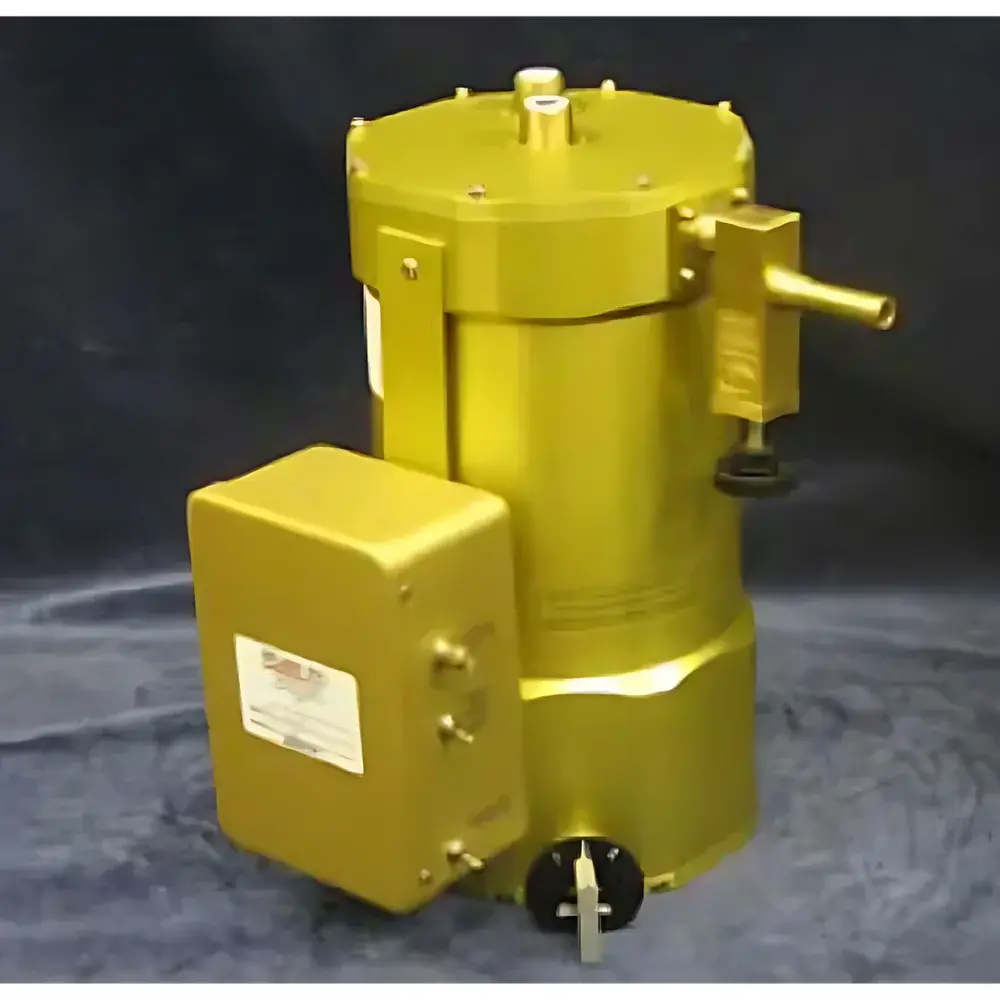
Auniontech HDL-5 Cryogenic Bolometer Detector System
| Brand | Auniontech |
|---|---|
| Origin | Shanghai, China |
| Model | Terahertz Bolometer Detector |
| Cooling | Liquid Helium (4.2 K / 1.6 K) |
| Spectral Range | 10 µm – 285 µm (1.05 THz – 30 THz) |
| Detector Type | Composite Silicon Thermistor |
| Mounting | IRLabs HDL-5 Dewar with LN₂ Radiation Shield |
| Standard Hold Time | >20 h (4.2 K), >10 h (1.6 K) |
| Optical Interface | Vacuum-Sealed Wedge Window + IR Collection Cone + Field Stop |
| Filter Options | Fixed IR-Cut, Manual 2-/3-Position Filter Wheel |
| Compliance | Compatible with FTIR, Molecular Beam, High-Field Magnet, and THz Time-Domain Spectroscopy Platforms |
Overview
The Auniontech HDL-5 Cryogenic Bolometer Detector System is a high-sensitivity, low-noise thermal radiation detector engineered for precision measurement of broadband far-infrared (FIR) and terahertz (THz) electromagnetic energy. Operating on the principle of resistive thermometry, the system employs a composite silicon thermistor element cooled to cryogenic temperatures—typically 4.2 K or 1.6 K—within an IRLabs HDL-5 liquid helium dewar equipped with a liquid nitrogen–cooled radiation shield. This architecture suppresses thermal background noise and enables detection of minute temperature fluctuations induced by incident radiation across a spectral range spanning 10 µm to 285 µm (corresponding to frequencies from ~1.05 THz to 30 THz). Unlike photon detectors, bolometers respond to total absorbed power rather than photon energy, making them intrinsically wavelength-independent within their operational band. To resolve DC-coupled signals, incident radiation must be mechanically or electronically modulated—typically via chopper wheels at 10–100 Hz—to produce an AC voltage signal proportional to radiant flux. The detector’s time constant, thermal conductance, and heat capacity are design parameters that can be optimized during system configuration to balance responsivity and response speed for specific experimental requirements.
Key Features
- Cryogenically stabilized composite silicon thermistor with <100 mK base temperature stability
- Integrated IRLabs HDL-5 dewar platform with dual-stage cooling: 4.2 K He bath + 77 K N₂ radiation shield
- Vacuum-tight optical interface featuring anti-reflection coated wedge window and parabolic IR collection cone
- Configurable field stop aperture to define solid angle and minimize stray radiation contribution
- Low-noise, battery-powered preamplifier with transimpedance gain up to 10⁸ V/A and bandwidth up to 1 kHz
- Optional manual filter wheel supporting two or three positions for spectral selection (e.g., long-pass cutoff at 285 µm)
- Compatibility with standard vacuum flanges (CF-63 or CF-100) for integration into ultra-high vacuum (UHV) spectroscopic systems
Sample Compatibility & Compliance
The HDL-5 bolometer system is designed for use in controlled laboratory environments requiring stable cryogenic operation and electromagnetic shielding. It supports direct coupling to Fourier transform infrared (FTIR) spectrometers, molecular beam apparatus, superconducting magnet cryostats (up to 20 T), and time-domain THz setups. All mechanical and electrical interfaces comply with ISO-KF/CF vacuum standards. The detector housing meets IEC 61000-6-3 (EMC emission) and IEC 61000-6-2 (immunity) specifications. Data acquisition workflows may be configured to support GLP/GMP audit trails when integrated with validated software platforms compliant with FDA 21 CFR Part 11. No hazardous materials are used in detector fabrication; all components conform to RoHS Directive 2011/65/EU.
Software & Data Management
The system interfaces via analog voltage output (±10 V, BNC) compatible with industry-standard data acquisition hardware (e.g., National Instruments PXI, Keysight DAQ, or Zurich Instruments HF2LI). Optional digital control modules enable remote actuation of filter wheels and chopper synchronization. AUCalib™ calibration suite (provided separately) delivers traceable NIST-referenced responsivity curves across the full spectral range using calibrated blackbody sources (e.g., CI Systems BB-100). Raw voltage-time traces are stored in HDF5 format with embedded metadata including timestamp, dewar pressure, stage temperature, and modulation frequency—ensuring full reproducibility per ISO/IEC 17025 requirements.
Applications
- Fourier-transform infrared (FTIR) spectroscopy in astronomy and atmospheric science, particularly for rotational-vibrational transitions of light molecules (e.g., H₂O, CO, CH₄)
- Molecular beam electric resonance (MBER) and Stark effect measurements under high magnetic fields
- Far-infrared characterization of topological insulators, cuprate superconductors, and 2D materials under cryogenic conditions
- Calibration reference for synchrotron-based THz beamlines and free-electron laser facilities
- Non-destructive evaluation (NDE) of polymer composites and ceramic coatings using pulsed THz transmission imaging
FAQ
What is the typical NEP (Noise-Equivalent Power) for this bolometer at 4.2 K?
NEP values are application-dependent and require calibration against a known blackbody source; typical published values for comparable composite Si bolometers range from 1×10⁻¹² W/Hz½ to 5×10⁻¹³ W/Hz½ at 10 Hz modulation.
Can the system be operated in continuous mode without modulation?
No—DC operation is not supported due to thermal drift and 1/f noise dominance; mechanical chopping (e.g., 30 Hz, 50% duty cycle) is mandatory for stable signal recovery.
Is vacuum compatibility certified to UHV standards?
Yes—the dewar body, window flange, and feedthroughs are rated for bake-out to 150 °C and sustained operation at ≤1×10⁻⁹ mbar.
Do you provide calibration certificates traceable to NIST?
Yes—each delivered system includes a factory calibration report with uncertainty budgets aligned to NIST SP 250-93 guidelines.
Can the detector be integrated into a custom optical cryostat?
Yes—mechanical drawings and mounting specifications are provided upon request to support third-party integration.



