
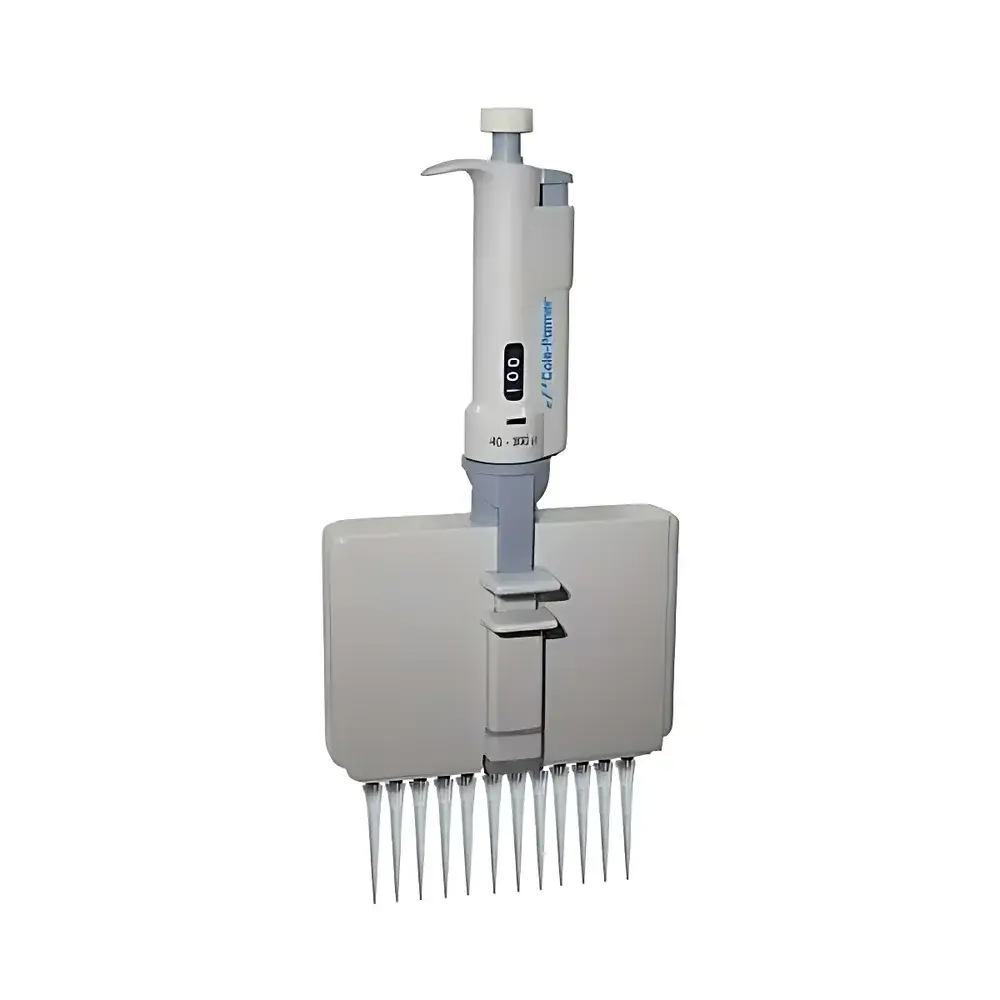
Cole-Parmer 21600 Series 8-Channel and 12-Channel Adjustable-Volume Manual Pipettes
| Brand | Cole-Parmer |
|---|---|
| Origin | USA |
| Manufacturer Type | Authorized Distributor |
| Product Category | Imported Instrument |
| Model | 21600-09 (8-channel) / 21600-23 (12-channel) |
| Pipette Type | Multi-channel Manual Pipette |
| Number of Channels | 8 or 12 |
| Volume Range | 0.5–300 µL (model-dependent) |
| Increment Resolution | 0.1–1.0 µL |
| Accuracy | ±0.5% to ±4.0% (volume-dependent) |
| Precision (CV) | ±0.2% to ±4.0% (volume-dependent) |
| Calibration Standard | DIN 12650 |
| Sterilization Compatibility | Autoclavable (121°C, 20 min) |
| Ergonomic Design | Low-force plunger activation, dual-stage blow-out piston, low-profile tip ejector |
Overview
The Cole-Parmer 21600 Series multi-channel manual pipettes are precision-engineered liquid handling instruments designed for high-throughput, reproducible dispensing across 8 or 12 parallel channels. Built on a robust air-displacement principle, these pipettes deliver consistent volumetric performance across a broad dynamic range—from 0.5 µL to 300 µL—enabling accurate transfer in applications such as ELISA plate preparation, PCR setup, cell culture seeding, and serial dilution workflows. Each unit is individually calibrated per DIN 12650, the internationally recognized standard for pipette performance verification, ensuring traceable accuracy and compliance with ISO/IEC 17025 laboratory requirements. The design prioritizes operator safety and long-term usability through mechanical optimization rather than electronic complexity, making it suitable for GLP-compliant environments where instrument stability, auditability, and minimal maintenance overhead are critical.
Key Features
- Ergonomic low-force plunger mechanism reduces hand fatigue during repetitive operations, supporting extended use without compromising control or repeatability.
- Dual-stage blow-out piston enables precise forward and reverse pipetting modes—including complete dispensing of residual liquid and controlled aspiration of viscous or volatile samples.
- Streamlined, low-profile tip ejection system allows unobstructed access to narrow-well microplates (e.g., 384-well formats) and conical tubes without lateral interference.
- Tool-free disassembly supports rapid cleaning, inspection, and routine maintenance; all major components are autoclavable at 121°C for 20 minutes without degradation of sealing integrity or calibration stability.
- Click-stop digital volume adjustment provides tactile feedback and prevents accidental setting drift; volume increments are discrete and model-specific (0.1 µL for sub-20 µL ranges; 1.0 µL above 50 µL).
- Each pipette ships with a manufacturer-issued, computer-generated calibration certificate compliant with DIN 12650, including full uncertainty budgets and traceability to NIST-traceable reference standards.
Sample Compatibility & Compliance
These pipettes accommodate standard conical polypropylene tips (including low-retention and filtered variants) and maintain compatibility with aqueous buffers, organic solvents (e.g., ethanol, DMSO), and moderately viscous reagents (e.g., glycerol solutions up to 30% v/v). They are certified for use in ISO 15195-accredited calibration laboratories and meet the mechanical and metrological criteria outlined in ASTM E1154 (Standard Practice for Calibration of Volumetric Delivery Devices). While not electronically governed, their manual architecture inherently satisfies FDA 21 CFR Part 11 requirements for non-electronic instruments used in regulated QC/QA environments—no audit trail software or user authentication layer is required. All units are manufactured under an ISO 9001-certified quality management system.
Software & Data Management
As fully manual instruments, the 21600 Series requires no embedded firmware, drivers, or proprietary software. Calibration documentation—including raw measurement data, environmental conditions (temperature, humidity), and uncertainty calculations—is delivered in PDF format with each unit. Laboratories may integrate calibration records into LIMS or ELN platforms via standard import protocols. Optional third-party calibration management tools (e.g., MET/CAL, PipetteTrack) support scheduled recalibration alerts and digital archiving aligned with ISO/IEC 17025 Clause 6.4.2 (Equipment Records).
Applications
- High-density assay setup: simultaneous dispensing into 96- and 384-well microplates for immunoassays, enzyme kinetics, and cytotoxicity screening.
- Molecular biology workflows: parallel preparation of master mixes for qPCR, RT-PCR, and NGS library construction.
- Cell-based assays: uniform seeding of adherent or suspension cells across replicate wells with minimized well-to-well variability.
- Quality control testing: standardized reagent addition in pharmaceutical stability studies per ICH Q5C guidelines.
- Teaching laboratories: durable, intuitive platforms for training students in fundamental pipetting technique and metrological awareness.
FAQ
Are these pipettes suitable for use with corrosive solvents such as concentrated acids or bases?
No. While compatible with common laboratory solvents (e.g., ethanol, isopropanol, acetonitrile), prolonged exposure to strong oxidizers, halogenated hydrocarbons, or caustic solutions may degrade internal seals and compromise accuracy.
Can I perform routine recalibration in-house without external service?
Yes. Each unit includes a dedicated calibration tool kit and step-by-step instructions aligned with DIN 12650 Annex B. Users may verify and adjust volume settings using gravimetric methods with certified analytical balances and distilled water at 20°C.
Is tip compatibility limited to Cole-Parmer branded consumables?
No. These pipettes accept any universal-fit conical tip meeting ISO 8655-2 dimensional specifications, including third-party low-binding and filtered options.
What is the recommended recalibration interval under GLP conditions?
Per ISO/IEC 17025 and internal lab SOPs, recalibration is advised every 3–6 months for daily use, or after any event that may affect mechanical integrity (e.g., impact, sterilization cycle deviation, or observed performance drift).



