
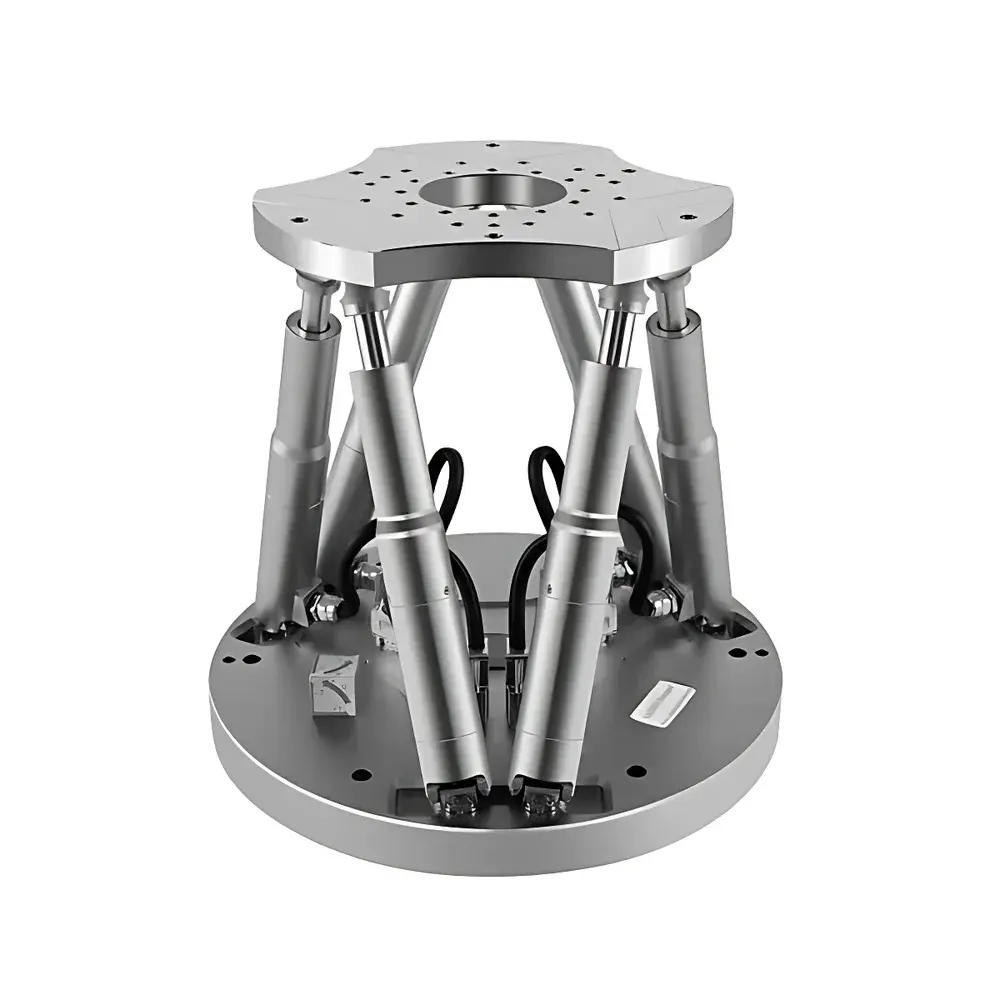
Auniontech Hexapod 6-DOF Precision Motion Platform
| Brand | Auniontech |
|---|---|
| Origin | Shanghai, China |
| Model | Precision Positioning Platform |
| Type | Motorized Translation Stage |
| Load Capacity | 10 kg (horizontal) / 3 kg (arbitrary orientation) |
| Travel Range | X/Y/Z ±50/±50/±25 mm |
| Angular Range | ΘX/ΘY/ΘZ ±15/±15/±30° |
| Positioning Accuracy | X/Y 3 µm, Z 1 µm, ΘX/ΘY 15 µrad, ΘZ 40 µrad |
| Repeatability | X/Y ±0.5 µm, Z ±0.2 µm, ΘX/ΘY ±2 µrad, ΘZ ±4 µrad |
| Backlash | X/Y 1 µm, Z 0.5 µm, ΘX/ΘY 8 µrad, ΘZ 5 µrad |
| Max Speed | X/Y/Z 50 mm/s, ΘX/ΘY/ΘZ 600 mrad/s |
| Typical Speed | X/Y/Z 30 mm/s, ΘX/ΘY/ΘZ 300 mrad/s |
| Motor Type | Permanent Magnet Synchronous Motor (PMSM) |
| MTBF | 20,000 hours |
| Operating Temperature | −10 to +50 °C |
| Construction Material | Aluminum Alloy |
| Mass | 12 kg |
Overview
The Auniontech Hexapod 6-DOF Precision Motion Platform is a parallel-kinematic Stewart platform engineered for sub-microradian angular control and sub-micrometer linear positioning across six degrees of freedom (X, Y, Z, ΘX, ΘY, ΘZ). Unlike serial-stage architectures, its rigid, symmetric six-actuator configuration delivers inherently high structural stiffness, minimal elastic deformation under load, and superior dynamic response—critical for applications demanding simultaneous multi-axis trajectory tracking with nanoscale fidelity. The platform employs brushless permanent magnet synchronous motors (PMSMs) coupled with high-resolution optical encoders and precision ball-screw or flexure-based actuators (model-dependent), enabling closed-loop motion control without mechanical slip or wear. Its compact footprint—relative to equivalent serial systems—and cable-free moving platform eliminate drag forces and torsional coupling, ensuring long-term stability and repeatable performance in both ambient and vacuum environments (vacuum-compatible variant available upon request).
Key Features
- True 6-DOF parallel kinematics with integrated real-time inverse kinematics solver for seamless Cartesian-to-joint coordinate transformation
- High-repeatability motion: ±0.2 µm in Z-axis translation and ±2 µrad in tilt axes, validated per ISO 230-2 Annex B protocols
- Low backlash design: ≤0.5 µm in Z and ≤5 µrad in ΘZ, minimizing hysteresis during bidirectional scanning or oscillatory motion
- Robust aluminum alloy monocoque construction (12 kg mass) optimized for thermal stability and vibration damping
- PMSM-driven actuators with sinusoidal commutation—enabling smooth, low-noise operation at speeds up to 600 mrad/s (angular) and 50 mm/s (linear)
- Vacuum-rated option compliant with ISO 10100 cleanroom standards (10−6 mbar base pressure, non-outgassing materials, bakeable to 80 °C)
- Integrated thermal management system maintaining encoder and motor performance across −10 to +50 °C ambient range
Sample Compatibility & Compliance
The platform accommodates payloads up to 10 kg when mounted horizontally (3 kg in arbitrary orientation), supporting standard optical breadboard interfaces (M6 threaded holes on top plate) and custom mounting fixtures. It complies with CE marking requirements for electromagnetic compatibility (EMC Directive 2014/30/EU) and low-voltage safety (LVD Directive 2014/35/EU). For regulated laboratory environments—including those operating under GLP, GMP, or FDA 21 CFR Part 11 frameworks—the system supports optional audit-trail-enabled controller firmware with user-access logging, electronic signature capability, and data integrity safeguards. Mechanical interface dimensions and mounting tolerances conform to ISO 9283 for robotic manipulators, facilitating integration into automated optical alignment cells and semiconductor metrology tools.
Software & Data Management
Control is delivered via Auniontech’s HexaControl SDK—a cross-platform C++/Python API supporting Windows, Linux, and real-time OS deployments. The SDK includes pre-validated motion profiles (trapezoidal, S-curve, harmonic), programmable dwell times, and synchronized trigger I/O for external devices (e.g., cameras, lasers, interferometers). Data acquisition supports timestamped position logging at ≥1 kHz sampling rate, exportable in HDF5 or CSV formats with metadata embedding (unit definitions, calibration timestamps, environmental sensor readings). Optional LabVIEW and MATLAB instrument drivers are provided for rapid prototyping. All firmware updates undergo SHA-256 signature verification; configuration files are digitally signed to prevent unauthorized parameter modification.
Applications
- Optical Alignment & Interferometry: Active compensation of beam path drift in gravitational wave detectors, adaptive optics systems, and multi-element laser cavity stabilization
- Microfabrication & Semiconductor Metrology: Wafer-level alignment during maskless lithography, nanoimprint stamp positioning, and probe station tip calibration
- Biophotonics & Microscopy: High-fidelity stage scanning in light-sheet fluorescence microscopy (LSFM), correlative live-cell imaging, and optical tweezer trap stabilization
- Aerospace Simulation: Six-degree-of-freedom motion cueing for flight simulator actuation subsystems and inertial sensor calibration testbeds
- Quantum Optics: Sub-wavelength positioning of atomic traps, cavity mirrors in cavity QED setups, and cold-atom lattice alignment
- Medical Device Testing: Dynamic loading simulation for orthopedic implant fatigue testing and endoscopic tool path validation under realistic kinematic constraints
FAQ
What is the difference between a hexapod and a stacked XYZ-θXYZ serial stage?
A hexapod’s parallel architecture provides higher stiffness, lower inertia, and no cumulative error from cascaded axes—resulting in better overall repeatability and reduced thermal drift compared to serial alternatives.
Is the controller compatible with third-party motion software such as PI’s GCS or Thorlabs’ Kinesis?
Native support is provided via TCP/IP and USB CDC virtual COM port protocols; ASCII command sets are documented and extensible for integration with vendor-agnostic automation frameworks.
Can the platform be operated in a Class 100 cleanroom environment?
Yes—the vacuum-compatible version uses stainless-steel fasteners, fluoropolymer-coated surfaces, and particle-controlled assembly; full cleanroom qualification documentation is available upon request.
What maintenance is required over its 20,000-hour MTBF lifetime?
No scheduled lubrication or mechanical adjustment is required; periodic verification of encoder zero-point offset and actuator homing accuracy (recommended annually) suffices for sustained metrological traceability.
How is thermal expansion compensated during extended operation?
The controller integrates dual-channel temperature sensing (baseplate and top platform) and applies real-time compensation coefficients derived from material-specific CTE models embedded in firmware.





