
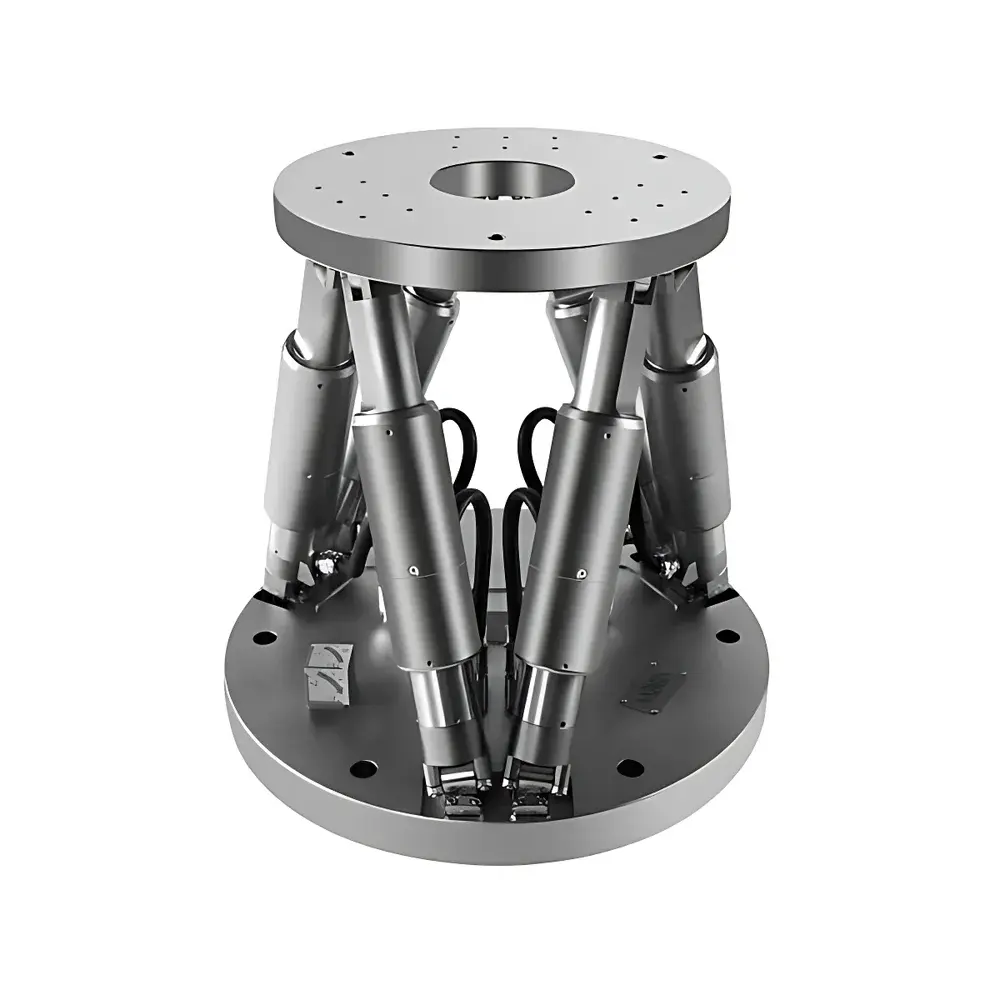
Auniontech HLD-600 High-Load Mid-Size 6-Axis Hexapod Positioning Stage
| Brand | Auniontech |
|---|---|
| Origin | Shanghai, China |
| Model | HLD-600 Precision 6-DOF Parallel Kinematic Stage |
| Load Capacity | 250 kg (horizontal), 50 kg (omnidirectional) |
| Travel Range | ±50 mm (X,Y), ±25 mm (Z), ±15° (θX,θY), ±30° (θZ) |
| Repeatability | ±0.3 µm (Z), ±0.7 µm (X,Y), ±3 µrad (θX,θY), ±9 µrad (θZ) |
| Positioning Accuracy | 0.3–0.5 µm (linear), 3–5 µrad (angular) |
| Backlash | 0.5–4 µm (linear), 8–60 µrad (angular) |
| Max Velocity | 0.5 mm/s (linear), 6 mrad/s (angular) |
| Motor Type | Brushless DC |
| MTBF | 20,000 hours |
| Material | Aerospace-Grade Aluminum Alloy |
| Weight | 17 kg |
| Operating Temperature | –10 to +50 °C |
Overview
The Auniontech HLD-600 is a high-load, mid-size 6-axis hexapod positioning stage engineered for precision motion control in demanding optical, metrological, and industrial research environments. Based on the Stewart platform architecture—a parallel kinematic mechanism—it delivers simultaneous control over six degrees of freedom (6-DOF): three orthogonal translations (X, Y, Z) and three rotations (θX, θY, θZ). Unlike serial-stage architectures, the hexapod’s rigid, closed-loop mechanical topology ensures exceptional stiffness-to-mass ratio, minimal Abbe error, and superior dynamic response—critical for applications requiring sub-micron repeatability and nanoradian angular stability. Its compact footprint and integrated brushless DC actuators eliminate mechanical slip, enabling wear-free operation and long-term positional integrity without recalibration. Designed for integration into vacuum chambers, cleanrooms, and active alignment systems, the HLD-600 serves as a foundational motion engine for beamline instrumentation, adaptive optics, semiconductor metrology, and aerospace ground-test rigs.
Key Features
- High static load capacity: 250 kg supported horizontally; 50 kg under arbitrary orientation—enabling stable positioning of heavy optical benches, interferometer heads, or sensor modules.
- Sub-micron linear repeatability (±0.3 µm in Z, ±0.7 µm in X/Y) and nanoradian angular repeatability (±3 µrad in tilt axes, ±9 µrad in yaw) verified per ISO 230-2 Annex B protocols.
- Low backlash design: ≤0.5 µm in Z, ≤4 µm in X/Y, and ≤60 µrad in θZ, minimizing hysteresis during bidirectional scanning or closed-loop servo tracking.
- Vacuum-compatible variant available (10−6 mbar rating) with non-outgassing materials, ceramic-insulated motors, and dry-lubricated spherical joints—qualified for UHV optical delay lines and space-simulation testbeds.
- Real-time deterministic control firmware supporting user-defined trajectory interpolation (S-curve, trapezoidal, custom spline) with <100 µs servo cycle time and hardware-based emergency stop compliance (IEC 61800-5-2).
- Modular drive electronics with EtherCAT interface (IEC 61784-2), enabling synchronized multi-axis coordination within distributed automation networks compliant with SEMI E54 and OPC UA Part 100 standards.
Sample Compatibility & Compliance
The HLD-600 accommodates payloads ranging from single-mode fiber collimators to full-sized optical tables (up to 250 kg). Its aluminum alloy structure (6061-T6) provides thermal stability (CTE ≈ 23.6 × 10⁻⁶/K) and compatibility with standard optical mounting interfaces (M6, M4, and Ø1/4″ tapped holes on top and base plates). The platform meets ISO 9001:2015 manufacturing controls and conforms to electromagnetic compatibility requirements per EN 61326-1 (industrial environment). For regulated environments—including GMP-compliant photolithography tooling and FDA-regulated optical coherence tomography (OCT) system integration—the controller supports audit-trail logging, electronic signatures, and 21 CFR Part 11–compliant user access management when paired with optional validation packages.
Software & Data Management
Auniontech provides the HexaControl SDK (C/C++, Python, MATLAB APIs) and GUI-based HexaStudio software for intuitive 6-DOF motion programming. HexaStudio includes real-time position/force monitoring, trajectory replay, and automated calibration routines based on laser interferometric verification. All motion logs are timestamped and exportable in HDF5 format—supporting traceability per ISO/IEC 17025 and facilitating post-processing with SciPy or LabVIEW. Firmware updates are delivered via signed binary packages with SHA-256 checksum validation, ensuring integrity in validated production environments.
Applications
- Astronomical instrument alignment: Active tip/tilt correction of segmented mirror assemblies in ground-based telescopes (e.g., ELT secondary mirror support systems).
- Optical metrology: Six-degree-of-freedom adjustment of interferometer reference arms and test object stages in ISO 10110–compliant surface form measurement.
- Aerospace testing: Simulating launch vibration profiles and performing inertial sensor calibration via controlled 6-DOF excitation (per MIL-STD-810H Method 514.8).
- Precision manufacturing: Wafer-level alignment in maskless lithography tools and multi-axis compensation in ultra-precision diamond turning machines.
- Quantum optics: Sub-wavelength positioning of cavity mirrors in cavity quantum electrodynamics (cQED) setups and cold atom trap stabilization.
FAQ
What is the maximum payload for vertical orientation?
The HLD-600 supports up to 50 kg under arbitrary orientation—including fully inverted configurations—verified via static load testing per ISO 22090-1.
Is third-party software integration supported?
Yes: Native EtherCAT master support enables seamless integration with Beckhoff TwinCAT, NI VeriStand, and Siemens SINUMERIK Operate environments.
Can the stage operate in vacuum without modification?
Only the vacuum-compatible variant (HLD-600-VAC) is certified for UHV use; standard units require vacuum bake-out and joint re-lubrication.
What calibration documentation is provided?
Each unit ships with a factory calibration certificate (traceable to NIST via PTB-accredited metrology lab), including 3D error mapping data and thermal drift coefficients.
How is thermal drift compensated during long-duration experiments?
Integrated temperature sensors feed real-time thermal expansion corrections into the forward kinematics model; optional external laser interferometer feedback enables active drift suppression.




