
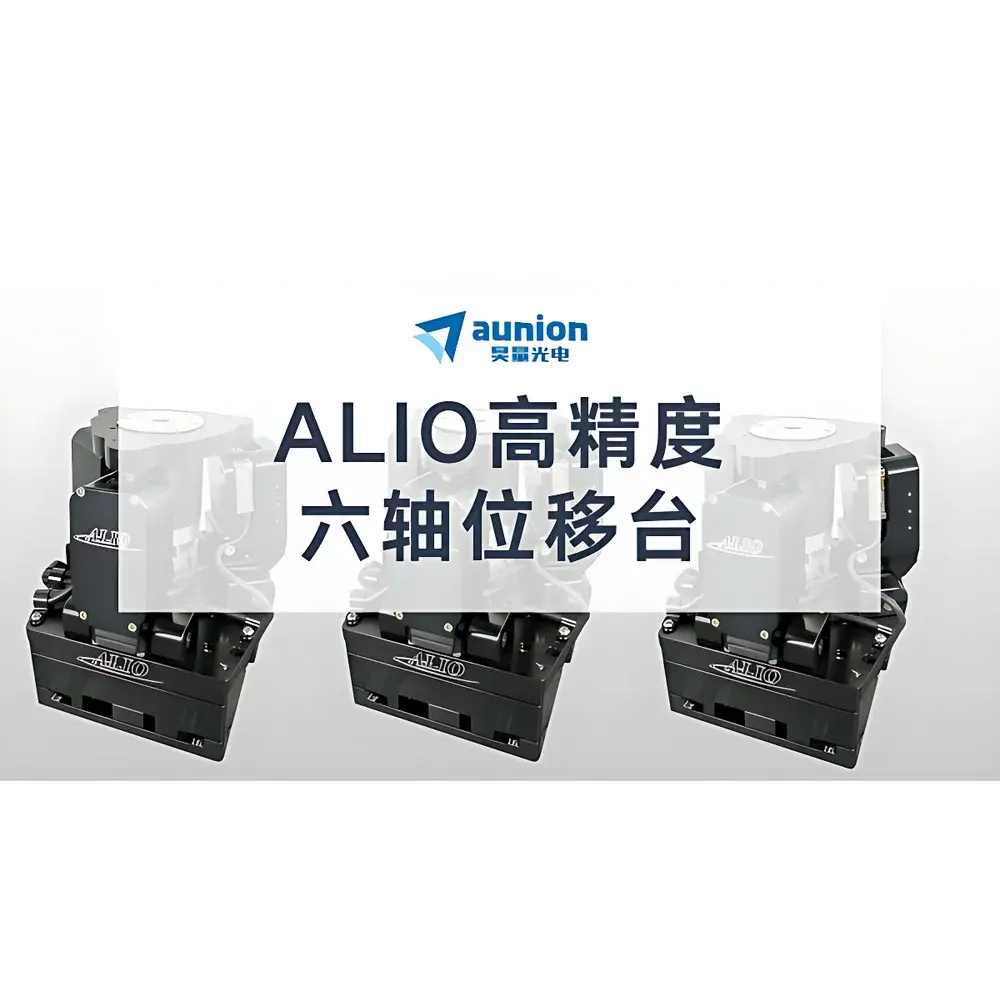
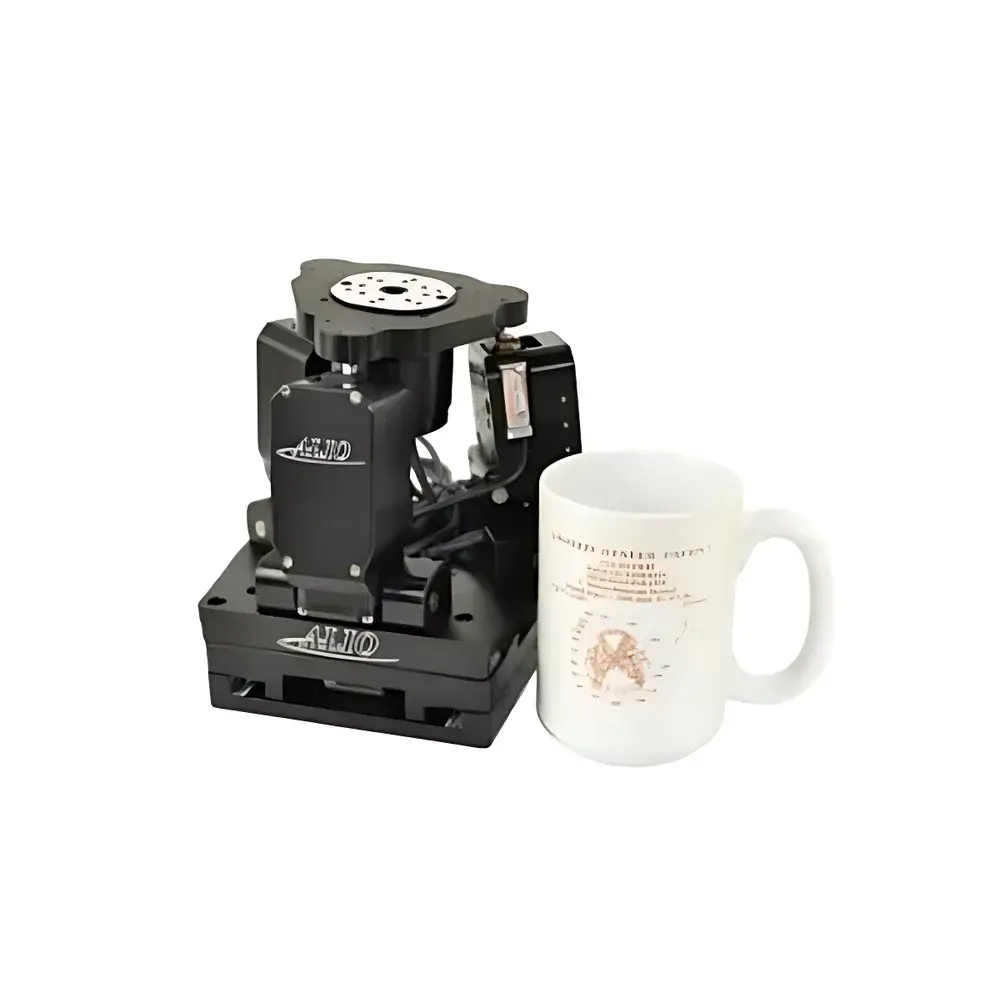
Auniontech Hybrid Hexapod High-Precision 6-Axis Parallel Kinematic Positioning Stage
| Brand | Auniontech |
|---|---|
| Model | Hybrid Hexapod |
| Type | Motorized Translation & Orientation Stage |
| DOF | 6 (X, Y, Z, θx, θy, θz) |
| Positioning Repeatability | <100 nm (3D, all axes) |
| Tip/Tilt Range (Angular variant) | ±30° (60° total) |
| XY Travel | Unlimited (via programmable TCP offset) |
| Z Travel (standard) | 62 mm |
| (tripod-enhanced mode) | up to 208 mm |
| Theta-Z Rotation | Continuous 360° |
| Minimum Incremental Motion | <10 nm linear / <0.1 arcsec angular |
| Bidirectional Repeatability (XYZ) | ±0.6 arcsec |
| Max Speed | 100 mm/s (XY/Z) |
| Feedback | Optical incremental or absolute encoders on all axes |
| Drive | Linear motors and/or servo ball screws |
| Bearing | Precision crossed-roller bearings |
| TCP Programmability | Fully configurable, dynamic coordinate offset support |
| Backlash | Zero |
Overview
The Auniontech Hybrid Hexapod is a high-precision, parallel-kinematic 6-axis positioning stage engineered for applications demanding sub-100 nm spatial repeatability, nanoradian angular resolution, and fully programmable tool center point (TCP) control. Unlike conventional Stewart-platform hexapods—whose performance is constrained by kinematic coupling, joint compliance, and six-leg synchronization overhead—the Hybrid Hexapod employs a hybrid architecture integrating a monolithic XY translation base, a tripod-based elevation and tilt mechanism, and a coaxial continuous-rotation θz axis. This topology decouples motion domains, eliminating cumulative error propagation across serial joints and significantly reducing dynamic coupling between degrees of freedom. As a result, it achieves order-of-magnitude improvements in stiffness (particularly in the XY plane), path fidelity, settling time, and volumetric workspace scalability—without sacrificing resolution or thermal stability. The system operates on first-principles metrology-grade motion control, making it suitable for use as a reference-grade positioning engine in optical alignment, interferometric calibration, and semiconductor process tool integration.
Key Features
- Hybrid Kinematic Architecture: Combines monolithic XY planar motion, tripod-driven Z/θx/θy, and coaxial θz rotation—reducing mechanical coupling and enabling independent axis optimization.
- Zero-Backlash Design: Achieved through preloaded crossed-roller bearings and direct-drive linear motors or precision-ground servo ball screws, ensuring hysteresis-free motion over full travel.
- Fully Programmable TCP: Enables dynamic redefinition of the tool center point anywhere within the workspace—critical for multi-sensor coordination, beam steering, and non-contact metrology setups.
- Nanometer-Level Repeatability: <100 nm 3D point repeatability across all six degrees of freedom, validated under ISO 230-2 compliant test protocols.
- Extended Angular Range (Angular Variant): ±30° tip/tilt (60° total) with <0.1 arcsec minimum incremental motion and ±0.6 arcsec bidirectional repeatability—optimized for freeform optics alignment and silicon photonics packaging.
- Scalable XY Travel: Effectively unlimited via TCP offset programming—enabling large-field stitching in wafer inspection or camera array assembly without mechanical reconfiguration.
Sample Compatibility & Compliance
The Hybrid Hexapod supports rigid mounting of optical components (lenses, mirrors, fiber collimators), sensor modules (CCD/CMOS arrays, photodetectors), and microfabrication tools (laser heads, probe stations). Its low-vibration, non-magnetic construction (optional stainless-steel or aluminum alloy variants) ensures compatibility with ultra-high vacuum (UHV) environments and EMI-sensitive measurement systems. All standard configurations comply with CE marking requirements for machinery safety (2006/42/EC) and electromagnetic compatibility (2014/30/EU). Encoder feedback systems meet ISO 10012-1 accuracy class M1 for length measurement standards. When integrated into regulated workflows—such as medical device manufacturing or semiconductor front-end processes—the system supports audit-ready operation when paired with compatible motion controllers featuring 21 CFR Part 11-compliant electronic logbooks and user-access controls.
Software & Data Management
Auniontech provides native SDKs for C++, Python, MATLAB, and LabVIEW, enabling deterministic real-time trajectory generation with sub-millisecond jitter. The optional AunionMotion Suite includes GUI-based TCP configuration, multi-axis contouring (G-code and S-curve profiles), and synchronized data logging at up to 10 kHz sample rate. Encoder position data is timestamped with hardware-level precision and exportable in HDF5 or CSV format for traceable metrology reporting. For GLP/GMP environments, optional firmware modules enable full audit trail capture—including user login events, parameter changes, motion command history, and encoder readout validation—aligned with ISO/IEC 17025 documentation requirements.
Applications
- Laser beam steering and adaptive optics alignment in ultrafast laser micromachining systems
- Freeform and aspheric lens metrology, including null-compensated interferometry and slope-error mapping
- Silicon photonics packaging: active fiber-to-waveguide coupling and grating coupler alignment
- Wafer-level camera module testing—OIS actuator characterization, lens tilt compensation, and autofocus calibration
- Multi-sensor fusion platforms requiring synchronized positional referencing across optical, thermal, and electrical measurement channels
- Micro-opto-electro-mechanical systems (MOEMS) fabrication and post-process verification
- Reference-grade coordinate measuring machine (CMM) augmentation for 6-DOF artifact calibration
FAQ
What distinguishes the Hybrid Hexapod from traditional Stewart-platform hexapods?
The Hybrid Hexapod replaces the six-leg parallel structure with a hierarchical hybrid design—monolithic XY stage + tripod + coaxial rotation—eliminating joint-induced compliance and synchronization errors inherent in classical hexapods.
Can the tool center point (TCP) be redefined during operation?
Yes. The TCP is fully software-defined and can be dynamically relocated anywhere within the mechanical envelope without hardware modification or recalibration.
Is the system compatible with vacuum or cleanroom environments?
Standard units are rated for ambient laboratory use. Vacuum-compatible versions (10−6 mbar) and cleanroom-certified (ISO Class 5) variants are available upon request with appropriate material and sealing specifications.
What encoder resolution options are supported?
Optical incremental encoders (5 nm or 1 nm resolution) and absolute encoders (single-turn or multi-turn, 24-bit or higher) are available across all axes, with configurable interpolation and real-time error compensation.
Does the system support third-party motion controllers?
Yes. Standard EtherCAT, RS-422, and analog ±10 V interfaces are provided. Integration with ACS, Galil, or Parker controllers is documented and validated.





