
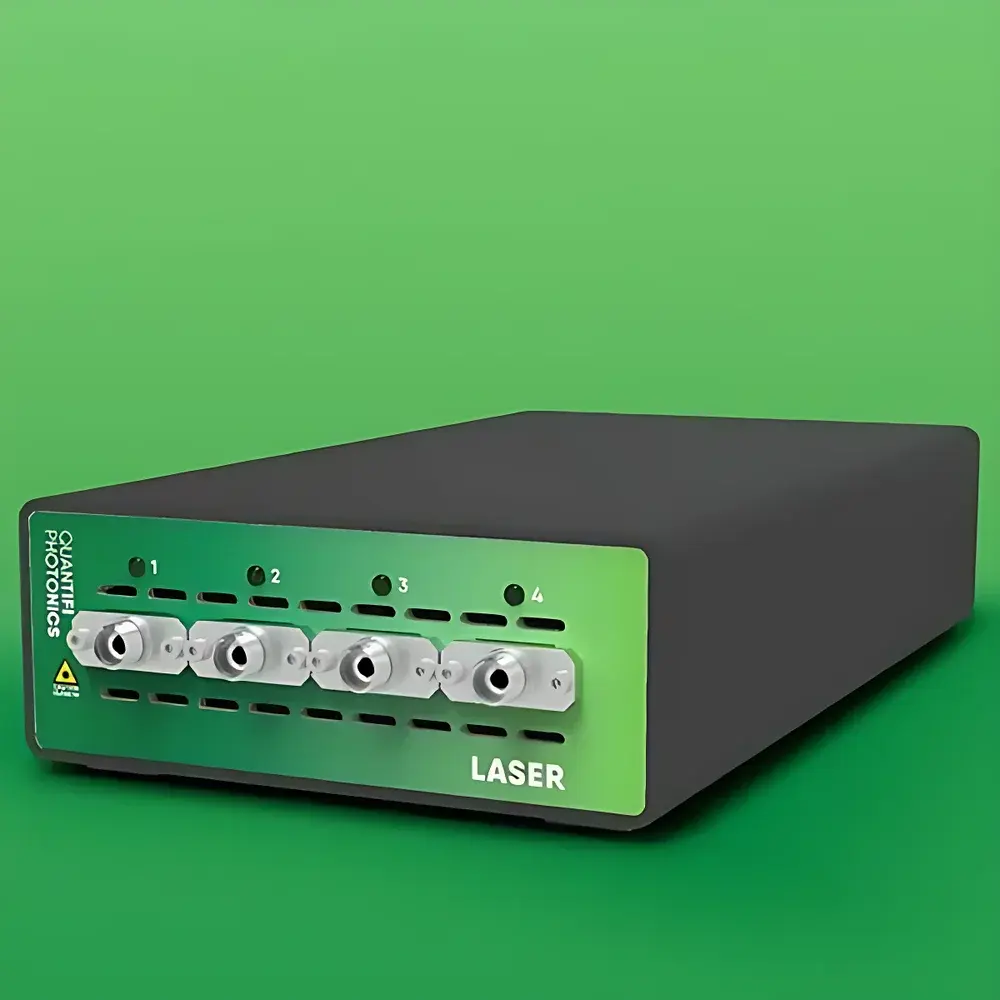
Auniontech Laser-1000 C+L-Band Continuous-Wave Tunable Laser Source
| Brand | Auniontech |
|---|---|
| Origin | Shanghai, China |
| Platform Options | MATRIQ or PXIe |
| Wavelength Range | 1527.605–1611.787 nm (C+L Band) |
| Output Power | up to +16.5 dBm |
| Linewidth | < 100 kHz |
| Tuning Resolution | 0.01 pm (1 MHz) |
| Polarization Extinction Ratio | > 18 dB |
| Relative Intensity Noise (RIN) | –140 dB/Hz (10 MHz – 40 GHz) |
| Frequency Stability | ±0.3 GHz over 24 h |
| Power Stability | ±0.1 dB over 24 h |
| Interface | USB / Ethernet / Web-based Control via COHESIONUI |
Overview
The Auniontech Laser-1000 is a high-precision, continuous-wave (CW), single-frequency tunable laser source engineered for demanding optical test and measurement applications across the C-band (1527.605–1568.773 nm) and L-band (1568.773–1611.787 nm). Operating on thermally tuned external cavity architecture, it delivers exceptional spectral purity, narrow intrinsic linewidth (<100 kHz), and high frequency reproducibility—critical for coherent optical communication system characterization, photonic integrated circuit (PIC) testing, and high-resolution spectroscopy. The instrument supports both discrete channel stepping (100 MHz / ~1 pm resolution, <25 s settling) and fine intra-channel tuning (1 MHz / 0.01 pm), enabling precise alignment with ITU-T grid frequencies and sub-picometer resonance tracking in cavity-based devices. Its all-fiber, polarization-maintaining (PM) output ensures stable state-of-polarization delivery essential for interferometric and coherent detection setups.
Key Features
- Full C+L band coverage (1527.605–1611.787 nm) in single-unit configuration (Model 1007) or optimized single-band variants (Models 1001–1005)
- Ultra-narrow linewidth (40 dB typical 55 dB)
- Sub-picometer tuning resolution (0.01 pm / 1 MHz) and ±22 pm absolute frequency uncertainty
- High output power stability (±0.1 dB over 24 hours) and low power non-uniformity (±0.25 dB across full tuning range)
- Integrated “WhISPer” mode (Models 1051–1055): disables active frequency dithering to preserve instantaneous linewidth integrity during sensitive heterodyne or locking operations
- Low relative intensity noise (RIN ≤ –140 dB/Hz from 10 MHz to 40 GHz) suitable for analog photonics and RF-over-fiber applications
- Modular platform compatibility: PXIe chassis integration for automated test systems or compact MATRIQ benchtop deployment
- Flexible fiber output options: FC/PC, FC/APC, SC/PC, SC/APC; PM-fiber pigtailed as standard
Sample Compatibility & Compliance
The Laser-1000 is designed for use with standard single-mode (SMF-28), polarization-maintaining (PANDA or bow-tie), and specialty fibers used in telecom, silicon photonics, and quantum optics laboratories. Its wavelength accuracy and repeatability conform to industry requirements for calibration traceability per ISO/IEC 17025-accredited optical test environments. While not certified to specific regulatory standards (e.g., FDA 21 CFR Part 11), its firmware architecture supports audit-ready logging when deployed within GLP/GMP-compliant test workflows—particularly when paired with COHESIONUI’s timestamped parameter recording and user-access control features. All models meet IEC 61326-1 (EMC) and IEC 61010-1 (safety) for laboratory instrumentation.
Software & Data Management
Control and configuration are implemented via COHESIONUI—a web-native, cross-platform application accessible from Windows, macOS, Linux, iOS, and Android devices via standard HTTP/HTTPS. No local installation is required: users connect directly to the instrument’s embedded web server using any modern browser. COHESIONUI provides real-time waveform visualization, multi-parameter sweep scripting (wavelength, power, fine tuning), and export of calibrated measurement logs in CSV and HDF5 formats. For automated test systems, native LabVIEW VIs, Python SDK (PyVISA-compatible), and SCPI command set support enable seamless integration into ATE platforms. Remote network access includes configurable user roles, session timeout policies, and TLS 1.2 encryption for secure lab-wide deployment.
Applications
- Coherent transceiver development: Local oscillator (LO) source for Tx/Rx characterization, EVM and BER analysis
- WDM component validation: Insertion loss, PDL, and passband shape mapping of filters, MUX/DEMUX, and ROADMs
- Silicon photonics wafer-level testing: Resonance tracking of microring resonators and Mach-Zehnder modulators
- Fiber optic sensor interrogation: High-resolution detection of Bragg grating shifts in FBG-based strain/temperature sensing
- EDFA and Raman amplifier gain profiling: Swept-wavelength ASE and small-signal gain measurements
- Photonic Doppler velocimetry (PDV) and laser vibrometry: Stable narrow-linewidth source for heterodyne displacement sensing
- Optical coherence tomography (OCT) system development: Swept-source OCT engine evaluation and dispersion compensation calibration
- Quantum optics experiments: Pump/probe source for SPDC, cavity QED, and frequency comb stabilization
FAQ
What platforms does the Laser-1000 support?
The Laser-1000 is available in two form factors: PXIe modules (for integration into automated test equipment racks) and MATRIQ standalone units (compact benchtop instruments with integrated power supply and cooling).
Does the instrument support remote calibration verification?
Yes—COHESIONUI enables periodic self-check routines using internal reference channels and records timestamped calibration metadata compliant with ISO/IEC 17025 documentation requirements.
Can multiple Laser-1000 units be synchronized?
Synchronization is achievable via external 10 MHz reference input and trigger I/O ports; phase-coherent multi-laser operation requires additional timing controller hardware (e.g., PXIe timing modules).
Is “WhISPer” mode enabled by default?
No—WhISPer mode is disabled by default and must be activated explicitly via software command or front-panel interface to avoid unintended suppression of active frequency stabilization.
What is the maximum channel count per unit?
Single-unit configurations support up to four independently tunable channels (Models 1001–1005 series); dual-channel C+L operation (Model 1007) uses shared thermal tuning but maintains independent power and fine-tuning control per channel.






