
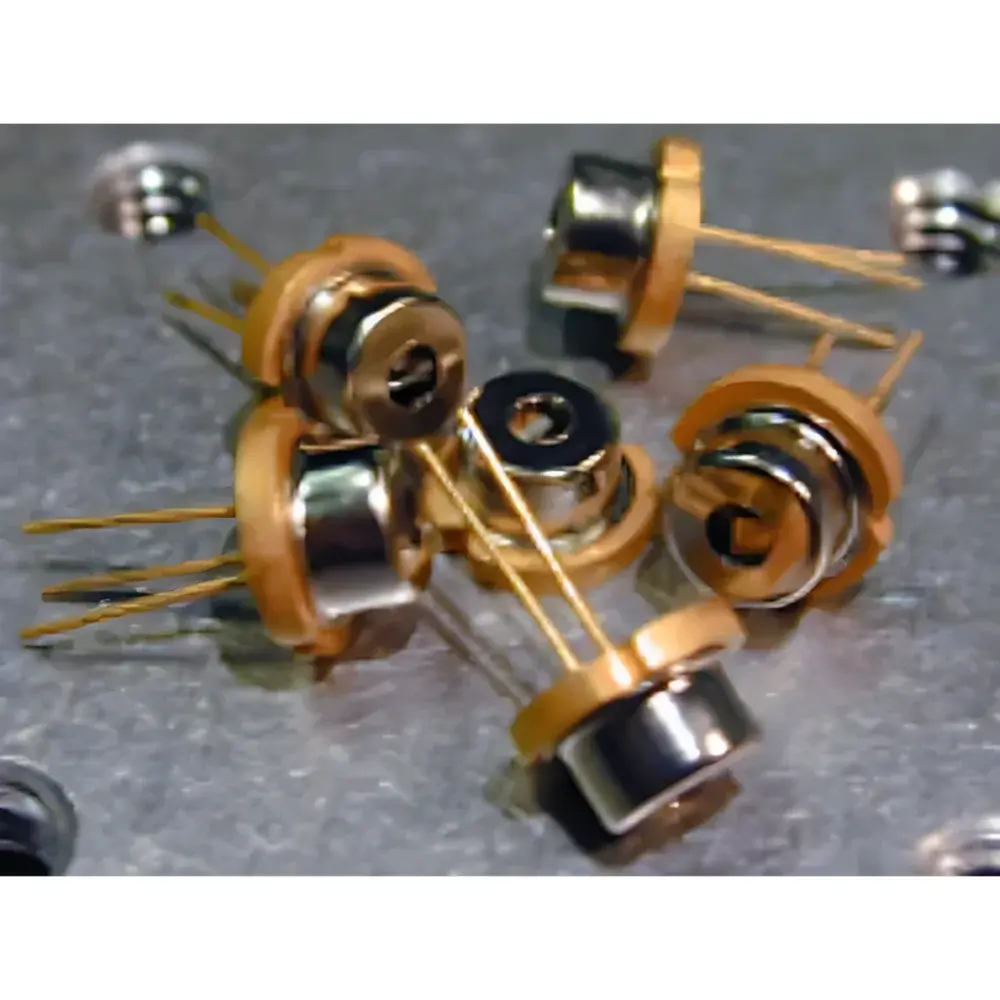
Auniontech Laser Diode Modules – UV to NIR Wavelengths, Fiber-Coupled & Free-Space Configurations
| Brand | Auniontech |
|---|---|
| Origin | Shanghai, China |
| Product Type | Semiconductor Laser Diode Module |
| Package Options | 14-Pin DIL, Butterfly, TO-Can, Mini-DIL |
| Operating Modes | CW or Pulsed |
| Wavelength Range | 250–1550 nm |
| Output Power | 1–100 mW (UV) |
| Spectral Stability | FBG- or DFB-stabilized options available |
| Fiber Options | SMF, PMF, FC/PC or FC/APC terminated |
| Integrated Monitoring | Built-in photodiode, thermistor, and TEC |
| Certifications | ISO 9001:2008, AS9100 |
Overview
Auniontech laser diode modules are precision-engineered semiconductor light sources designed for demanding optical laboratory, industrial, and scientific applications. These devices operate on the principle of stimulated emission in III–V compound semiconductor heterostructures (e.g., AlGaAs/GaAs quantum wells for visible/NIR; AlGaN for deep-UV), enabling highly efficient, electrically pumped coherent emission across a broad spectral range—from 250 nm (deep ultraviolet) to 1550 nm (telecom C-band). Unlike broadband lamps or LEDs, laser diodes deliver narrow spectral linewidths (<0.1 nm for DFB/FBG-stabilized variants), high spatial coherence, and fast temporal response (sub-2 ns rise time), making them essential for applications requiring wavelength-specific excitation, interferometric stability, or time-resolved detection. The modules integrate critical optoelectronic subcomponents—including thermoelectric coolers (TECs), NTC thermistors, and monitor photodiodes—within industry-standard hermetic packages (14-pin DIL, butterfly, TO-can, or Mini-DIL), ensuring thermal stability, long-term output reproducibility, and compatibility with automated alignment and OEM integration workflows.
Key Features
- Multi-wavelength coverage: Deep-UV (250–355 nm), visible (405–670 nm), NIR (780–1550 nm), and high-power pump bands (915–1480 nm)
- High wall-plug efficiency: Up to 20% in UV variants; >30% in 980 nm and 1480 nm pump diodes
- Spectral stabilization options: Fiber Bragg grating (FBG)-coupled FP lasers and distributed feedback (DFB) structures for linewidths <5 MHz (single longitudinal mode)
- Flexible packaging: Free-space (collimated or focused beam), fiber-pigtailed (SMF-28, PM1550), and hybrid configurations with integrated driver/TEC control interfaces
- Rugged mechanical design: Hermetically sealed butterfly and DIL packages rated for operation under thermal cycling (−40°C to +70°C ambient) and vibration per MIL-STD-883
- Fast modulation capability: Direct current modulation up to 500 MHz (with appropriate driver); sub-2 ns electrical rise time enables time-of-flight and LIDAR-compatible pulse shaping
Sample Compatibility & Compliance
These laser diodes are compatible with standard optical breadboards, kinematic mounts, fiber launch systems, and OEM subsystems requiring Class 3B or Class 4 laser safety compliance (IEC 60825-1:2014). All modules undergo burn-in testing and meet ISO 9001:2008 and AS9100 quality management requirements for aerospace-grade component traceability. For regulated environments—including clinical instrumentation, environmental monitoring, and pharmaceutical QA/QC—the modules support integration into systems compliant with FDA 21 CFR Part 11 (when paired with validated controllers), GLP/GMP documentation protocols, and ASTM E275 (UV source characterization) standards. UV variants (250–280 nm) are suitable for germicidal irradiation validation per NSF/ANSI 55 and EPA UV disinfection guidelines.
Software & Data Management
While the laser diodes themselves are analog-optoelectronic components, Auniontech provides optional controller suites featuring embedded microprocessors with USB/RS-232/Ethernet interfaces. These controllers implement closed-loop temperature regulation (±0.01°C stability) and constant-current or pulsed-current drive (with adjustable duty cycle, pulse width, and trigger delay). Firmware supports logging of real-time photodiode feedback, TEC voltage/current, and junction temperature—enabling audit trails required under GLP and 21 CFR Part 11 when used in validated systems. Data export is supported in CSV and HDF5 formats for post-processing in MATLAB, Python (NumPy/Pandas), or LabVIEW environments. No proprietary cloud services or vendor-locked firmware are employed; all communication protocols are openly documented.
Applications
- UV curing and photochemical processing (250–365 nm)
- Fluorescence excitation in flow cytometry, DNA sequencing, and immunoassay platforms
- Water and air disinfection systems leveraging 265 nm and 280 nm germicidal action
- Fiber-optic sensing: FBG interrogation, distributed acoustic sensing (DAS), and methane leak detection
- Optical coherence tomography (OCT) light sources (850 nm, 1060 nm, 1300 nm)
- Pump sources for Er-doped fiber amplifiers (EDFAs), Raman amplifiers, and OPOs
- Atomic physics experiments requiring narrow-linewidth, frequency-stabilized diodes (e.g., rubidium or cesium D2-line pumping)
- Time-resolved spectroscopy and ultrafast pump-probe setups using nanosecond or picosecond pulse trains
FAQ
What is the typical lifetime of these laser diodes under continuous operation?
Mean time to failure (MTTF) exceeds 10,000 hours at rated output power and junction temperature ≤50°C, per Telcordia GR-468-CORE reliability testing.
Do you provide spectral characterization data for each unit?
Yes—each module ships with a calibration sheet including measured center wavelength, FWHM, SMSR (for DFB/FBG types), threshold current, slope efficiency, and far-field divergence angles.
Are custom wavelengths or fiber termination options available?
Custom epitaxial wafers (AlGaAs/GaAs, InGaAsP, AlGaN) and tailored FBG designs are offered for volume orders; FC/APC, SMA905, and bare-fiber pigtails are standard options.
Can these diodes be operated in pulsed mode without external modulation?
All models support direct current pulsing; maximum repetition rate and minimum pulse width depend on package thermal mass and driver capability—consult datasheets for safe operating area (SOA) limits.
Is there documentation supporting regulatory submissions (e.g., FDA 510(k) or CE marking)?
Yes—technical files include risk analysis (ISO 14971), EMC test reports (EN 61326-1), laser safety classification reports (IEC 60825-1), and RoHS/REACH declarations.





